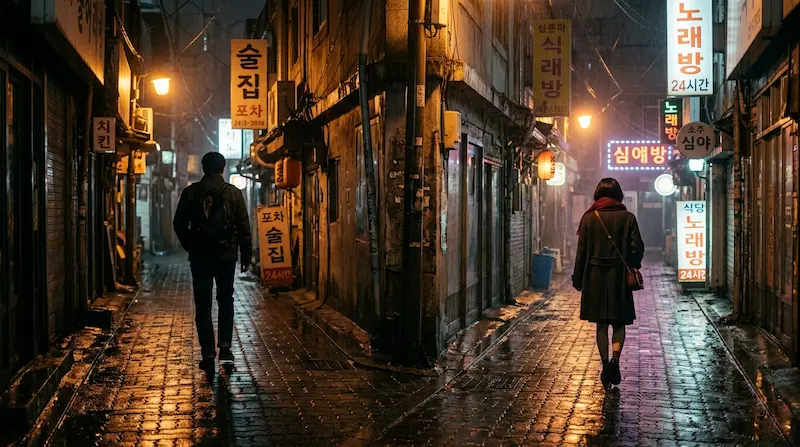
In Part 2, we stopped at the moment Ji-an decided to stop being Dong-hoon’s enemy. The camera placed them at equal eye level for the first time, and everything about the drama shifted. Episodes 1-8 were the foundation. Episodes 9-16 are the detonation. This review contains full spoilers for the entire series. If you have not finished My Mister, close this page and go watch it. You will not regret a single minute. This My Mister episodes 9-16 review contains everything the second half delivers — and why it still haunts viewers eight years later.
Episodes 9-10: The Earpiece Goes Both Ways
Episode 9 opens with the most dangerous sentence in the drama. Dong-hoon tells Ji-an: “I heard you’re having a hard time.” The earpiece is still a secret. He does not know she has been listening to every breath he takes on the subway. And yet he simply noticed. That is what makes this man devastating — not his intelligence, not his position, but his instinct to acknowledge pain he was never invited to see.
In contrast, Ji-an’s reaction is terror. Nobody has ever said that to her. Kindness, in her experience, is always a transaction. She does not know what to do with a sentence that asks for nothing in return. IU plays this moment with a micro-expression that lasts perhaps two seconds — her jaw tightens, her eyes go glassy, and then the mask snaps back into place. It is the kind of acting that award committees miss because it does not announce itself.
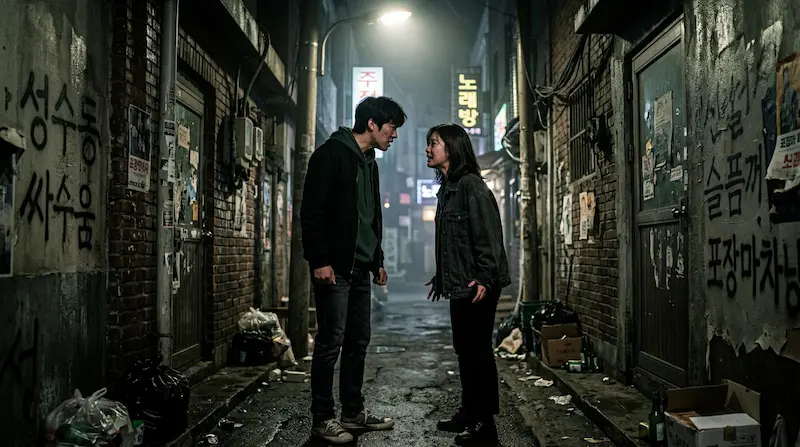
Episode 10 delivers the first confrontation with Kwang-il that feels genuinely dangerous. Until now, their encounters were terrifying but contained. However, in episode 10, Kwang-il discovers that Ji-an has people who might protect her. That changes his calculus entirely. A victim with allies is far more threatening than a victim alone, because now hurting her means attracting witnesses.
The critical detail is what Dong-hoon does not do. There is no dramatic charge, no thrown punch. He simply walks Ji-an home — one step behind her, close enough to be seen by anyone watching. It is protection through presence, not force. For viewers who grew up on K-drama male leads who solve problems with their fists, Dong-hoon’s restraint is almost unsettling. It is also far more realistic. Most decent men in their 40s do not fight. They stand nearby and make sure you get home safe.
Episodes 11-12: The Truth Comes Out
Episode 11 is where Park Hae-young pulls every thread she has been weaving since episode 1 and yanks them simultaneously. As a result, Dong-hoon discovers the affair. Not through evidence, not through confrontation — through silence. Yoon-hee’s hesitation in a single phone call tells him everything. Lee Sun-kyun plays the realization scene sitting perfectly still at his desk. His face does not move. Those hands stay unclenched. The only visible change is that his breathing stops for approximately four seconds. It is the most devastating piece of acting in the entire series, and it happens without a single word of dialogue.
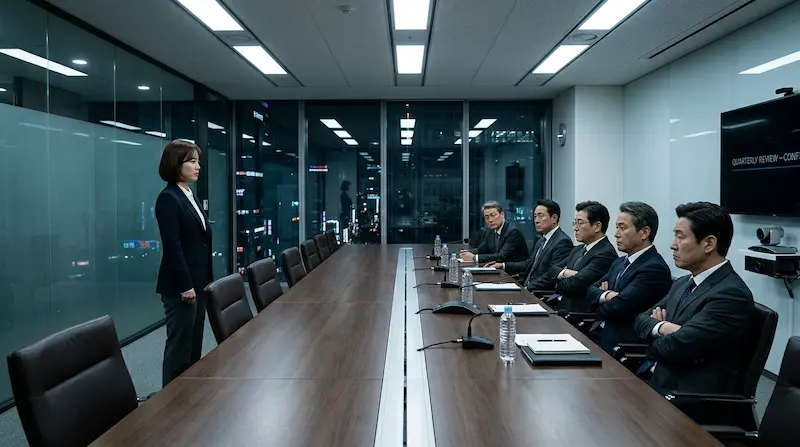
The boardroom scene in episode 12 has been analyzed by Korean drama critics more than almost any other scene in television history. Ji-an walks into a room full of executives — the same people who treated her as invisible for months — and delivers testimony that saves Dong-hoon’s career while simultaneously destroying her own position in the company. She does this knowing she will be fired. The earpiece secret will surface eventually. She does this anyway.
What makes the scene structurally perfect is its callback. Back in episode 4, Ji-an told a stranger that asking about her father was rude. By episode 12, she voluntarily exposes every humiliating detail of her life — the debt, the violence, the surveillance — in front of a room full of strangers. In other words, the woman who refused. She is no longer protecting herself. She is protecting someone who deserves it.
The Three Brothers — Korea’s Realest Male Friendship
A note on the three brothers, because episodes 11-12 also give them their finest hours. Ki-hoon, the youngest, has spent the entire drama pretending to study for the bar exam he has already failed multiple times. Meanwhile, Sang-hoon, the eldest, has spent it cleaning buildings and swallowing humiliation. In episode 11, they sit in Jung-hee’s bar and have the quietest, most honest conversation about failure that Korean television has ever produced.
For instance, Ki-hoon says he is tired of pretending. Sang-hoon says he never pretended — people just stopped asking. Dong-hoon says nothing. He drinks. The three of them sit in a row at the bar counter, shoulders touching, and the camera holds on them for nearly forty seconds without a cut. Director Kim Won-seok understood that male friendship in Korea does not look like Hollywood buddy comedies. Instead, it looks like three men sitting close enough to feel each other’s body heat, saying almost nothing, and meaning everything.
Episodes 13-14: The Earpiece Reveal and the Collapse
Episode 13 is the episode that breaks the drama open. Dong-hoon discovers the earpiece. He learns that Ji-an has been listening to his life — his humiliations, his wife’s affair, his brothers’ struggles, his quiet moments of despair on the subway — from the very beginning. She heard everything. And she was originally paid to use it against him.
Furthermore, Park Hae-young writes the confrontation scene with surgical precision. There is no yelling, no accusation. He asks one question: “From when?” Ji-an answers: “From the beginning.” The silence that follows is the loudest moment in the drama. Lee Sun-kyun’s face cycles through betrayal, understanding, grief, and something close to compassion in approximately ten seconds. He does not forgive her in this scene. He simply absorbs the information the way he absorbs everything else in his life — by enduring it. This is the structural reason every My Mister episodes 9-16 review calls the earpiece reveal the drama’s single most important scene.
The Cost of Silence
Episode 14 shows the cost. Dong-hoon withdraws. The walks through Yongsan end. The visits to Jung-hee’s bar stop. He is no longer the quiet anchor that everyone in his life depends on. The drama makes a brilliant structural choice here: it shows you what the world looks like without Park Dong-hoon’s presence. His brothers flounder. The office feels colder. Even the lighting shifts — director Kim Won-seok desaturates the color palette so subtly that most viewers do not consciously notice, but the emotional effect is unmistakable. The world without Dong-hoon is grayer.
Ji-an, meanwhile, does something unexpected. There is no chase, no apology. She disappears. Not because she does not care, but because she understands — perhaps better than anyone — that Dong-hoon needs space to rebuild the dignity she helped dismantle. This is the most mature writing in the entire series. A lesser drama would have Ji-an crying at his doorstep. Park Hae-young has her vanish, because sometimes the kindest thing you can do for someone you have hurt is to remove yourself from their life entirely.
Episodes 15-16: The Walk, the Apology, and the Ending
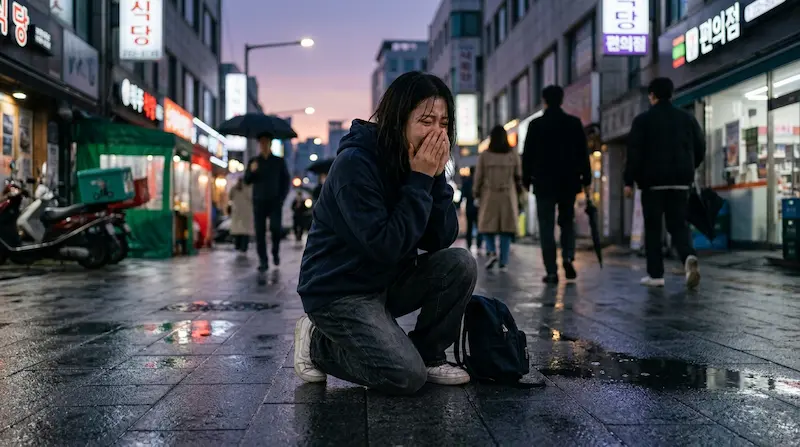
Episode 15 contains the scene that was planted in episode 3. Ji-an finds Dong-hoon on the street. She drops to her knees. She apologizes — not ten times, but over and over, sobbing, on the wet pavement, in front of strangers. It is the most raw, unguarded moment IU has ever delivered on screen. Every wall she built across fifteen episodes collapses in ninety seconds.
However, what elevates this beyond melodrama is Dong-hoon’s response. The words “I forgive you” never come. Neither does “It’s okay.” He says: “Get up. The ground is cold.” That sentence contains more compassion than most dramas fit into an entire series. Absolution is not what he offers. Instead, he acknowledges her pain. He treats her the same way he has always treated her — as a person who deserves basic human warmth, regardless of what she has done.
The Time Skip
The final episode delivers the time skip that has been debated in K-drama communities for eight years. Ji-an leaves. She builds a life. Dong-hoon stays. He rebuilds his. Years pass. And then, on an ordinary street on an ordinary afternoon, they meet again.
They smile.
That is the ending. No grand declaration. No dramatic reunion speech. Just two people who once carried each other through the worst period of their lives, meeting again in sunlight, and smiling because the other person is still standing. Writer Park Hae-young understood that the most honest love story is not about two people staying together. It is about two people who made each other strong enough to survive apart, and who are genuinely happy to see proof that it worked.
The OST — Why “Adult” by Sondia Still Makes Korea Cry
No review of My Mister’s second half is complete without discussing the OST. Sondia’s “어른 (Adult/Grown Ups)” plays during the apology scene and the finale, and it functions as the emotional spine of the entire drama. Specifically, the lyrics — “I wanted to be a good adult, I wanted to be a warm person” — land differently depending on where you are in life. At twenty, it sounds aspirational. At fifty, it sounds like a confession. As we explored in our Complete Guide, the My Mister OST contains 33 tracks, but Sondia’s song is the one that endures because it captures the drama’s core question: did I become the person I hoped I would be?
My Mister Episodes 9-16 Review — Why It Still Matters in 2026
Any honest My Mister episodes 9-16 review must start with a confession: this drama does not leave you. My Mister premiered on March 21, 2018. Eight years later, it still appears on virtually every “Greatest K-Drama” list in existence. It holds a 9.1 on MyDramaList. Its Reddit discussion threads still receive new comments weekly. Lee Sun-kyun is gone — his passing in December 2023 cast a permanent shadow over the drama — and yet the work endures, because great art outlives the people who make it.
Ultimately, the reason My Mister ages so well is structural. It does not rely on plot twists that lose their power on rewatch. It relies on behavioral truth — the way a man buys tomatoes for a stranger, the way a woman stops reaching for a knife, the way three brothers sit in a bar and say nothing. These details do not expire. They deepen every time you return to them.
Writer Park Hae-young proved this with We Are All Trying Here, her 2026 JTBC drama that carries My Mister’s DNA in every frame. Dong-man’s belief that he destroys everything he touches mirrors Dong-hoon’s quiet self-imprisonment. The silent observation, the walking scenes, the refusal to explain emotion through dialogue — it is all there, refined by eight more years of craft.
From Ji-an to Hui-ju — IU’s Evolution as an Actress
And then there is IU. In 2018, she was a K-pop idol trying to prove she could act. Ji-an proved it beyond any doubt. Eight years later, she is starring in Perfect Crown (21세기 대군부인), MBC’s Friday-Saturday blockbuster that is currently the most-watched drama in Korea with peak ratings above 13%.
Of course, the distance between Ji-an and Seong Hui-ju is enormous. Ji-an was silence, survival, and suppressed rage. Hui-ju is strategy, elegance, and controlled power. But watch closely and the throughline is unmistakable. Both characters weaponize observation and read rooms before they speak. They protect the people they love through intelligence rather than force. IU learned something playing Ji-an that she carries into every role since: the most powerful acting is what you choose not to show.
Revisiting this My Mister episodes 9-16 review in 2026, the throughline from Ji-an to Hui-ju is unmistakable. Perfect Crown is airing its second act right now — episodes 7 and 8 drop this weekend — and the fashion choices, the OST selections, and the political intrigue are all earning the kind of attention that My Mister received in 2018. If My Mister was IU’s dramatic birth, Perfect Crown is her coronation. The girl who crushed a ladybug now wears the crown.
Final Verdict
If you have read this far in our My Mister episodes 9-16 review, you already understand. My Mister is not a drama you watch. It is a drama that watches you. It holds a mirror to every compromise you have made, every humiliation you swallowed, every time you chose endurance over escape. There is no judgment, no preaching. It simply says: I see you. That is enough.
If you are new to this series, start with our Complete Guide for cast and context, then read our Episodes 1-8 Deep Dive. If you have already watched it three times and still cry at Sondia’s opening notes, you already know everything this review is trying to say.
In the end, some dramas entertain. Some dramas move you. My Mister changes the way you walk home at night.