
After the stolen first kiss on Jeju Island in Episode 6, viewers braced for the morning-after awkwardness. Instead, My Royal Nemesis Episode 7 delivered something far heavier. The hour stacked humiliations, losses, and small kindnesses until Shin Seo-ri’s iron defenses finally cracked. SBS‘s Friday-Saturday hit climbed to 9.4% nationally on May 29. It dominated its time slot for the seventh straight episode. The romance pushed into territory where past life and present life can no longer stay separate. By the closing seconds, the show inverted its core dynamic — Cha Se-gye protecting Shin Seo-ri — and earned every percentage point of that turn across the first six episodes.
Where We Left Off — A Quick Bridge from Episode 6
Episode 6 closed on the impulsive Jeju Island kiss. Seo-ri then dropped a drunken confession that Se-gye’s face “looks like someone who would commit high treason.” The line sounded like a joke. It was actually the show’s first explicit hint that her past-life memories are surfacing. Episode 7 picks up the next morning. Seo-ri pretends to remember nothing. Se-gye refuses to let her play that card. They return to Seoul carrying unresolved tension. That tension becomes the load-bearing beam of the entire hour. Every scene afterward tests how long Seo-ri can keep denying what she already knows.
The Bribe and the Backlash
Episode 7 wastes no time. The chaebol gauntlet opens immediately for Shin Seo-ri (Lim Ji-yeon). Cha Joo-ran (Jung Young-joo), Se-gye’s aunt, arrives with the classic K-drama prop — a thick white envelope of cash. She demands Seo-ri walk away from the family. What follows ranks as the most cathartic two minutes of the episode. Seo-ri doesn’t just refuse. She throws yeot (Korean candy whose name carries a vulgar double meaning) at the aunt’s face, flipping the bribe-scene cliché on its head. Korean SNS clipped the moment within minutes of broadcast. It already ranks as the year’s most satisfying chaebol-aunt comeuppance.
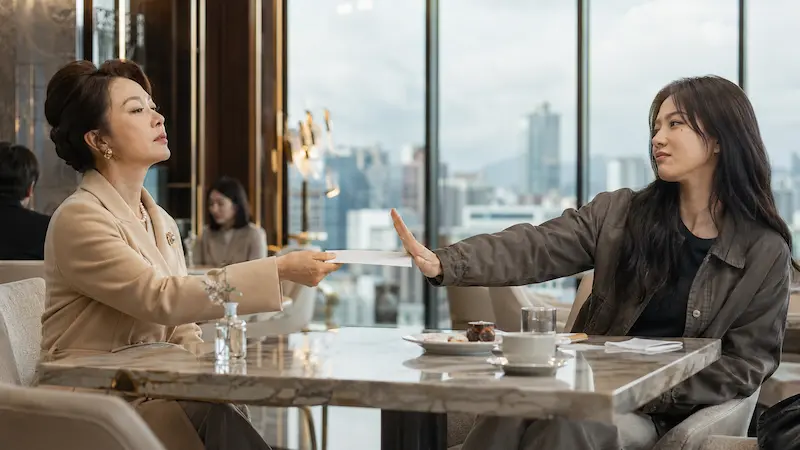
The writers refuse to let her stay on top. Moments later, Se-gye’s arranged-marriage candidate Mo Tae-hee (Chae Seo-ahn) arrives with sharper weapons. “I can give him a crown — what can you give him?” she asks. The line lands harder than the envelope did. Seo-ri walks away outwardly composed. The camera lingers on her face just long enough to show the wound opening. Underneath, a flash of her past life as Kang Dan-sim cuts in. Dan-sim once loved Prince Lee-hyun across an impossible class divide. The pattern is repeating, and she knows it. Here Episode 7 makes its first crucial move — it gives Seo-ri the cathartic win, then takes it back. The show refuses to let her stay in the role of plucky underdog.
The aunt-rival one-two punch also serves a structural purpose. Seo-ri can survive direct attacks on her dignity. She cannot survive attacks on Se-gye’s future. That distinction drives everything that follows.
The Rumor That Shook Cha Se-gye
While Seo-ri absorbs Mo Tae-hee’s blow, Choi Moon-do (Jang Seung-jo) escalates his shadow war. A fabricated drunk-driving and hit-and-run rumor about Se-gye’s Jeju trip explodes across the press. It triggers an owner-risk crisis at BOJ Group. The stock implications are real. The board pressure is immediate. Se-gye’s grandfather (Yoon Joo-sang) starts receiving the kind of phone calls that end careers.
The writing here works through parallel construction. Mo Tae-hee tells Seo-ri she’s worthless to Se-gye’s future. Moon-do simultaneously destroys that future. The two pressures squeeze toward the same conclusion — leave him for his own good. Episode 7 also reminds viewers that Moon-do isn’t just a corporate villain. He’s the reincarnation of An-jong, the man who destroyed Dan-sim and Lee-hyun three centuries ago. The show keeps these dual-timeline beats in the corner of the frame rather than the center. That restraint is exactly why the Episode 8 payoff hits as hard as it does.
How the press scandal gets shot deserves special notice. Director Han Tae-seop keeps the camera tight on Se-gye’s face during the worst of it. He refuses the wide-shot spectacle of a chaebol fall. The crisis stays personal, which keeps the emotional stakes aligned with Seo-ri’s parallel collapse.
Grandmother’s Diagnosis
The third blow lands at the hospital. Nam Ok-soon (Kim Hye-sook), Seo-ri’s only anchor in this life, receives an Alzheimer’s diagnosis. The hospital admits her after a stroke. Director Han shoots the scene quietly. Soft natural light, no swelling score, Seo-ri’s tears turned away from the camera. After two episodes of escalating chaebol absurdity, this moment of stripped-down grief reorients the entire hour. Seo-ri isn’t fighting for love anymore. She fights because nothing else remains to lose.
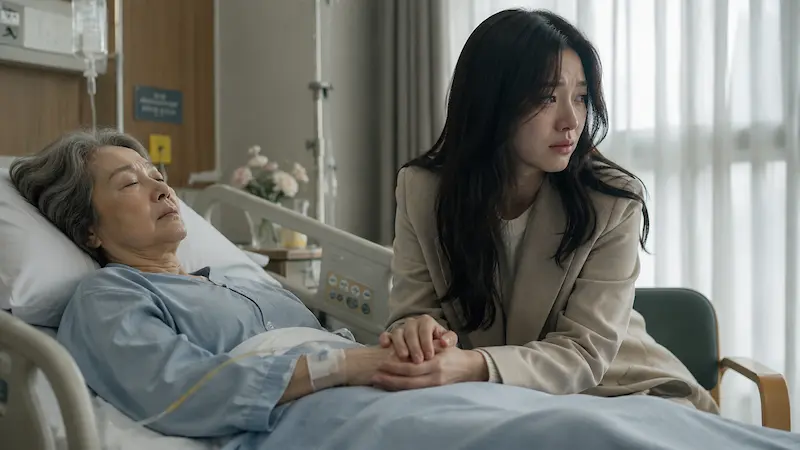
A deeper question surfaces here. Is this body’s original Shin Seo-ri still alive somewhere in the consciousness Kang Dan-sim has occupied? Watching Dan-sim hold Grandmother Ok-soon’s hand, fully aware she is the granddaughter only by inheritance, the show plants a thematic seed. That seed almost certainly pays off in the final episodes.
The structural choice also lands. The writers needed to push Seo-ri to her absolute floor before Se-gye’s gesture could carry its planned weight. Without the grandmother’s diagnosis, the rooftop scene becomes just a sweet moment. With it, the rooftop becomes the turning point of the entire 14-episode arc.
The Rooftop That Lit Up Everything
On the worst birthday of her life, Seo-ri trudges home to her rooftop apartment. She finds the narrow outdoor staircase wrapped in warm fairy lights, glowing in the dark. Cha Se-gye (Heo Nam-jun) has left a card. He remembered an offhand comment she made weeks earlier — that she hates dark, closed-in spaces.

Why the Gesture Works
This moment caps the build since Episode 1. Throughout the press rumor crisis, Se-gye spent his energy not on damage control for himself. Instead he shielded Seo-ri from media exposure. He absorbed the owner-risk hit personally so her name would stay out of the headlines. The lit-up staircase rejects the chaebol grand gesture — no helicopters, no jewelry, no penthouse reveal. It’s smaller and more specific, which is precisely why it works. He listened. He remembered. Then he acted.
The Card and the Crack
The card itself is the kicker. The exact wording hasn’t been clipped widely yet. The camera close-up on Seo-ri’s hand holding it tells the entire story. This isn’t a chaebol’s romantic flourish. It’s a quiet promise from someone who has finally decided what he wants. Seo-ri reads it, cries on the staircase, and decides. The walls she rebuilt after Mo Tae-hee’s verbal attack come down in a single take. Lim Ji-yeon’s performance here ranks as her strongest of the series. Watch the moment her breath changes. Most actresses would play the scene as a single emotional release. Lim layers it — grief, then resolve, then fury at her own hesitation.
The Suit Shield Ending
Seo-ri sprints to BOJ headquarters. Se-gye sits trapped inside, facing a press storm. She doesn’t sneak past the reporters. She walks straight into the flash bulbs and declares she will protect him. Se-gye opens his tailored suit like a shield, hiding her behind him. Their fingers lock as the cameras explode. The image — a chaebol’s tailored suit transformed into literal armor — already circulates across Korean SNS as the defining still of Episode 7.
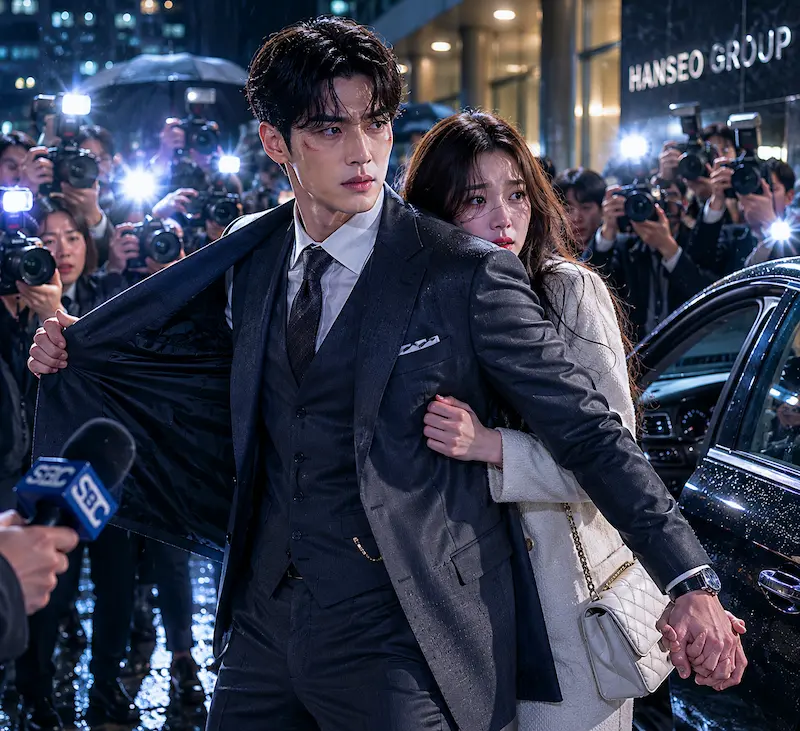
For seven episodes, Se-gye has done the protecting. The Episode 7 ending inverts that dynamic for the first time. This is a two-way rescue story now. The visual rhyme also matters. Earlier in the hour, Mo Tae-hee asked what Seo-ri could give Se-gye. The closing shot answers her. Seo-ri gives him the one thing his entire world trained him not to expect — a person who runs toward him instead of away.
Choco Papa’s Take
Episode 7 belongs to a category of structurally disciplined hours that gets undervalued because no single explosive twist anchors it. What it offers instead is patience. Building on the 9.5% surge of Episode 5, the writers stack four separate humiliations — bribe, rival’s taunt, rumor, hospital — before allowing Se-gye’s gesture to land. That stacking is why the rooftop scene works at all. Skip any one of those beats and the staircase becomes just a Pinterest moment.
The dual-timeline structure also pays off in a way few time-slip dramas manage. The Joseon flashbacks aren’t decoration anymore. They explain why Seo-ri keeps trying to leave even when she doesn’t want to. Lim Ji-yeon plays two women now, and the layering shows on her face before any flashback even cuts in. Heo Nam-jun deserves equal credit. He carries the harder job because Se-gye spends his life suppressing emotion. The actor must communicate everything through restraint. The rooftop card moment works because he isn’t there to deliver it himself.
One weakness remains. Mo Tae-hee stays a thin antagonist. Her cruelty lands because the actress sells it, not because the writing has given her a believable interior life yet. Six episodes remain. If the show wants to stick the landing, she needs at least one scene that complicates her. The same caution applies to Choi Moon-do. His Joseon-era counterpart An-jong still functions as a structural device rather than a person. Director Han Tae-seop has handled the dual-timeline mechanics beautifully. The villains need the same care the leads have been given. International viewer scores on MyDramaList have stayed consistently above 8.5. The global audience agrees — the leads carry weight the side characters haven’t yet matched.
Looking Ahead
Episode 8 promised something the series has teased since the prologue: Se-gye finally recovering the full Joseon memory. The closing seconds of Episode 7 set the trap. Episode 8 sprung it. Ratings climbed to a new self-best of 10.4% as a result. The recap for Episode 8 is coming next.