The premiere of My Royal Nemesis introduced the impossible — a 17th-century Joseon noblewoman trapped in the body of a 21st-century actress. Episode 2 had the harder job: prove the show isn’t just a one-joke fantasy. However, it delivered. This My Royal Nemesis episode 2 recap walks through every major beat — the failed deal, Dan-sim’s hilarious adaptation, the villain king reveal, the reverse trade, and a Joseon epilogue that rewrites the entire premise. If you missed our coverage of the premiere, start with our My Royal Nemesis Episode 1 Recap, and for the full series breakdown see our Complete Guide.
What makes episode 2 work is its confidence. Most fantasy romance dramas spend their second hour re-explaining the rules. Instead, My Royal Nemesis assumes you accepted the body-swap, and immediately pushes into character work, comedy, and a mythology twist that almost no second episode dares to attempt. By the closing credits, the show isn’t asking can these two coexist — it’s asking were they always connected?
The First Trade Falls Apart: Dan-sim’s Bold Proposal
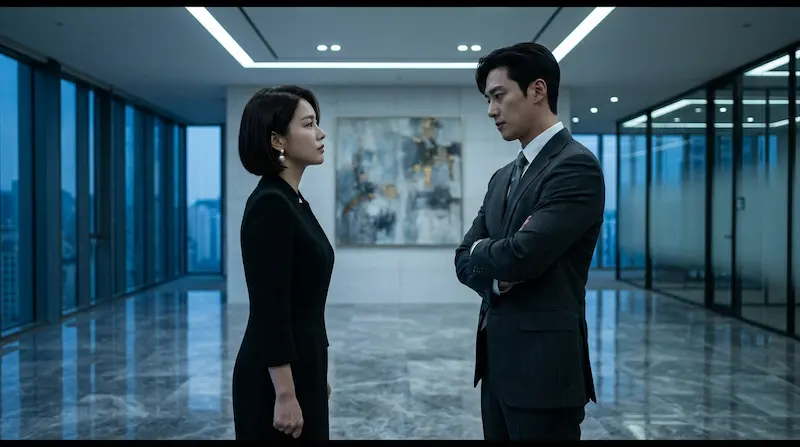
Episode 2 opens exactly where the premiere left off. Kang Dan-sim (Lim Ji-yeon), still inhabiting actress Shin Seo-ri’s body, has just survived the mannequin terror incident with chaebol heir Cha Se-gye (Heo Nam-jun). She wakes up in a hospital VIP suite, dressed in clothes she doesn’t recognize, surrounded by machines she can’t name. Her first instinct isn’t panic. Instead, it’s negotiation.
A Joseon Noblewoman Walks Into a Modern Boardroom
This is where Lim Ji-yeon’s dual-role brilliance starts paying off. Dan-sim isn’t Seo-ri pretending to be brave. Rather, she’s a Joseon-era woman who once stood before a king and refused to bow. The hospital is just another court. Therefore, she straightens her spine, walks into Cha Se-gye’s office on impossibly tall heels she clearly can’t manage, and offers him a deal: she will protect him from whoever orchestrated yesterday’s attack, in exchange for shelter, information, and a path back to her own body.
Cha Se-gye’s response is one of the episode’s quietest devastations. He doesn’t laugh. He doesn’t dismiss her as crazy. Instead, he simply asks, “Why would I trust a woman who claims to be 400 years old?” and rejects her cleanly. No anger. No mockery. Just a closed door.
For a man who saw the same impossible things she did during the eclipse, his refusal is pointed. He isn’t denying her story; he’s refusing to be drawn into it. That distinction matters, and the episode plants it as a seed for everything that follows.
Why the Refused Deal Builds a Better Romance
The rejection forces Dan-sim out into 2026 Seoul alone, with no money, no allies, and a face that strangers keep recognizing. Consequently, the deal she counted on for survival is dead before episode 2 reaches its 15-minute mark. The show is better for it. A romance built on convenient cohabitation would have been ordinary. On the other hand, a romance built on a refused trade — and the slow erosion of that refusal — is the structure of every great K-drama.
Modern Korea, 400 Years Late: Dan-sim’s Adaptation Comedy

The middle stretch of episode 2 is where My Royal Nemesis stops being a curiosity and starts being a hit. Dan-sim, locked out of Cha Se-gye’s protection, has to navigate Seoul on her own. What follows is roughly twenty minutes of the funniest physical comedy any Korean drama has produced this year. Moreover, it’s all built on a single principle: Dan-sim is intelligent, dignified, and absolutely unprepared.
The Fish-Out-of-Water Sight Gags
She tries to pay a convenience store cashier with a silver hairpin. Then she mistakes a smartphone notification chime for a court bell and bows reflexively. Later, she watches a young couple kiss on the subway and looks genuinely scandalized — not because she’s prudish, but because in her time that public display would have ended both their lives. Lim Ji-yeon plays every reaction with absolute commitment. Furthermore, she isn’t winking at the audience. She is a woman from 1626 watching 2026 happen to her.
The Stakeout and Mukbang Centerpiece
The episode’s comedic centerpiece is the stakeout sequence. Dan-sim, still convinced Cha Se-gye is in danger, decides to surveil his building from the street. However, she doesn’t know what surveillance looks like. Instead, she crouches behind a lamppost in broad daylight, in designer clothes that scream celebrity, and within three hours has accumulated a small audience of street vendors who think she’s filming a variety show.
They feed her — tteokbokki, hotteok, sundae, fish-shaped bread — and she eats it all. The mukbang scene that follows isn’t fan service. Rather, it’s character work. Dan-sim has not eaten freely in her own life for years. As a noble widow under house surveillance, every meal was monitored. Therefore, the street food is the first food in two lifetimes she has chosen for herself, and Lim Ji-yeon plays it with tears running down her face while she’s still chewing. It is, genuinely, one of the best acted scenes of the spring season.
Why the Comedy Lands
Director Kim Hee-won (멜로가 체질, 마인) understands that comedy in this kind of show only lands if the emotional stakes are real. The stakeout is funny because Dan-sim is dying inside. Similarly, the mukbang is funny because she has never been allowed to want anything. By the time the sequence ends and she falls asleep on a bus bench with a half-eaten hotteok in her hand, the audience has stopped laughing at her and started rooting for her.
Choi Mun-do: The Villain King Reborn
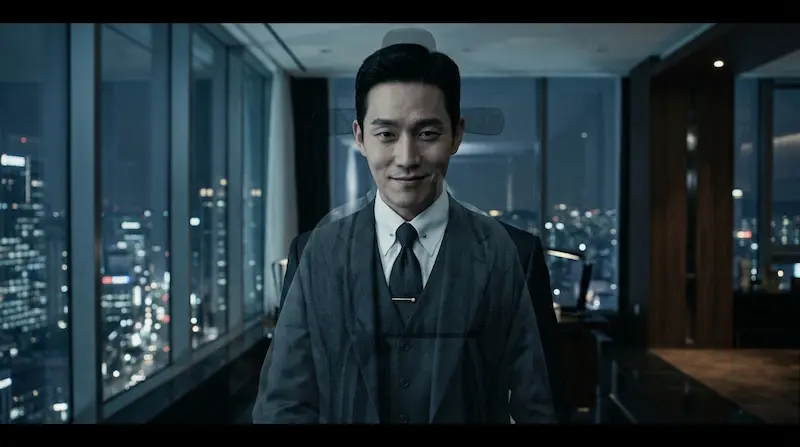
The smile of a man who once signed her death warrant — Jang Seung-jo's villain reveal lands like a quiet blade.Just when episode 2 settles into its comedic rhythm, the show fires its biggest twist. Cha Se-gye’s business rival Choi Mun-do (Jang Seung-jo) walks into a boardroom in a charcoal three-piece suit, smiles politely, and Dan-sim — watching from a TV in a coffee shop — drops her cup. She has seen that face before. Moreover, she has seen that smile before. Four hundred years before, in a throne room, when a king signed her execution warrant and dismissed her like she was nothing.
Direction That Treats the Reveal as Horror
The reveal is staged as a horror sequence, not a romantic one. Director Kim cross-cuts between modern Mun-do shaking hands at a press conference and Joseon-era Mun-do, in royal robes, watching guards drag Dan-sim out of his court. Then the cuts get faster. The score drops out. By the time we land on Mun-do’s modern face turning slowly toward the camera, the show has confirmed what episode 1 only hinted: this isn’t a body-swap drama. Instead, it’s a reincarnation drama. And Dan-sim isn’t the only one who came back.
Jang Seung-jo’s Quiet Menace
Jang Seung-jo (Doctor Lawyer, The Good Detective 2) is doing something specific and dangerous here. He plays Mun-do with no obvious villainy — no smirks, no cruelty, no monologues. Instead, he’s polite. He’s charming. He pours tea correctly. The threat is entirely structural: this man, in his previous life, had absolute power and used it to destroy her, and there is no reason to believe he has been improved by reincarnation.
The casting is one of the show’s smartest moves. A more theatrical villain would have telegraphed the reveal. By contrast, Jang Seung-jo lets it land like a quiet blade. Furthermore, the implications reshape the entire premise. Cha Se-gye is no longer just a chaebol who happened to witness an eclipse. Mun-do is no longer just a business rival. The body-swap wasn’t an accident — it was a summons. Something pulled Dan-sim across four centuries because something across four centuries needed her back.
The Reverse Deal: Cha Se-gye Comes Back
The episode’s structural masterstroke is the reverse trade. After Dan-sim sees Mun-do, she stops trying to contact Cha Se-gye. She vanishes — sleeping in 24-hour spas, eating from convenience stores, refusing to pick up the phone Seo-ri’s manager left her. Meanwhile, it’s Cha Se-gye who breaks. He finds her on a rainy street at 3 a.m., soaked through, and offers the exact deal he refused twelve hours earlier — protection for cooperation — except now the terms are his.
What changed? The episode is careful not to spell it out, and that restraint is the writing’s biggest strength. Cha Se-gye doesn’t suddenly believe she’s from Joseon. He doesn’t confess to feelings. Instead, he simply says, “I checked the security footage from the eclipse. Twice.” That’s the whole explanation. Heo Nam-jun plays the line with the controlled exhaustion of a man who has just spent twelve hours arguing with his own logic and lost. Whatever he saw on that footage, it was enough to override every instinct he has built his career on.
This is the moment the romance officially begins, but the show is smart enough not to call it that. There’s no music swell. No close-up. Instead, Dan-sim, soaked and starving, looks up at him and says, “Took you long enough,” and gets in the car. Meanwhile, the rest of the episode treats them as reluctant business partners, not lovers. The romance is being built underneath, brick by brick, and the audience is being trusted to see it.
The Joseon Epilogue: A Connection Older Than Memory
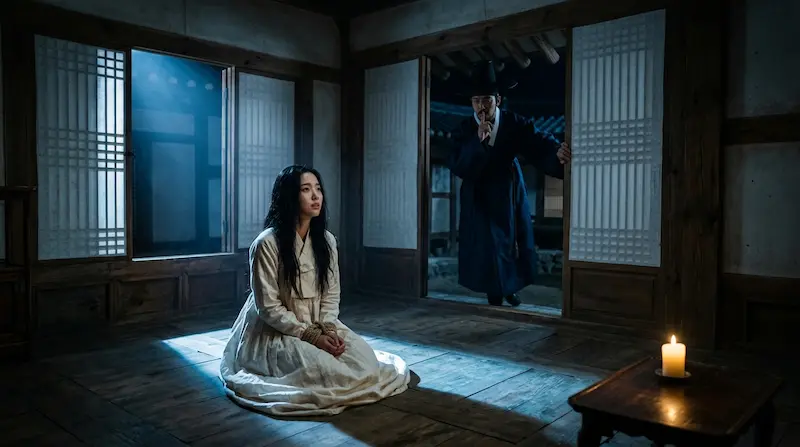
The epilogue rewrites everything — they were connected 400 years before they met again.And then, with sixty seconds left in the episode, My Royal Nemesis drops the bomb that will define the rest of the season.
The screen fades to a Joseon-era wooden chamber, dimly lit by a single oil lamp. A woman in white hanbok lies bound on the floor — Dan-sim, in her original body, the night before her execution. Suddenly, the door slides open silently. A nobleman in a dark hanbok steps inside, kneels beside her, and cuts her ropes. He doesn’t speak. He doesn’t show his face fully. However, as he turns to leave, the candlelight catches his profile, and the audience sees what Dan-sim, in the 17th century, never did.
It is Cha Se-gye.
What the Past-Life Reveal Detonates
The implication detonates the whole show. Cha Se-gye in 2026 doesn’t remember Joseon — but Cha Se-gye in 1626 was the man who tried to save her. Whether he succeeded, whether he was punished for it, whether he is the reason her soul made the four-hundred-year jump at all — none of it is answered. Instead, the episode just lets the image hang for a beat, cuts to black, and rolls credits.
A Bold Bet on Consequence Over Mystery
This is the kind of swing very few second episodes attempt. Most fantasy romances spend a full season teasing a past-life connection. By contrast, My Royal Nemesis confirms it before the third hour airs. The bet is clear: the writers don’t want the past life to be the mystery. Rather, they want the consequences of the past life to be the mystery. What did Cha Se-gye lose to save her? Why doesn’t his soul remember? Furthermore, how does Mun-do, who clearly does remember, fit into a triangle that was already drawn four centuries ago?
Episode 3 Preview: First Love Across Lifetimes
The episode 3 teaser leans hard into the romantic implications of the epilogue. Cha Se-gye, contractually bound to keep Dan-sim close, accompanies her to an advertising shoot — Seo-ri’s actual job, which Dan-sim now has to fake her way through. Additionally, there are flashes of a dream sequence, a Joseon-era hand reaching for a Joseon-era hand, and a single line of voiceover from Cha Se-gye: “Why does this woman feel like a memory I never had?” Therefore, expect episode 3 to be the first love-recognition episode, and expect it to hurt.
Final Thoughts
Two episodes in, My Royal Nemesis has done something rare — it has earned its premise. The premiere asked the audience to accept a body-swap. Meanwhile, episode 2 asked them to accept a reincarnation triangle, a villain king reborn, and a hero who saved his lover four centuries before he was born to meet her again. That is a lot of mythology for a 16-episode SBS Friday-Saturday drama, and the show is loading it in fast.
Ratings and Buzz
Episode 1 ratings landed at 5.4% nationwide and 4.3% in Seoul (Nielsen Korea), strong for an SBS opener with no pre-release hype. Meanwhile, episode 2 numbers are still pending at the time of writing, but the production team has publicly stated a 19% target, and lead actor Heo Nam-jun has promised a fan event if the show breaks 20%. Given the word-of-mouth Lim Ji-yeon’s mukbang scene is already generating on Korean Twitter and Naver, those targets aren’t impossible.
Risks and Rewards Going Forward
The show’s biggest risk is pacing. Burning the past-life reveal in episode 2 leaves fourteen episodes to sustain a mystery that has already been partially answered. On the other hand, the biggest reward, if the writers stick the landing, is a romance with stakes most K-dramas can only dream of — two souls who have already chosen each other once, finding out whether they’ll do it again.
For more on the spring 2026 lineup, see our Perfect Crown Episode 10 Recap and We Are All Trying Here Complete Guide. My Royal Nemesis airs Fridays and Saturdays at 21:50 KST on SBS, with global streaming on Netflix.