A Quick Snapshot Before We Dive In
Episodes 3 and 4 of We Are All Trying Here aired on April 25 and 26 on JTBC, and they hit considerably harder than the already-impressive premiere week. According to Nielsen Korea, Episode 3 recorded a nationwide rating of 2.15%, while Episode 4 climbed to 2.44% with a Seoul rating of 3.01%. Those numbers still look modest on paper. However, context matters here. The drama continues to hold its Netflix Korea No. 1 position, and the Reddit discussion thread for Episodes 3-4 pulled 125 upvotes with over 100 comments — a level of engagement usually reserved for mainstream hits with far higher TV ratings.
In our Complete Guide,//kdramarecaphub.com/we-are-all-trying-here-complete-guide-cast-plot-where-to-watch/ we introduced the world of writer Park Hae-young’s latest creation. In our Episodes 1-2 Recap,//kdramarecaphub.com/we-are-all-trying-here-episodes-1-2-recap-review/ we explored the ramen-scene energy of Dong-man’s first explosion and the MoodWatch device that set this drama apart. Now, Episodes 3 and 4 deliver what the first two episodes promised: raw emotional confrontation, an identity crisis that physically manifests on screen, and a brother’s near-death moment that Reddit users are already calling “the most harrowing scene in K-drama this year.”
Episode 3: “I Am Not a Destructive Person”
The episode opens at an AS Group company retreat, where Dong-man picks up a new Ximfit Emotion Watch model. He and Eun-a sit down for coffee, and what follows is one of the most unconventional bonding scenes in recent K-drama memory. Dong-man does not hold back. He tells Eun-a that when he witnessed a car accident outside, his Emotion Watch flickered with the word “excitement.” When news of a terrorism incident broke, the watch displayed “thrilling.” When world leaders were rescued safely, it showed “disappointment.” As a result, he has concluded that he is a monster — a destructive human being who feeds on the misfortune of others.

Eun-a does not flinch. Instead, she gives him a high five and laughs. She then offers a stunningly honest review of his character, telling him he seems like someone with “a thousand doors wide open” and that he is far more compelling than the protagonist of his own screenplay Weather Maker. For the first time in the series, Dong-man’s Emotion Watch turns green — signaling genuine warmth and comfort. Meanwhile, Koo Kyo-hwan plays the moment with frozen eyes and visible confusion, as if the concept of being praised is something his body has forgotten how to process.
Gyeong-se’s Jirisan Hike and the 300K Prophecy
While Dong-man discovers he might not be a monster, Park Gyeong-se is busy becoming one. Oh Jung-se delivers a masterclass in wounded pride as Gyeong-se hikes through Jirisan, literally chewing over each negative review of his film Sister Vengeance so they will not follow him for the rest of his life. The advance ticket sales have landed at around 300,000 — exactly the number Eun-a predicted when she first read the manuscript. Director Choi dismisses her accuracy as a “lucky guess,” but the audience knows better. In contrast, Gyeong-se’s climb down the mountain is fueled by a devastating discovery: one-third of those vicious online comments were written by Dong-man in the group chat that Gyeong-se had supposedly left but secretly re-entered.
The confrontation between the two men is brutally honest. Gyeong-se tells Dong-man he is “nothing. Nothing. Nothing.” — three repetitions that land like punches. For the first time, we see Dong-man genuinely wounded rather than provocatively defiant. As the Reddit thread’s top comment (74 upvotes) put it: “We give some shitty people in life too many chances, and that one sentence woke me up.”
Jin-man’s Rope Scene: Hold Your Breath
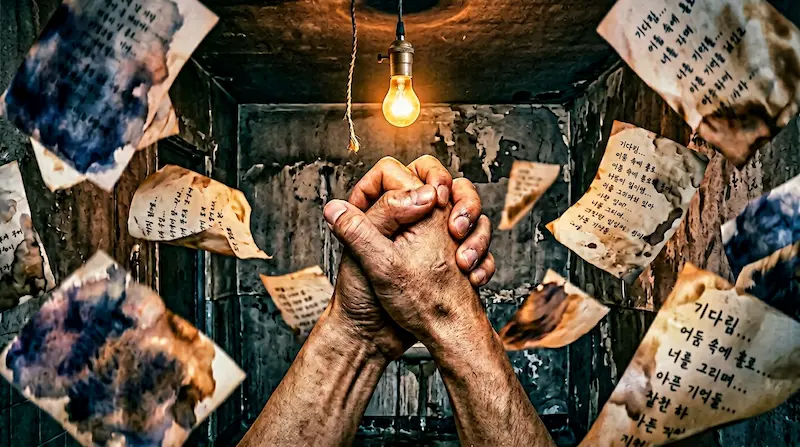
Then comes the scene that has dominated every discussion board. Dong-man returns home to find his brother Jin-man surrounded by empty soju bottles with a single can of tuna on the table. He walks into the bathroom and discovers Jin-man standing on a bucket, eyes vacant, toes gripping the edge, with a rope prepared overhead. Park Hae-joon’s performance is devastating in its stillness — he looks as if his soul has already left while his body remains.
Dong-man’s hands shake as he grabs his brother’s arm. He instinctively pulls out one of Jin-man’s old poems and begins reading it aloud, refusing to break eye contact. Several Reddit commenters noted they did not realize they had been holding their breath until the scene ended. One user with 40 upvotes wrote: “I HAD CHILLS WHEN HIS BROTHER WAS HOLDING THAT ROPE… This broke me.” Furthermore, earlier in the episode, Dong-man had been insisting his brother eat before drinking — a detail that now retroactively signals this was not the first time such an episode had occurred.
The Car Crash Turning Point
The episode’s closing minutes deliver the payoff. Dong-man spots Eun-a near a traffic accident and sprints toward her, his body moving before his mind can calculate. For the first time, his Emotion Watch does not display excitement or thrill. Instead, it shows “shocked,” “flustered,” and “worried.” Dong-man roars: “I am not a destructive person! I am not a monster!” In response, Eun-a lifts a bundle of 500-won coins and shouts: “Where do you live? I’ll scatter 500-won coins for you!” — a callback to his earlier advice that when depression hits, even picking up a 500-won coin from the street counts as a win.
Episode 4: Sleep Paralysis, Scandal, and Standing Up
Episode 4 opens with a genuinely happy Dong-man — a rare sight. He slept well for the first time in what appears to be months, and his newfound peace radiates through small details: he hums while brushing his teeth, he nods politely at a neighbor, and he does not check his phone for group-chat attacks. However, this calm is short-lived.
On the train, he and Eun-a share another intimate conversation. Dong-man describes his brother as someone who used poetry to “find the truth,” and when Eun-a asks what single emotion defines him, she chooses “anxious.” He admits that in quiet moments, a Gollum-like creature whispers that he is worthless. The metaphor is deliberately fantastical — writer Park Hae-young uses it to externalize an internal torment that millions of viewers recognize but rarely see depicted with such specificity.
Gyeong-se’s Seven-Point Message and Dong-man’s Sleep Paralysis
Gyeong-se, still raging from the restaurant confrontation, types a message organized into seven brutal items. It essentially declares Dong-man talentless, humorless, and beneath contempt. The message goes viral within their industry circle, and word reaches Choi Film. As a consequence, Dong-man is so psychologically destabilized that he experiences sleep paralysis — unable to move even when a delivery arrives at his door.
That night, Eun-a calls him during a severe nosebleed and asks him to tell her something funny. In response, Dong-man describes his sleep paralysis episode, and the insight he drew from it lands beautifully: when he decided to stop fighting the paralysis and simply refused to engage, it seemed startled and quietly left. The subtext is clear — some battles are won by not fighting. Eun-a cries and laughs simultaneously, and her nosebleed stops as if by magic. This scene is the emotional core of Episode 4, and it achieves something remarkable: it makes two broken people healing each other feel neither sentimental nor contrived.
Oh Jeong-hui Scandal: Eun-a’s Deepest Wound Exposed
A scandal erupts online about national actress Oh Jeong-hui (Bae Jong-ok), star of the upcoming blockbuster My Mother. An anonymous post alleges that 23 years ago, when she was still unknown, she abandoned her young daughter and later adopted stepdaughter Jang Mi-ran (Han Sun-hwa) as her public-facing “daughter.” The abandoned child, of course, is Eun-a.
The drama handles this reveal with surgical precision. We had already seen Eun-a unable to even pronounce the word “mother,” spelling it out in consonants instead. We had seen her look meaningfully at the My Mother poster when her boss asked her to predict its box-office performance. Now those earlier breadcrumbs click into place. Director Choi orders his team to find the abandoned daughter and convince her to cooperate with damage control — unaware she is sitting ten feet away. Go Youn-jung plays this scene with an expression that manages to convey terror, resignation, and grim amusement simultaneously.
The Double Stand: Eun-a Walks Out, Dong-man Walks In

The final act delivers the catharsis these four episodes have been building toward. Eun-a confronts Director Choi, telling him not to confuse power with arrogance. She tells colleague Hyo-jin that openly delighting in others’ failures — the way Dong-man does — is at least more honest than disguising cruelty as concern. Then she leaves the office by formally clocking out early, leaving the entire Choi Film team stunned.
Simultaneously, Dong-man walks into the bar and delivers the episode’s killer line. He tells Gyeong-se that the seven-point message gave him sleep paralysis — and that it was the best thing Gyeong-se has ever written. He wishes Gyeong-se could channel that same raw passion into his screenplays. The compliment disguised as a critique is so perfectly constructed that even Gyeong-se has no comeback.
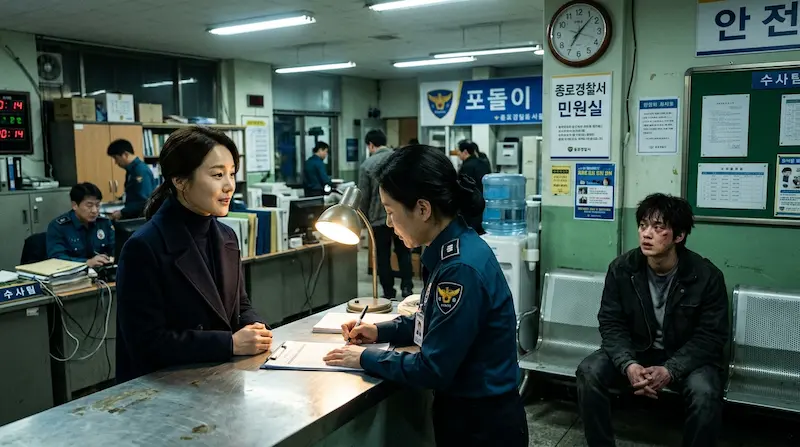
The chaos escalates when Jin-man arrives, punches Dong-man in the face, and the brothers tumble into a messy fight while Gyeong-se hides behind a bush — a visual gag that perfectly captures his character. At the police station, when an officer asks Dong-man his occupation, he freezes. Then Eun-a appears and answers for him: “He is a film director.” With one sentence, she gives him the title he has wanted for twenty years, and Dong-man’s eyes fill with something we have never seen in them before — belief.
Author’s Take: The 2% Drama That Hits Like 20%
There is a paradox at the heart of this show’s reception. The TV ratings hover around 2%, yet the emotional intensity per minute exceeds almost anything on Korean television right now. Writer Park Hae-young built the same slow-burn architecture in My Mister and My Liberation Notes — both of which started with modest ratings before word-of-mouth turned them into cultural phenomena. As one Reddit commenter (38 upvotes) confidently predicted: “I have no doubt they will nail the ending. Park Hae Young is a magnificent writer.”
What makes Episodes 3-4 particularly effective is the structural mirroring. Dong-man believes he is a monster; the Emotion Watch proves he is not. Eun-a believes she deserves abandonment; Dong-man’s constant presence proves she does not. Gyeong-se believes public success equals personal worth; his crumbling under bad reviews proves the opposite. Every character operates under a false belief about themselves, and Episodes 3-4 begin cracking those beliefs open.
The MoodWatch device continues to be the drama’s secret weapon. Unlike typical K-drama props, it functions as both a plot device and a thematic engine. When Dong-man’s watch shows “worried” instead of “excited” at the car crash, it is not just a reveal about his character — it is a direct rebuttal to the label he has accepted for years. Technology as emotional mirror is a concept I have not seen any other K-drama attempt with this level of sophistication.
I am raising my rating from 8.5 to 9.0 out of 10. Jin-man’s rope scene alone justifies the increase. If the remaining eight episodes maintain this trajectory, We Are All Trying Here will not just be the best drama of Spring 2026 — it will be a genuine contender for drama of the year.
Rating: 9.0 / 10
What Reddit Is Saying
The r/KDRAMA discussion thread for Episodes 3-4 generated 125 upvotes and over 100 comments. The top-voted comment (74 upvotes) praised Dong-man as “the epitome of all the feelings we feel throughout our lives” and highlighted Go Youn-jung’s performance as a revelation. Multiple users compared the writing quality to My Mister, with one stating it is “already exceeding my expectations” and will be their “most favorite drama of 2026.” The brother’s scene drew the most visceral reactions, with users describing physical responses like breath-holding and chills. Notably, several commenters expressed appreciation for the weekly airing format, saying the drama benefits from time to digest between episodes rather than binge-watching.
What to Watch For in Episodes 5-6
The Oh Jeong-hui scandal is far from resolved. Eun-a’s identity as the abandoned daughter will inevitably surface at Choi Film, creating a professional crisis on top of her personal one. Based on the trailer, Jang Mi-ran (Han Sun-hwa’s character) will enter the main storyline — and her character description reveals she is an actress who falls genuinely in love with co-stars and genuinely hates the characters she is supposed to hate. Her collision with Dong-man and Eun-a should provide both comic relief and emotional depth.
Additionally, the rift between Dong-man and Gyeong-se appears headed toward a flashback-driven revelation. Something specific happened between them in college, and Episodes 5-6 may finally reveal what turned admiration into animosity. Meanwhile, expect the Emotion Watch data to surface in a more consequential way — Ximfit detected another person matching Eun-a’s nosebleed emotional signature, and the framing strongly suggests it is Dong-man himself.
If You Love This Drama, Watch These Next
Writer Park Hae-young’s previous masterpiece My Mister walks the same emotional territory — a man crushed by life and a woman who sees his worth before anyone else does. If Dong-man and Eun-a’s dynamic resonates with you, Lee Sun-kyun and IU’s chemistry in My Mister will hit even harder.
For a completely different tone but equally addictive watch, Perfect Crown is currently airing on the same weekend. Where We Are All Trying Here strips characters down to their rawest emotions, Perfect Crown wraps them in royal silk and palace intrigue. Both dramas share one thing in common, though: characters wearing masks that crack a little more each episode. Our Episode 6 recap covers the latest twist.