Six episodes of We Are All Trying Here have built toward two confrontations — one with the mother who abandoned her, and one with the friend who stopped seeing him. Episode 7, aired 2026-05-09 on JTBC, finally delivers both. This We Are All Trying Here episode 7 recap walks through Eun-a’s devastating mother confrontation, Hwang Dong-man’s first green light on the emotion watch, and the night sea dance that has already become the most-shared scene of the spring season. For broader context, see our Complete Guide and last week’s Episode 6 Recap.
Writer Park Hae-young (My Mister, My Liberation Notes) has always understood that healing in her dramas is never clean. Therefore, episode 7 refuses every shortcut. Eun-a’s confrontation does not redeem her mother. Dong-man’s friendship does not erase his envy. However, both characters move forward anyway, and that small movement is the whole point of this show.
Where We Left Off
Episode 6 ended with Eun-a discovering that her famous-actress mother, Choi Yu-ri (Bae Jong-ok), had been quietly raising a stepdaughter for years while leaving her own biological child to grow up alone. Meanwhile, Hwang Dong-man (Koo Kyo-hwan) had finally confessed to Park Gyeong-se (Oh Jung-se) that he had been envious of him for twenty years. Gyeong-se did not respond. Episode 7 picks up exactly there, with both leads waiting for an answer that may never come.
The Confrontation: Eun-a Faces Her Mother
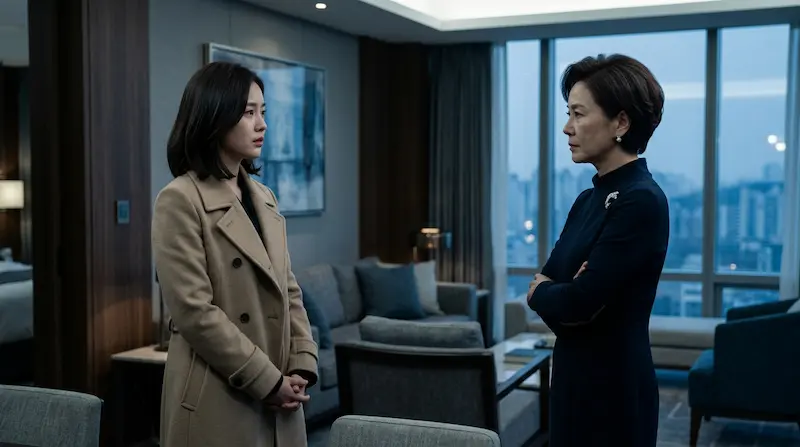
Eun-a arrives at her mother’s hotel suite without an appointment. Choi Yu-ri opens the door in full makeup, ready for a magazine shoot, and the visual contrast does most of the writing’s work. One woman is dressed for the public eye. The other has come to ask why she was never seen at all.
The Question That Took Twenty Years to Ask
The scene runs almost ten minutes with very little movement. Bae Jong-ok plays Yu-ri as a woman who has rehearsed this conversation in her head a thousand times, and lost it every time. Furthermore, she does not deny abandoning Eun-a. Instead, she explains it — career timing, a difficult marriage, the stepdaughter who needed her more visibly. Each explanation is reasonable. Moreover, each one lands like a small cut.
Go Youn-jung’s performance here is remarkable for its restraint. Eun-a does not shout. She does not cry. She simply asks one question after another, each calmer than the last, until her mother runs out of answers. The silence that follows is the loudest moment in the episode.
Bae Jong-ok’s Best Scene of the Year
Bae Jong-ok has played national-actress figures before, but this version is different. Yu-ri is not cruel. Rather, she is a woman who built a public image so carefully that she forgot which parts of her life were real. When Eun-a finally says, “I was real. I was always real,” Yu-ri’s face cracks for exactly two seconds before the professional mask returns. That two-second crack is the entire performance.
Aftermath: What the Confrontation Couldn’t Fix
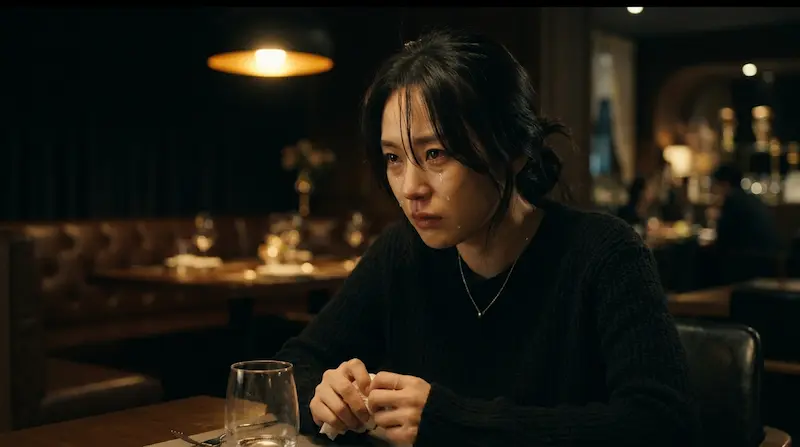
Park Hae-young’s writing refuses the catharsis most dramas would offer here. Eun-a leaves the hotel suite without an apology, without a promise, without anything resembling closure. Instead, she sits alone in a hotel restaurant, orders a single glass of wine, and does not drink it.
The camera holds on her face for nearly a full minute. Director Cha Young-hoon trusts the audience to read the small shifts — the moment the rage settles into something quieter, the moment the quiet hardens into a decision. By the time Eun-a finally stands up and leaves, she has not forgiven her mother. However, she has decided that her mother’s answer was never going to fix anything, and she is no longer waiting for it.
This is the show’s central thesis stated plainly: some wounds do not close. Some only become survivable. Furthermore, episode 7 argues that survivable is enough — at least for now.
The Night Sea Dance: Dong-man and Gyeong-se Reconcile
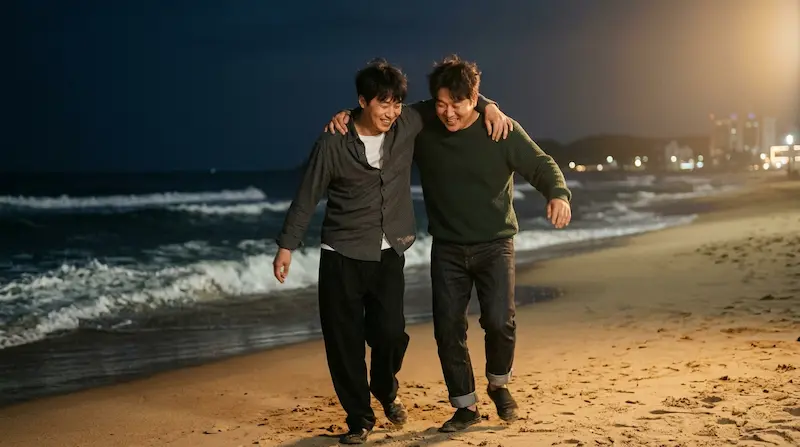
The episode’s tonal counterweight arrives on a beach at 2 a.m. Dong-man and Gyeong-se, drunk and exhausted after a film industry award ceremony Dong-man was not invited to, end up at the East Sea with no plan and no ride home.
The Walk Before the Dance
They walk along the shoreline for ten minutes without speaking. Then Gyeong-se finally addresses Dong-man’s confession from episode 6. He does not forgive Dong-man for the envy. Instead, he says something harder: “I knew. I always knew. And I kept being your friend anyway.” The line sits in the air for a beat. Afterward, Dong-man laughs — not because it is funny, but because twenty years of hidden shame have just been told back to him as something his friend had quietly carried too.
The Dance Itself
Then Gyeong-se throws an arm over Dong-man’s shoulder and starts an awkward two-step in the sand. Dong-man, after a moment of paralysis, joins him. They dance badly. The waves do most of the soundtrack work. Director Cha Young-hoon shoots the entire sequence in one wide take, refusing close-ups, letting the smallness of two middle-aged men dancing on an empty beach carry the emotional weight.
This scene is already being shared widely on Korean social media, and for good reason. It is the rare reconciliation scene that earns its catharsis without a single explicit line of forgiveness. Moreover, Koo Kyo-hwan and Oh Jung-se play it with the kind of physical awkwardness that only friends of twenty years can perform convincingly.
Emotion Watch Goes Green

The show’s central device — the emotion watch that reads other people’s feelings toward Dong-man — has been red, yellow, or dark for six episodes. On the beach, mid-dance, it finally turns green.
What the Green Light Actually Means
The show has been careful not to over-explain the watch. However, episode 7 makes its meaning unmistakable. Green is not love. Green is not approval. Green is the absence of the small, constant hostility Dong-man has been absorbing from every room he enters since he was a teenager. For one moment on a beach with one friend, no one in his immediate vicinity wishes he were smaller, quieter, or somewhere else.
Koo Kyo-hwan’s reaction to the green light is the episode’s most tender beat. He looks at the watch. Then he looks at Gyeong-se, who has not noticed. Subsequently, he says nothing. The watch goes back to its usual dim glow within a minute, but Dong-man has seen it, and the audience has seen him see it.
Why This Beat Reframes the Whole Series
Until episode 7, the watch felt like a gimmick — a clever sci-fi flourish in an otherwise grounded human drama. This episode reveals what it has always been: a measurement of how rarely envious people are allowed to feel safe. Therefore, the show is not about Dong-man learning to be less envious. It is about Dong-man learning that one green light, briefly, in twenty years, was always going to have to be enough.
Episode 8 Preview
The episode 8 teaser, airing 2026-05-10 at 22:30 KST, hints at fallout from both confrontations. Eun-a’s mother attempts a public response through a magazine interview. Meanwhile, Dong-man and Gyeong-se face the morning-after question of whether a night-sea dance survives the return to Seoul. Additionally, a brief flash of Yu-ri’s stepdaughter suggests episode 8 will finally introduce her on screen.
Final Thoughts
Seven episodes in, We Are All Trying Here has quietly become the most emotionally precise drama of the spring lineup. Episode 7 ratings will not post until Sunday, but the show has been climbing steadily — 2.2% to 2.9% over the first six episodes by Nielsen Korea paid-household metrics, with 2.4% recorded for episode 5. That trajectory is modest by network standards. However, the buzz on Naver, Twitter, and Reddit suggests the show’s true audience lives on streaming, where Netflix global numbers are not yet released.
Park Hae-young’s writing continues to do the thing she is best at — refusing easy redemption while insisting on small forward motion. Furthermore, Director Cha Young-hoon’s restraint, particularly in the hotel suite and beach sequences, is becoming the show’s signature. Koo Kyo-hwan and Go Youn-jung are both delivering career-best work, and Bae Jong-ok’s two-second crack will likely earn an end-of-year acting nomination.
Five episodes remain. The series ends 2026-05-24. For more spring 2026 coverage, see our Perfect Crown Episode 10 Recap and We Are All Trying Here OST Guide. We Are All Trying Here airs Saturdays at 22:40 and Sundays at 22:30 KST on JTBC, with global streaming on Netflix.