Episode 9 of My Royal Nemesis aired on June 5, 2026, and it didn’t just deliver — it detonated. The SBS Friday-Saturday drama hit a peak national rating of 13.7% on Nielsen Korea, setting yet another self-best record and cementing its position as the dominant title in its time slot. More importantly, this My Royal Nemesis Episode 9 recap has to cover a turning point the entire run has been building toward — the moment Shin Seo-ri stops running from her past life and Cha Se-gye stops pretending he doesn’t remember his.
If Episode 8 ended on a question, Episode 9 answers it. Twice. And then it answers a third question nobody saw coming.
Where We Left Off
Episode 8 closed on the line that ate Korean SNS for an entire weekend — Cha Se-gye walking across an industry party ballroom, stopping inches from Shin Seo-ri’s face, and saying “Dan-sim. Kang Dan-sim. Who are you?” The full Joseon memory had cracked open inside him in a single dream sequence, and the show left viewers with a five-day cliffhanger.
Episode 9 picks up exactly where 8 left off — same room, same lighting, same standoff. Seo-ri does what any sensible person would do in front of that question. She doesn’t answer it. She walks away. The choice to deflect rather than confess is what gives Episode 9 its entire shape. Everything else in the hour is the cost of that hesitation. For context on how the show set this dual-timeline payoff up over six earlier episodes, the Episode 7 recap and Episode 8 recap cover the build.
The Jealousy That Cracked His Composure
The first major sequence is the kind of scene Heo Nam-jun has been quietly preparing to deliver since the pilot. Shin Seo-ri is back on set filming an intimate scene with a male lead actor — the type of scripted love scene every working actress in Korea has to navigate. Cha Se-gye, having insisted on visiting the set under the cover of a BOJ Group sponsorship check-in, ends up watching the take from the monitor area.
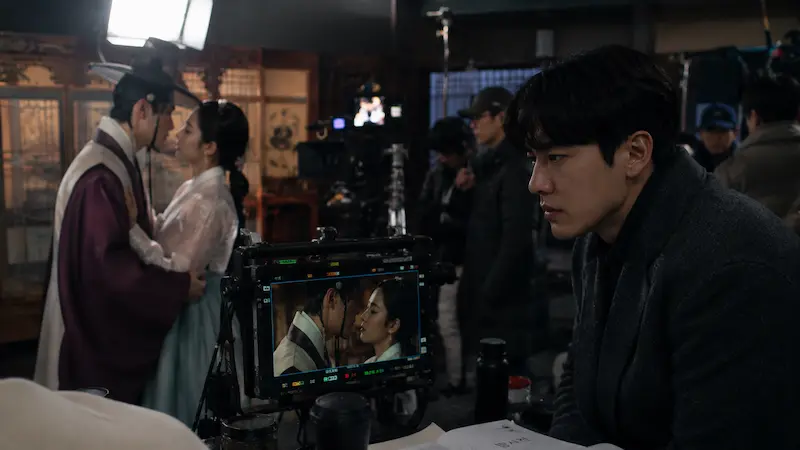
The scene works because nothing is yelled. Heo Nam-jun plays the entire sequence as restraint cracking in slow motion — the clenched jaw, the breath he forgets to take, the moment his hand grips the back of the monitor chair hard enough that the staff coordinator notices. The line that lands (“이런 개 같은…”) is muttered, not shouted, and that’s exactly why it cuts. A man who has spent eight episodes being the most composed person in any room loses composure for the first time over something that is, objectively, just acting.
What the scene reveals is not jealousy in the petty sense. It’s the realization that he doesn’t know how to be ordinary about her. Every other woman in his life has been a negotiation. She isn’t. He doesn’t have the protocol for that.
Cha Se-gye’s Full Memory Returns
The middle of the episode pivots to the dual-timeline payoff the show has been seeding since Episode 2. Cha Se-gye starts experiencing waking flashbacks — not the dreamy fragments of earlier episodes, but full coherent memories of his life as Crown Prince Lee-hyun. He remembers the political faction that wanted him removed from the line of succession. He remembers Kang Dan-sim approaching him in the palace gardens. He remembers her confession of adultery — the satong charge — and the moment the executioners took her away.
He also remembers what he did. Which was nothing.
The episode is careful to land this with weight rather than melodrama. The flashbacks are shot in muted gold tones, almost faded, and Heo Nam-jun plays the recovery as a man being slowly buried under memory rather than enlightened by it. By the time he’s done remembering, he isn’t excited to find Seo-ri. He’s ashamed. The drama earns this beat because it set the structural groundwork six episodes ago — something the Complete Guide tracks across the full series arc.
“What If I Really Am Kang Dan-sim?”
The confession scene happens in Seo-ri’s apartment, late at night, after Cha Se-gye shows up unannounced. He doesn’t ask the question from Episode 8 again. He doesn’t have to. She asks it herself.
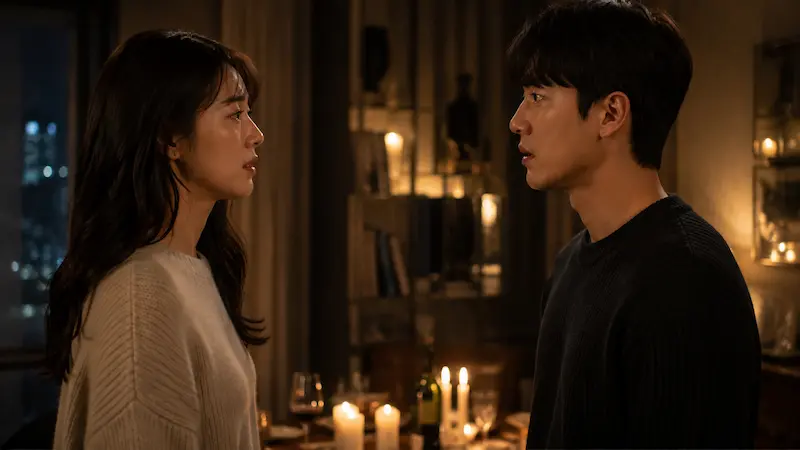
“내가 그 강단심이라면 어쩔 테냐?” — “What if I really am that Kang Dan-sim?” Lim Ji-yeon delivers the line not as a confession but as a challenge. She’s testing whether he can hold the answer. The camera holds on her face for what feels like ten seconds. Heo Nam-jun’s response is to sit down on the floor — not from weakness, but from the physical impossibility of standing under that question.
What follows is the longest dialogue scene of the series. Seo-ri tells him what she remembers — the fragments she’s been hiding since Episode 1. The palace. The trial. The poison. The specific sound the executioner’s blade made on the stone floor. She tells him she has been carrying this for thirty years of her current life, since she was a child, and that she has never told anyone, because there is no version of telling it that doesn’t sound insane.
The scene works because the show finally stops being clever about its central mystery. Both characters know. Both characters know the other knows. And both of them are now responsible for what they do with that knowledge.
The Satong Truth — A Political Sacrifice
The Joseon flashback that follows is the most consequential the show has run. The satong charge — Kang Dan-sim’s confession of adultery that sent her to execution — wasn’t the truth, and it wasn’t simply love either. It was a calculated political sacrifice.
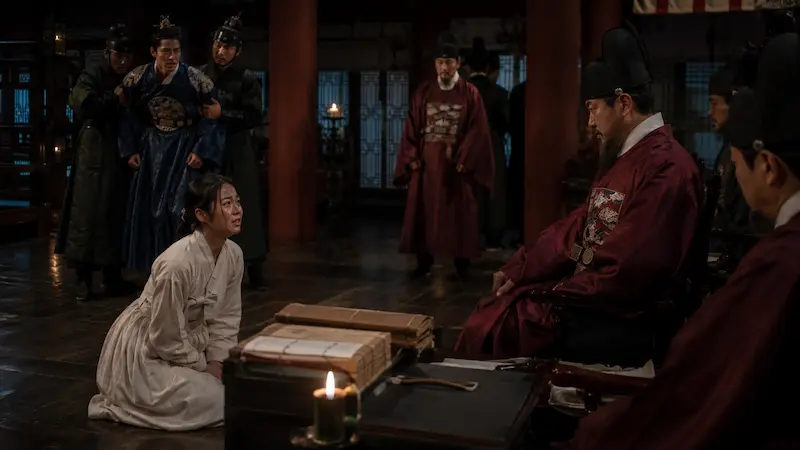
The faction trying to depose Prince Lee-hyun had built a treason case against him using forged letters between him and a court servant. Kang Dan-sim, who had access to the palace through her role, intercepted the case and substituted a confession of adultery in her own name. The logic was brutal but rational — a treason conviction would end the prince’s line and bring down the dynasty. An adultery conviction would only end her. She traded a clean death for the survival of his claim to the throne.
The flashback ends with Prince Lee-hyun restrained by his own guards, watching her be led away, unable to stop what she had chosen. It’s the scene that explains everything Cha Se-gye has been feeling since the memories returned. He owes her three hundred years of guilt, and he just found out the bill.
The Tearful Kiss Ending
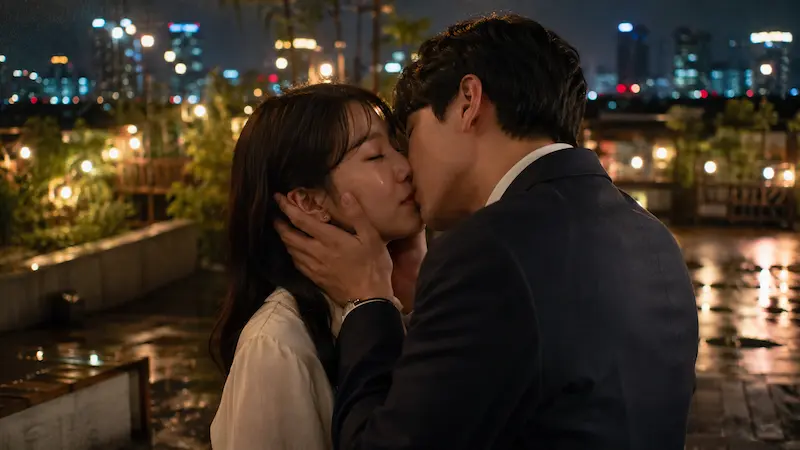
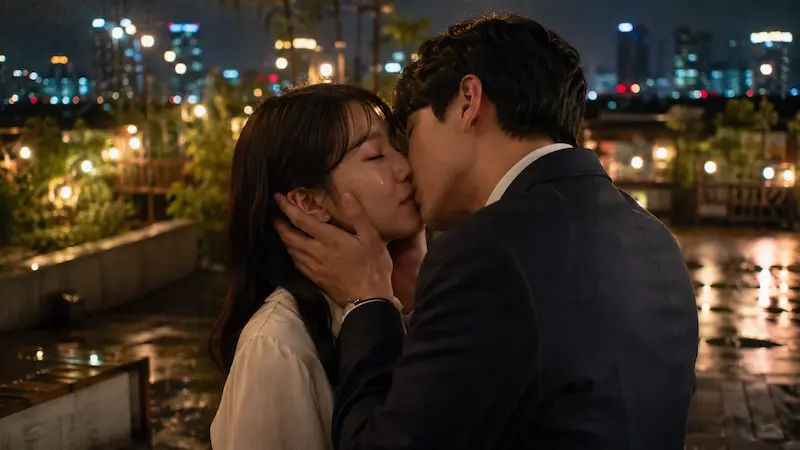
The closing scene returns to Seo-ri’s apartment. Cha Se-gye, now carrying the full weight of what Kang Dan-sim did, stands in front of her with the kind of expression Heo Nam-jun has been holding in reserve for nine episodes. “네가 뭐라든 다 믿으니까 나만 봐” — “Whatever you say, I’ll believe you, just look at me.”
The kiss is not the swooning kind. Both actors are crying through it. It’s the kind of kiss that functions as an apology, a promise, and a contract all at once. The episode ends on a hold-shot of their faces — no music swell, no fade-out montage, just two people who have finally stopped being other people.
Choco Papa’s Take
What’s Working — The Dual-Timeline Payoff
The reason this episode works at a 13.7% rating ceiling and not lower is structural. Writer Kang Hyun-ju has been laying the satong subplot since the pilot, and Episode 9 collects every breadcrumb in a single hour without it feeling rushed. That’s hard to do. Most time-slip K-dramas burn their best card by Episode 4 and spend the rest of the run filling space. My Royal Nemesis held the card until Episode 9 and made the wait pay.
Lim Ji-yeon’s confession monologue is the single strongest piece of acting in the show so far. She doesn’t play it as catharsis. She plays it as exhaustion — the relief of finally putting down a weight she’s been carrying since childhood. Heo Nam-jun’s quiet jealousy in the filming set sequence, and his floor-sit during the confession, complete a performance arc that has steadily moved from chaebol cliché to something more interesting. The behind-the-scenes guide covers how the production team supported these tonal shifts through costume and lighting changes.
What’s Not Yet Working — The Choi Moon-do Subplot
The episode plants a teaser about Choi Moon-do’s son that lands without weight, because the show has spent nine episodes treating Choi Moon-do as a procedural villain rather than a person. Jang Seung-jo is too good an actor to be wasted on the role as currently written, and the late-episode reveal that his son may be central to the final arc reads more like a writer’s room recalibration than a planned beat.
The remaining five episodes need to give Choi Moon-do interiority, fast. Otherwise the political-conspiracy plot — which is the show’s secondary spine — will collapse into wallpaper while the romance carries the entire load. The romance can probably carry it. The drama would be better if it didn’t have to.
Looking Ahead
Episode 10 airs Saturday, June 6, and the SBS official preview suggests three escalations. Cha Se-gye introduces Seo-ri to Dal-su as his confirmed partner — a relationship-public move with chaebol-family consequences. Choi Moon-do’s son enters the main timeline. And the press, having sniffed something during the BOJ Group set visit, starts circling. International fans tracking the show on MyDramaList are already calling Episode 9 the series peak. Episode 10 will test whether that ceiling holds.