After the strong premiere weekend that pulled in 4.4% nationally with Episodes 1-2, MBC’s Friday-Saturday action thriller had a structural problem to solve. Episodes 1-2 laid out the world, the trio, and the ten-year-old ferry incident hanging over all of them. Episodes 3-4 had to start moving the story without losing the deliberate slow burn that made the premiere work. The hour delivered. Episode 3 hit a new self-best of 5.5% on May 29, and Episode 4 climbed to a peak of 7.6% during the closing minutes on May 30 — a clear signal that Korean audiences are settling in for the long haul. The trio of Shin Ha-kyun, Oh Jung-se, and Heo Sung-tae starts pulling against each other for real this weekend, and the MBC drama finally lets the loyalty triangle bend.
Where We Left Off — A Quick Bridge from Episodes 1-2
The premiere ended on the reveal that Bong Je-soon (Oh Jung-se) — the seemingly harmless Oran Chinese Restaurant employee — is in fact the North Korean special agent known as Bul-gae (Fire Dog), washed up on Yeongseon Island with no memory of who he is. Jung Ho-myung (Shin Ha-kyun), the disgraced former NIS black agent now hiding as a cook at the same restaurant, recognized the signs first. Kang Beom-ryong (Heo Sung-tae), the legendary Volcano Gang number two now running a convenience store, was circling for his own reasons. Episode 2 closed with three predators in the same small town, none of them ready to show their hand. Episodes 3-4 force two of them to start showing it anyway.
The Abduction — Ho-myung Corners Ma Gong-bok
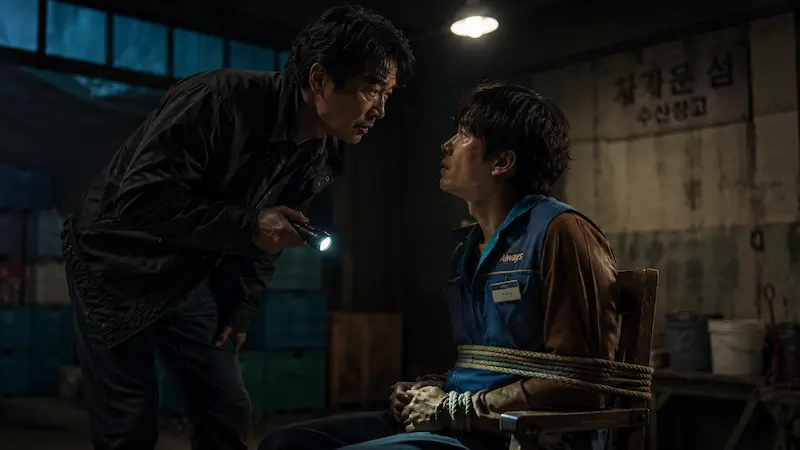
Episode 3 opens with Ho-myung following Je-soon to a back alley confrontation. What he finds there isn’t just Je-soon — it’s Ma Gong-bok (Lee Hak-joo), a familiar face from Oran Restaurant, getting beaten alongside him. Ma Gong-bok works at Beom-ryong’s convenience store. That coincidence is too clean to be a coincidence, and Ho-myung knows it.
What follows is the episode’s central setpiece. Ho-myung abducts Ma Gong-bok off the street, takes him to a warehouse, and starts the kind of cold, methodical interrogation that the show’s previous episodes only hinted at. The lighting drops to a single hanging bulb. The camera holds tight on Shin Ha-kyun’s face for nearly a full minute before Ma Gong-bok says anything. The point of the scene lies elsewhere, not in the information extracted. The point is that Ho-myung is still the man he was at the NIS, even after ten years of pretending to be a chef. Director Han Dong-hwa, working from the playbook he developed on Shadow Detective, films the abduction without any of the showy violence the genre normally invites. The threat is in the patience.
Ma Gong-bok’s reaction is what reframes the scene. There’s no breaking, no begging. Ma Gong-bok answers only the questions he chooses to answer and stonewalls the rest, which tells Ho-myung something more useful than any confession — the convenience store clerk is a professional too. That cover isn’t just a cover. It’s a layered one, and Ho-myung now has to decide whether to flip him or eliminate him.
The Loyalty Triangle Bends
The decision Ho-myung makes is the structural pivot of Episodes 3-4. He doesn’t eliminate Ma Gong-bok. He recruits him. The recruitment plays out across three separate scenes scattered through Episodes 3 and 4, and what makes the writing work is that the show refuses to flatten Ma Gong-bok’s choice into a clean betrayal. Lee Hak-joo plays the moment with visible cost. Walking away from Beom-ryong means walking away from the man who took him in when no one else would, and the actor lets the audience see that weight in every scene afterward.
The Korean press picked up on the framing immediately. Industry coverage during the broadcast week led with the phrase “흔들리는 의리 관계” (the shaking loyalty relationship), and that phrase is exactly what the writers are dramatizing. Beom-ryong doesn’t yet know that Ma Gong-bok has flipped. The audience does. That gap — between what one character knows and what another character is hiding — is the engine that will drive the next four episodes. The show planted a slow leak in Beom-ryong’s organization, and Heo Sung-tae’s performance in his Episode 4 scenes plays beautifully against the audience’s knowledge of what’s coming.
This is also the episode’s first real test of the central premise. Marketing positioned the three men as a reluctant team-up. Episodes 3-4 reveal that the team-up is going to cost something on every side.
The Family Date That Wasn’t
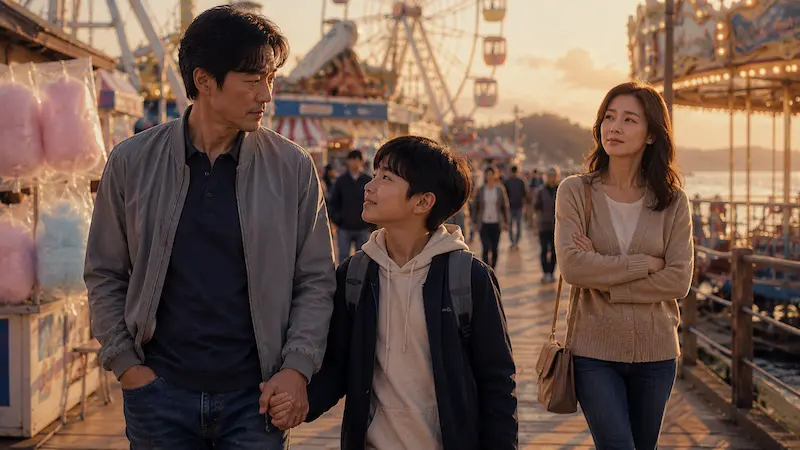
Episode 4 redirects from the abduction subplot to something the premiere only sketched in the margins — Ho-myung’s family. His wife Oran (Shin Dong-mi) has noticed that since Je-soon arrived on the island, her husband has been distant, evasive, and absent during the hours he used to spend at home. The two of them fight in long, unbroken takes, and Shin Dong-mi delivers the kind of grounded work that Korean dramas often skip past in favor of louder confrontations. There’s no yelling. Just exhaustion.
Ho-myung responds the way men in this genre always respond. He plans a family date. He takes his son Ji-woo and Oran to a seaside amusement park, buys cotton candy, rides the rides, and tries to act like the husband he hasn’t actually been for a decade. The afternoon plays warmly. Shin Ha-kyun lets a softness into Ho-myung’s face that the abduction scene the night before forbade entirely, and the contrast is the whole point. This is who Ho-myung wanted to be. The NIS, the ferry incident, and now Je-soon’s arrival keep dragging him back to who he actually is.
The amusement park sequence ends the way the audience already knows it will end. A call comes in. Ho-myung has to choose. He chooses the mission, and the camera holds on Oran watching him walk away. The show doesn’t dramatize her reaction with music or close-ups. It just lets her stand there. That restraint is the episode’s most damaging emotional move.
Prosecutor Kang Walks Into Yeongseon Island
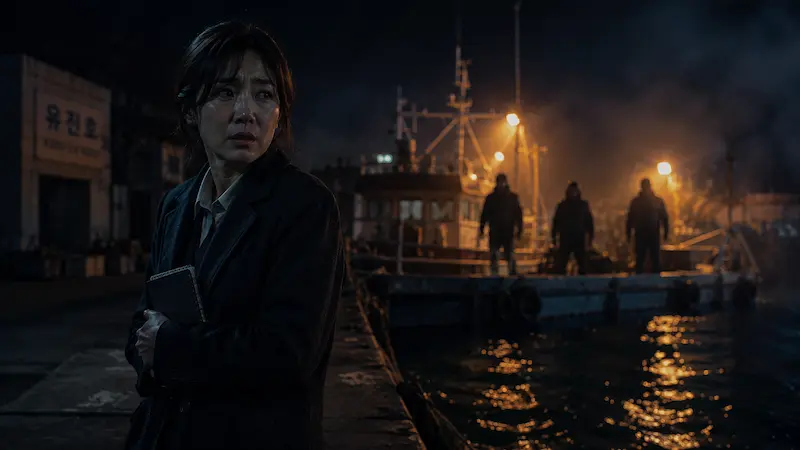
Running parallel to the family fracture is the introduction of Episode 4’s most consequential new piece — Prosecutor Kang Young-ae (Kim Shin-rok). Kang has been investigating the connection between Han Kyung-wook (Kim Sang-kyung) and Yoo In-gu (Hyun Bong-shik), the two men whose names keep surfacing in the margins of the ferry incident. Her investigation leads her, in Episode 4, to Yeongseon Island itself.
This is where the geography of the show starts paying dividends. Yeongseon Island has been positioned across four episodes as a place where former predators hide. Kang walks onto it as a prosecutor with a notebook and no backup, and the moment she steps off the ferry the show signals — without saying so directly — that she is now in danger. Kim Shin-rok plays the role with the kind of composed unease that defines the best prosecutorial characters in the genre. She is smart enough to know she shouldn’t be there alone. She came anyway.
The Episode 4 mid-act ending puts her in actual physical danger at the harbor. The show doesn’t resolve it within the hour. It hangs the cliffhanger and pivots back to Ho-myung, which is structurally smart — Kang’s storyline now functions as the ticking clock for the second half of the season. Viewers already know she is exposed. The trio doesn’t, yet.
The Heaven Capital Infiltration
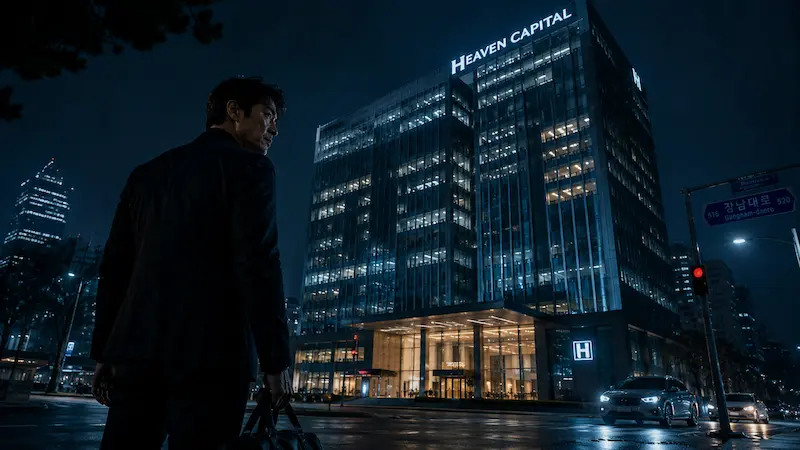
Episode 4’s final ten minutes are where the ratings spiked to 7.6%. Ho-myung, having walked out of the amusement park to take the call, follows the thread of his investigation to its current end point — Heaven Capital, the financial firm whose name has been hovering in the background since the premiere. The ferry incident ten years ago was not just a maritime accident. It was a cover for something larger, and Heaven Capital is the place where the money flowed.
Han Dong-hwa shoots the infiltration sequence with the kind of disciplined craft that defines his directing style. No exploding glass, no slow-motion gunplay. Just Ho-myung in a tactical jacket standing across the street, looking up at the building, and walking in. The camera follows him through the lobby in a single long take that recalls Squad 38’s quieter procedural moments. By the time the closing credits roll, Ho-myung has reached the floor he needed to reach, and the audience has confirmation that the ten-year-old conspiracy he’s been chasing is real, current, and operational.
The 7.6% peak during this sequence is the show’s first real signal that Korean audiences are committing to the long game. Premiere ratings can be curiosity. Sustained climbs across four episodes are something else.
Choco Papa’s Take
Episodes 3-4 are where Fifties Professionals stops being a premise and starts being a show. The premiere was structurally cautious — a lot of setup, a lot of character introduction, a Bul-gae reveal that earned the slow burn. Episodes 3-4 finally let that setup do work, and the result is the kind of disciplined mid-season storytelling that Korean action thrillers usually rush past in favor of louder beats.
What’s Working — The Trio Dynamic
What’s working is the trio dynamic. Shin Ha-kyun has spent ten years specializing in characters whose external composure barely contains their internal damage, and Jung Ho-myung is exactly that role. Oh Jung-se is doing something subtler — Je-soon’s memory loss reads as unpredictability rather than sympathy, which is much harder to make compelling. Heo Sung-tae is the surprise of the four-episode stretch. Beom-ryong could easily have been a stock convenience store gangster. The actor is finding small notes of fatigue and regret that suggest a character with somewhere to go.
What’s Not Yet Working — The Family Material and Scale
What’s not yet working is the family material. Shin Dong-mi delivers excellent work in the fragments she’s given, and the amusement park sequence lands because of her. But Oran as a character is still functioning as Ho-myung’s emotional consequence rather than a person with her own arc. With eight episodes left, the writers need to give her at least one storyline that doesn’t depend on her husband’s choices. The same caution applies to the son Ji-woo, who exists right now mostly to make Ho-myung’s exits more painful.
The bigger structural question is the show’s sense of scale. Comparing the contained patience of Episodes 3-4 to the explosive ratings climb of My Royal Nemesis Episode 7 running on the same Friday slot, Fifties Professionals is playing a longer game with smaller weekly payoffs. That can work if the back half delivers. It can also lose audience patience if the Heaven Capital plot doesn’t accelerate by Episode 6. The 7.6% peak suggests Korean viewers are willing to wait. International viewers, judging by early MyDramaList discussion threads, are slightly more impatient. The next four episodes will reveal which audience the show is built for.
The series remains, four episodes in, one of the most quietly confident productions of the 2026 spring lineup. It just hasn’t yet earned the full confidence Korean industry coverage is already extending to it. Episodes 5-6 need to convert promise into payoff.
Looking Ahead
Episode 5 airs June 5 and escalates on three fronts at once. Ma Gong-bok’s secret allegiance starts paying intelligence dividends. Prosecutor Kang’s island situation forces the trio to decide whether to intervene. The Heaven Capital infiltration produces its first concrete evidence about what actually happened on the ferry ten years ago. The slow burn now has its payoff lined up. Now the burn needs to start spreading. The recap for Episodes 5-6 is coming next.