
The Alchemy of Souls ending explained question has confused English-speaking viewers since 2023, and for good reason. The show ran across two production blocks, swapped its lead actress between seasons, and ended with a quiet bamboo path instead of a wedding or a coronation. Many international fans finished Light and Shadow feeling something happened — but not quite sure what. This breakdown decodes the lake scene, the ice stone, the Mu-deok question, and the final reunion. Written by a 59-year-old Korean fan who watched both seasons live, this guide explains what the Hong Sisters actually meant and why their choices land harder for Korean audiences than for first-time international viewers.
Why This Ending Confused International Viewers
The Alchemy of Souls ending lands differently for international viewers for three reasons. First, the show changed lead actresses between seasons, and tvN never gave a clear in-universe explanation in marketing materials. Second, Korean fantasy storytelling often resolves through stillness rather than spectacle, and the final scene rewards patience more than it rewards drama. Third, the magical terms — soul shifting, ice stone, soul ejector — sound dense to viewers unfamiliar with East Asian Taoist concepts.
Most English-language recaps treat the ending as a romance resolution. That reading is incomplete. The ending is really about identity, grief, and what a soul owes the body it borrows. Once those themes click into place, every confusing element starts to make sense.
Season 1 Finale Explained — The Lake Scene
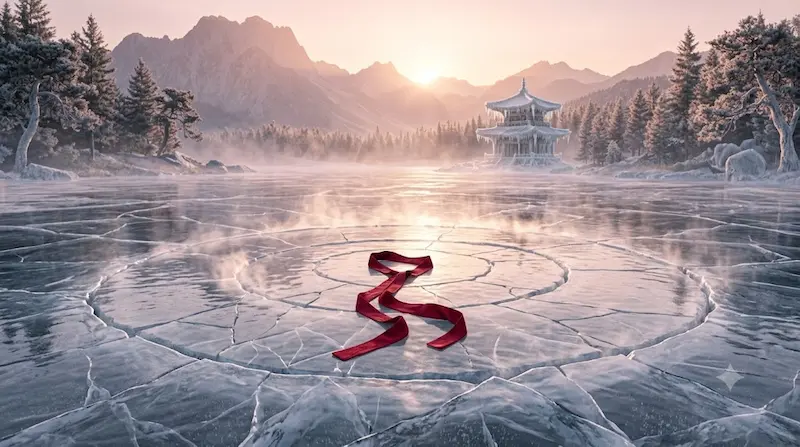
Season 1 ends at the frozen lake where Naksu makes her final choice. The scene runs almost without dialogue. The camera holds on the ice, the moonlight, and the moment Jang Uk understands what is about to happen. Korean viewers in 2022 watched this episode live and called it the most heartbreaking finale of the year.
What Actually Happened to Naksu
Naksu does not simply die at the lake. She uses the soul ejector ritual on herself to release her soul from Mu-deok’s body before the ice stone consumes her completely. This is a deliberate choice, not a defeat. She knows Jang Uk has the ice stone inside him now. She knows her continued presence puts him at greater risk. So she leaves on her own terms.
The red hair ribbon on the ice is the show’s only physical marker of her sacrifice. Korean viewers understood the symbolism immediately. In traditional Korean culture, a red ribbon represents a binding promise or fate connection — the same red thread that appears throughout East Asian folklore. By leaving it behind, Naksu signals that the connection itself is not broken. Only the body is gone.
Why Jang Uk Received the Ice Stone
The ice stone transfer is the show’s most important plot mechanism, and it works on two levels. On the surface, the ice stone needed a host body powerful enough to contain it, and Jang Uk’s bloodline made him the natural vessel. Underneath, the transfer is an emotional inheritance. He receives not just the stone but the responsibility — the weight of suppressing his own power so he does not become what the ice stone could turn him into.
This is why his three years of training between seasons matter. He is not learning new magic. He is learning to live with something inside him that wants out.
The Three-Year Gap and the Mu-deok Question
The most asked question about the Alchemy of Souls ending is also the simplest to answer once you know the production context. Between Season 1 and Light and Shadow, the lead actress changed. Within the story, three years pass. When Jin Bu-yeon appears in Light and Shadow, she looks completely different from Mu-deok.
The show treats this as a feature, not a bug. The whole magical system is built around the idea that souls can move between bodies. So when the actress changes, the show is not asking viewers to pretend. It is asking them to accept that the soul beneath two different faces might still be the same — or might be something new entirely. The ambiguity is the point.
For English-speaking viewers approaching the show fresh in 2026, the cleanest mental model is this: treat Mu-deok and Jin Bu-yeon as separate characters who share something the show will reveal slowly. Do not try to map one face onto the other. Let Light and Shadow earn its own answer.
Light and Shadow Finale — Jin Bu-yeon’s True Identity
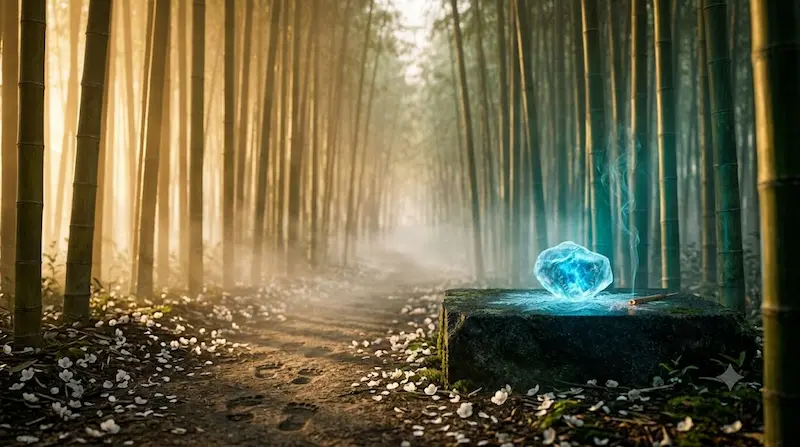
Light and Shadow opens three years after the lake scene, and the woman who walks out of the misty forest is not who Jang Uk expects. She introduces herself as Jin Bu-yeon, the long-lost daughter of the Jin family, returned after years of mysterious absence. She has memories of being Jin Bu-yeon. She has the family resemblance. By every external measure, she is exactly who she claims to be.
The Soul That Refused to Stay Dead
The Light and Shadow finale reveals that Jin Bu-yeon’s body is genuinely Jin Bu-yeon’s body. The Jin family daughter did exist, did go missing, and her body was preserved through powerful magic until a soul could be returned to it. The soul that was returned, however, is Naksu’s. The ritual Naksu performed at the lake did not destroy her soul. It released it into a kind of waiting state, and the Jin family’s preservation magic eventually pulled her into Jin Bu-yeon’s empty body.
So both answers are true. She is Jin Bu-yeon in body and in inherited memory. She is Naksu in soul and in the deeper recognition that draws her back to Jang Uk. The show refuses to collapse these into one simple identity. It insists that she is both, and that being both is not a contradiction.
Why the Body Changed but the Soul Did Not
This is where the show’s deepest theme lands. The ending argues that identity is not located entirely in the body or entirely in the soul. Jin Bu-yeon does not remember Mu-deok’s life clearly. She does not recall the lake scene with the precision of a returning lover. What she has is a pull — a recognition that bypasses memory. She knows Jang Uk matters before she knows why.
For Korean viewers raised on Buddhist and Taoist ideas about reincarnation and karmic connection, this lands as profound rather than confusing. The soul carries something forward that is not memory but is also not nothing. The English term for this concept does not really exist, which is part of why the ending feels harder to translate than to experience.
What the Ice Stone Really Symbolizes
The ice stone is not just a power source. Across both seasons, it functions as the show’s central metaphor for grief held inside a body. Whoever carries the ice stone gains immense power but pays for it by suppressing their own emotions, their own desires, and their own connections. The stone freezes everything around it, including the heart of its host.
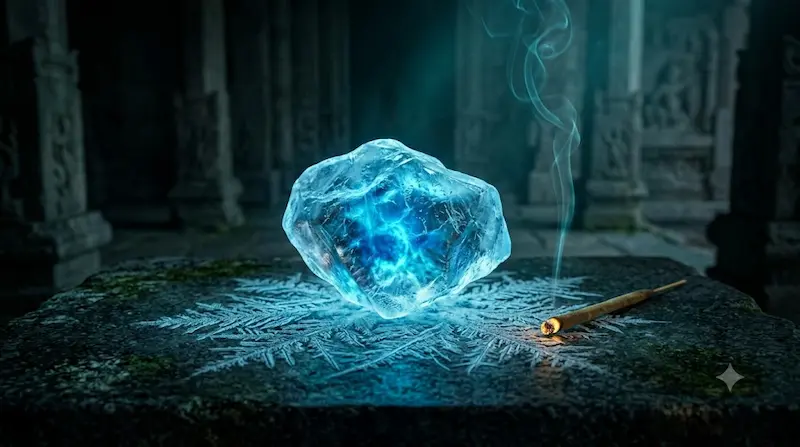
Jang Uk’s arc across Light and Shadow is the slow process of releasing what the ice stone wanted him to keep frozen. His coldness in the middle episodes is not bad acting. It is the show showing what happens when a person who has lost everything tries to function by sealing the loss away. The final scenes work because he chooses to let the ice stone go — not by destroying it, but by accepting that some things should not be held in.
Korean viewers in their 50s and 60s recognized this immediately. Many of us spent decades suppressing emotions for the sake of work, family, and social expectation. The ice stone is not just fantasy magic. It is what happens to anyone who decides feeling is too dangerous to allow.
The Final Scene Decoded
The final scene of Light and Shadow is deliberately quiet. No wedding. No grand declaration. No public restoration of either character to their previous positions. Just Jang Uk and Jin Bu-yeon walking together on a misty bamboo path, with the implication that they are choosing each other again — knowing exactly what that means and what they have already lost.
Many international viewers found this anticlimactic. That reaction is understandable but mistakes the show’s argument. The Hong Sisters are not writing a fairy tale where love conquers all. They are writing about two people who have already paid the highest price, who have already died and come back in different bodies, who have already lost the world they grew up in. Anything louder than a quiet walk together would betray what the show has been saying for fifty-plus episodes.
The bamboo, by the way, is a Korean visual cue. Bamboo bends without breaking and grows back from cut stalks. It is the traditional symbol of resilience after grief. Placing the final scene on a bamboo path is the show telling Korean viewers exactly what the ending means without saying a word.
Why the Hong Sisters Chose This Ending
The Hong Sisters are arguably Korea’s most successful drama-writing team, with credits including My Girl, You’re Beautiful, The Master’s Sun, and Hotel del Luna. They are known for fantasy concepts that turn out to be emotional metaphors. Alchemy of Souls fits that pattern, and the ending is the cleanest example of their style.
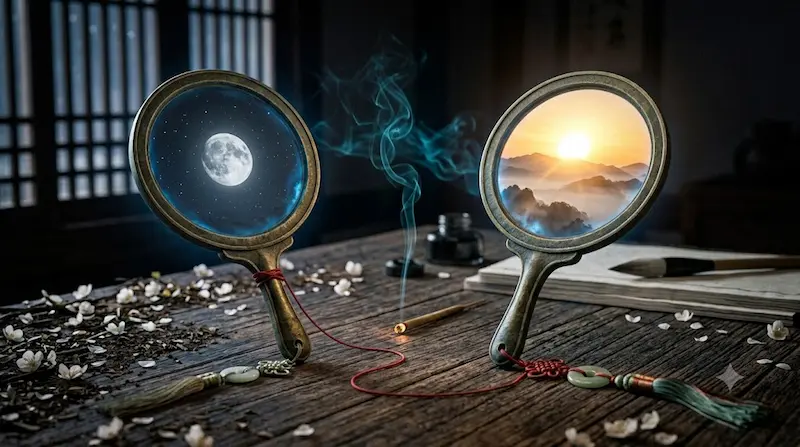
Three reasons explain the ending choice. First, a louder finale would have betrayed the show’s restraint. The show earned its emotional weight through small moments, and the ending honors that. Second, the Mu-deok and Jin Bu-yeon ambiguity was always the point. Resolving it cleanly would flatten the show’s most interesting idea. Third, Korean audiences in 2023 were exhausted by fantasy spectacle endings, and the Hong Sisters knew a quiet finale would feel like respect rather than disappointment.
Ratings backed up the choice. Light and Shadow’s finale pulled strong numbers and trended on Korean social media for days, with most viewers calling the ending earned rather than confusing. The international reception was more mixed, which is partly a translation problem and partly a cultural expectation gap.
Choco Papa’s Take — Is the Ending Satisfying?
Honest take from someone who watched both seasons live: yes, the ending is satisfying, but it asks more from you than most K-drama endings. If you came to Alchemy of Souls for romance, the quiet bamboo path will feel small. If you came for the world-building and the philosophical questions about identity, the ending is one of the most thoughtful in recent Korean fantasy television.
What Makes It Land for Korean Viewers
For viewers in their 50s — my generation — the ending hits harder because we recognize the emotional logic. The show is not really about magic or kingdoms. It is about whether you can accept someone you love after they have changed into something you do not fully recognize. That is the actual experience of long marriages, long friendships, and aging parents. People become different versions of themselves, and the question is whether the soul connection holds across those changes.
By the time Jang Uk walks beside Jin Bu-yeon on the bamboo path, the show has spent fifty episodes earning the answer: yes, the connection holds, but only if you stop demanding that the other person stay exactly who they were. That is a hard lesson for a fantasy drama to land, and Alchemy of Souls lands it.
For new viewers approaching the show in 2026, my advice is simple. Watch both seasons in one stretch if you can. Do not read theories between seasons. Let the Mu-deok question stay open as long as the show wants it open. The ending will explain itself if you let it, and the silence of the final scene will say more than any lecture could.
For continued Alchemy of Souls coverage, see the complete drama guide covering cast, seasons, and watch order, the Alchemy of Souls category page for all upcoming episode recaps, and the broader Ending Explained collection for similar breakdowns of other completed dramas. Official series information is available on the tvN Alchemy of Souls page, and the Netflix series listing covers where international viewers can watch. Additional writer background is available in the Hong Sisters Wikipedia entry.