Climax has reached its final chapter. Episode 10, which aired on April 14, 2026, delivered the series-high rating of 3.9% nationwide on Nielsen Korea’s paid-platform metric, with a peak minute rating of 4.6% in Bundang and 4.8% in the Seoul metropolitan area. For a 10-episode ENA Monday-Tuesday drama built entirely on political intrigue and moral ambiguity, these numbers speak volumes. The audience stayed, and the finale gave them plenty to argue about.
This recap covers both Episode 9 and Episode 10 together because the finale functions as a single, continuous two-hour arc. Episode 9 tears everything down. Episode 10 rebuilds it, only to knock it sideways again with an open ending that practically begs for a second season.
Climax Episodes 9–10 Ratings at a Glance
| Episode | Air Date | Nationwide (Paid) | Note |
|---|---|---|---|
| Ep 1 | Mar 16 | 3.6% | Series premiere |
| Ep 2 | Mar 17 | 3.8% | |
| Ep 3 | Mar 23 | 3.0% | |
| Ep 4 | Mar 24 | 2.8% | |
| Ep 5 | Mar 30 | 2.5% | Series low |
| Ep 6 | Mar 31 | 2.6% | |
| Ep 7 | Apr 6 | 2.7% | |
| Ep 8 | Apr 7 | 2.9% | Upward trend begins |
| Ep 9 | Apr 13 | 3.3% | |
| Ep 10 | Apr 14 | 3.9% | Series high / Finale |
Episode 9 Recap: The Scandal That Destroyed Everything
Episode 9 opens with a detonation. The intimate video of Chu Sang-a and Hwang Jeong-won spreads across every platform within hours. It is not a leak born of carelessness. Lee Yang-mi orchestrated the entire thing, paying Jeong-won to drug Sang-a during their time together, then recording footage that Sang-a has no memory of. The revelation comes too late. By the time Sang-a’s assistant traces the money trail back to Yang-mi, the damage is done.
Bang Tae-seop’s political career collapses overnight. His party expels him. His campaign team vanishes. The industrial backer who had been funding his run against Yang-mi’s faction turns violent, sending men to assault him and demand repayment. In the space of a single day, the man who was positioning himself as a serious political contender becomes a pariah with no allies, no funding, and no future.
At home, journalists surround the couple’s residence, attempting to break in for statements. Sang-a locks herself inside. When Tae-seop finally returns, the confrontation between husband and wife is raw and brutal. Sang-a apologizes but insists she was drugged. She also accuses Tae-seop of manipulating her life and hiding the tax investigation that has been quietly destroying her. Tae-seop fires back that she has no idea what he has sacrificed for her. He packs his belongings and leaves.
With nowhere left to turn, Tae-seop meets Lee Yang-mi. She offers him a choice: abandon Sang-a and join her political faction, or lose everything permanently. Tae-seop chooses survival. He sides with Yang-mi and enters Son Guk-won’s campaign as an advisor. It looks like surrender. It is not.
Hwang Jeong-won’s Sacrifice
Meanwhile, Jeong-won receives her payment from Yang-mi and is told to disappear. But Jeong-won does not go quietly. She threatens to expose Yang-mi using leverage she has accumulated, warning that she will destroy her if she continues targeting Sang-a. Jeong-won prepares to leave the city, giving a share of the money to her partner, but Sang-a finds her first.
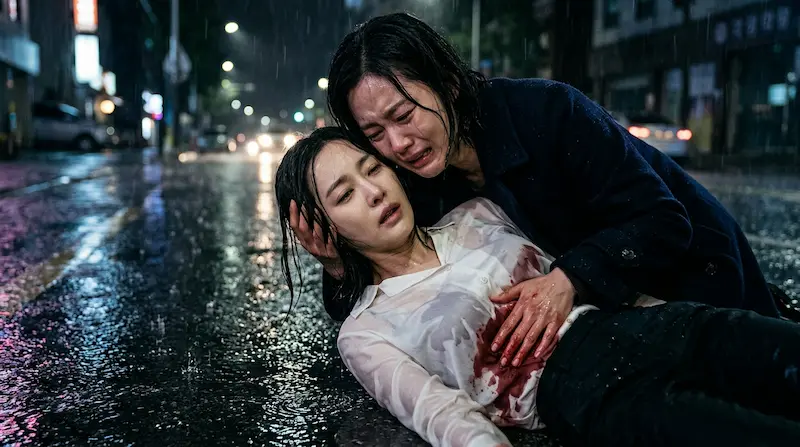
Their confrontation is interrupted by violence. An armed attacker rushes toward Sang-a with a knife. Jeong-won throws herself in the way, taking the stab wound meant for Sang-a. She dies in Sang-a’s arms before medical help arrives. Her partner is detained as the murder suspect when Sang-a fails to describe the attacker’s face.
This is the turning point of the entire series. Jeong-won’s death is not just emotional devastation. It is the key that unlocks the finale. When Tae-seop, as Jeong-won’s next of kin, sorts through her belongings, he discovers an envelope she left behind. Inside: footage linking Lee Yang-mi to multiple crimes, including the death of Park Jae-sang. The dead woman’s final gift becomes the weapon that will bring Yang-mi down.
Episode 10 Recap: The Long Game
Episode 10 jumps forward one year. The time skip is jarring but necessary. Tae-seop and Sang-a are living separate lives, appearing together only at official events. They have not divorced, but the distance between them is deliberate. Both are playing a long game that requires patience, isolation, and the appearance of defeat.
Tae-seop has spent the year embedded inside Yang-mi’s political machine. Working as an advisor to Son Guk-won’s presidential campaign, he meticulously builds trust while quietly gathering intelligence. His strategic brilliance is on full display: he engineers favorable polling numbers for Son, coaches him through a presidential debate, and positions himself as indispensable. Yang-mi watches approvingly, unaware that every move Tae-seop makes is designed to eventually destroy her.
The reason Yang-mi needs Son to win is specific and personal. If her preferred candidate takes office, she can push through changes to the inheritance bill that would secure her financial position and her daughter’s future after her husband’s eventual death. Tae-seop understands this vulnerability and files it away.
The Reunion and the Revenge
Sang-a has not been idle during the separation. She has rebuilt her acting career and, more importantly, she has been weaponizing her connections. Using the Oh Gwang-jae list, an original diary containing the secrets of Korea’s most powerful elites, she leverages the relationships and scandals accumulated through years of high-society entertaining. By the time she and Tae-seop reconnect, she has independently secured a war chest of dark money rivaling what Yang-mi offered Son Guk-won.
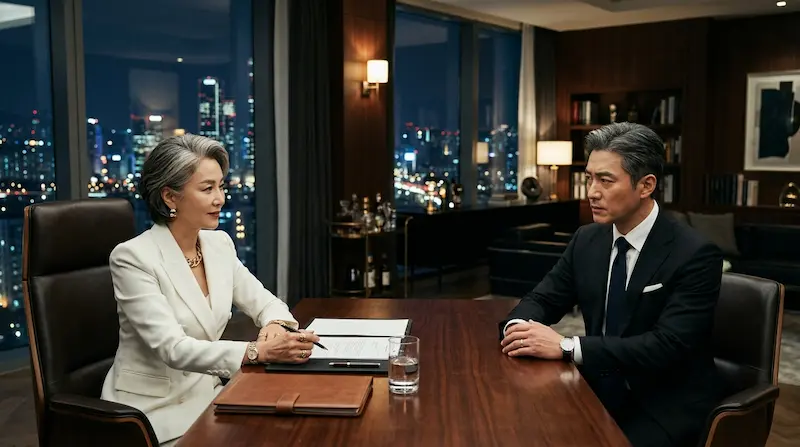
The year apart has changed both of them. When they finally sit down together, there is no pretense. They acknowledge how alike they have become, how the same ruthlessness that once drove them apart now binds them. They are, for the first time, truly partners. The reunion is not romantic. It is tactical. They launch a coordinated operation against Lee Yang-mi.
Sang-a personally approaches Son Guk-won and persuades him to switch sides. The scene is a masterclass in manipulation. She presents evidence of Yang-mi’s crimes, offers financial backing as a replacement, and appeals to Son’s survival instinct. He flips. The political structure Yang-mi spent years building begins to crumble from the inside.
Lee Yang-mi’s Downfall
With Son Guk-won turned, Tae-seop plays his final cards. The blackbox footage from Jeong-won’s envelope proves Yang-mi’s involvement in ordering the murder of Park Jae-sang. The testimony video from the Daeyang Fund representative, which Tae-seop had been saving since the general election, seals the case. Yang-mi is arrested and formally charged as the mastermind behind the murder.
But Tae-seop does not stop at Yang-mi. Kwon Jong-uk, who had been wavering between alliances throughout the series, crawls back to Tae-seop’s side once Yang-mi falls. Tae-seop welcomes him, then immediately neutralizes him. He reveals that he knows Jong-uk ordered excessive aspirin doses administered to his own father, Kwon Se-myung, the WR Group chairman. With this leverage, Tae-seop takes unofficial but absolute control of WR Group. He has not just defeated Yang-mi. He has replaced her.
One Year Later: The New Power Couple
Another time skip. Sang-a walks a red carpet at an international film festival, trophy in hand. The movie she produced with Jeong-won’s creative input has become a global success, earning her recognition as both an actress and a producer. She has transcended the scandal entirely, reborn as an artist with international credibility.
Tae-seop’s rise is even more dramatic. Son Guk-won wins the presidency. Tae-seop is appointed Senior Secretary for Civil Affairs, a position of enormous behind-the-scenes power. He is also the leading candidate for mayor of Seoam and is widely regarded as a future presidential contender. Every position Yang-mi once held, every lever of power she once controlled, now belongs to him.
The irony is deliberate and uncomfortable. Tae-seop has become exactly what Yang-mi was. Perhaps worse. He controls the corporation, the political machine, and the narrative. The drama does not celebrate this. It simply shows it, and lets the audience decide whether revenge or ambition was the real driving force.
The Open Ending: Why Climax Refuses to Let You Rest
If the story ended there, it would be a dark but satisfying conclusion. It does not end there.
Two years after Yang-mi’s arrest, Chairman Kwon Se-myung regains consciousness. The man everyone assumed would die in his hospital bed opens his eyes, and with him, the entire power structure Tae-seop built on the assumption of his death begins to wobble. Kwon Jong-uk’s younger brother, Jong-il, returns to the company, further destabilizing the corporate hierarchy.
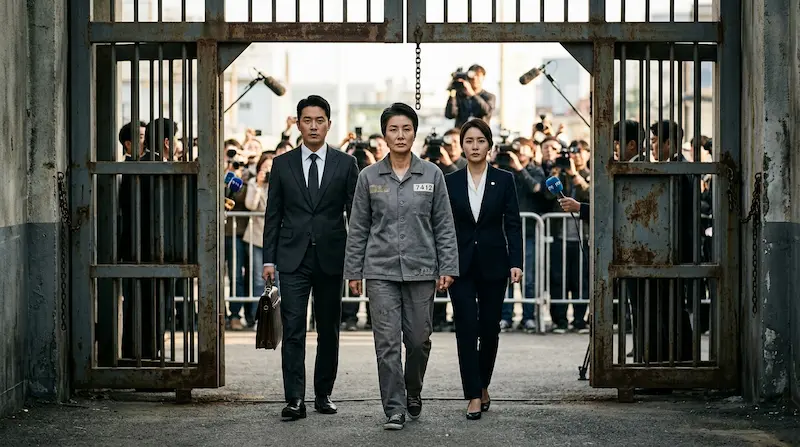
Then the real blow lands. Lee Yang-mi, sentenced to twenty years, is granted a presidential pardon and walks free. Sang-a’s wish, that Yang-mi would rot in prison for the rest of her life, is shattered. Yang-mi calls Sang-a from prison before her release, requesting a meeting. The call alone is enough to break Sang-a.
In the episode’s most devastating scene, Sang-a collapses in her bathroom after taking pills. The fear of Yang-mi’s return, the trauma of everything she endured, the knowledge that the cycle is about to begin again, it overwhelms her completely. Tae-seop finds her and pulls her back.
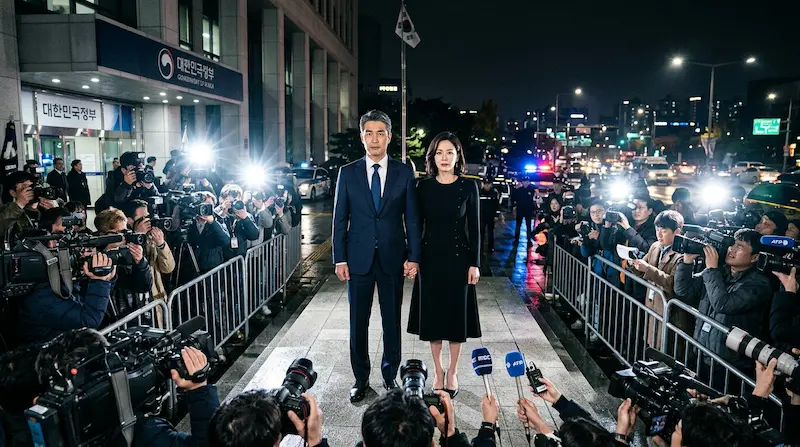
The final image of Climax is the two of them, hand in hand, walking out to face a wall of reporters. No smiles. No victory speeches. Just two people who have been through hell together, standing upright because the alternative is falling apart. The credits roll on a story that is clearly, deliberately, unfinished.
The Performances That Carried the Finale
Ju Ji-hoon delivers his strongest work in years. His Tae-seop in the finale is a man who has learned to weaponize patience, and Ju plays the transformation from desperate survivor to calculating power broker with surgical precision. The scene where he confronts Yang-mi with the murder evidence is chilling specifically because he shows no emotion. He has become the machine he needs to be.
Ha Ji-won matches him scene for scene. Her Sang-a in the bathroom collapse is the emotional core of the entire finale, a woman who won everything and realizes it changed nothing about the fear living inside her. Ha brings a physicality to the role that makes the psychological breakdown feel visceral rather than melodramatic.
Nana’s Hwang Jeong-won, though absent from Episode 10 due to her Episode 9 death, haunts the entire finale. Her sacrifice is the moral center of the story, the one genuinely selfless act in a drama full of calculated moves. Cha Joo-young’s Yang-mi remains terrifying precisely because she never raises her voice. Even in her arrest scene, she projects control. Oh Jung-se brings quiet desperation to Kwon Jong-uk, a man who keeps choosing the wrong side and knows it.
Climax Season 2: Will It Happen?
There is no official confirmation of a second season as of April 15, 2026. However, the open ending is not subtle about its intentions. Three specific plot threads demand continuation.
First, Yang-mi’s release and her phone call to Sang-a is a direct setup for renewed conflict. She has lost her empire but not her intelligence or her grudge. Second, Chairman Kwon Se-myung’s awakening threatens everything Tae-seop built through his control of Kwon Jong-uk. If the chairman reclaims WR Group, Tae-seop loses his corporate power base. Third, Sang-a’s relapse into pill dependency suggests that her psychological war is far from over, even if the external battle is won.
The production side also supports a continuation. Climax recorded the highest finale rating in the series at 3.9%, topped Disney+ Korea’s daily Top 10 series chart for four consecutive weeks, and ranked in the Top 5 across six Asian markets on Viu. ENA has every commercial reason to greenlight a follow-up. The successor drama, Scarecrow starring Park Hae-soo, premieres on April 20, but that does not preclude a Climax return in a later programming slot.
Final Verdict
Climax is a drama that respects its audience enough to deny them a clean ending. The finale works because it understands that in the world it has built, nobody gets to walk away clean. Tae-seop and Sang-a won. They also became the monsters they set out to destroy. Yang-mi lost. She also survived. Jeong-won was the only character who acted out of genuine love, and she paid for it with her life.
The open ending will frustrate viewers who wanted closure. It should. That frustration is the point. Climax argues that power is not a destination but a treadmill, and the moment you think you have reached the top, someone is already pulling the floor out from under you. If Season 2 arrives, it will not offer redemption. It will offer another round. And based on this finale, that is exactly the right call.
Overall Series Rating: 8.2 / 10
Read More About Climax
- Climax Episode 9 Recap: Hwang Jeong-won’s Sacrifice and the Scandal That Changed Everything
- Climax K‑Drama Review: A Bold Noir That Burns Bright but Ends in Smoke — Full Series Verdict