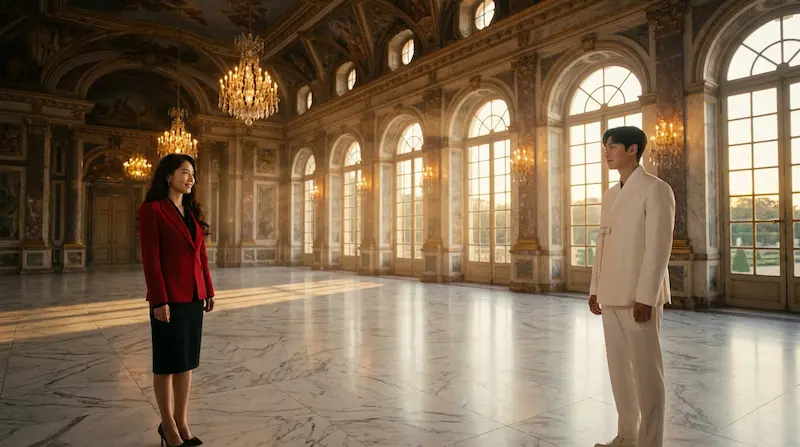
MBC’s Perfect Crown (21세기 대군부인) premiered on April 10‑11, 2026, and within 48 hours the internet had already split into two camps: those who believe IU (Lee Ji‑eun) and Byeon Woo‑seok are the most electrifying K‑drama pairing of the decade, and those who think the hype is overblown. After watching Episodes 1 and 2 twice each, reading every Korean and English review available, and cross‑referencing the ratings data, this is our full breakdown — covering the story, every major cast member, the filming locations you can actually visit, the OST lineup, and what the Episode 3‑4 previews are telling us.
The Numbers Don’t Lie: A Ratings Surge That Shocked the Industry
Perfect Crown Episode 1 debuted at a 7.8% nationwide rating (Nielsen Korea). For a Thursday‑night MBC drama in the spring season, that number alone would have been impressive. Then Episode 2 aired the very next night and pulled 9.5% nationwide, with a peak minute rating of 11.1% in the Seoul metropolitan area. That is a 21.8% jump overnight — a rate of growth that industry analysts are calling the steepest pilot‑to‑second‑episode climb since Extraordinary Attorney Woo in 2022.
| Episode | Air Date | Nationwide Rating | Note |
|---|---|---|---|
| 1 | April 10, 2026 (Thu) | 7.8% | Series premiere |
| 2 | April 11, 2026 (Fri) | 9.5% | Seoul peak 11.1% |
| 3 | April 17, 2026 (Thu) | TBA | — |
| 4 | April 18, 2026 (Fri) | TBA | — |
The combined two‑episode viewership surpassed an estimated 3 million unique viewers. MBC’s internal projection for the time slot was 5‑6%, which means Perfect Crown over‑delivered by roughly 60%. Disney+, which holds the global streaming rights, has not released viewing figures yet, but the drama trended at number one on Disney+ in South Korea, Japan, and Southeast Asia within hours of each episode’s release.
The Premise: A Constitutional Monarchy Meets a Contract Marriage
The world of Perfect Crown is built on a single bold premise: what if South Korea had never abolished the monarchy? In this alternate 2026, the nation operates as a constitutional monarchy where the royal family holds cultural authority and symbolic power, while elected officials run the government. The crown exists not as a relic but as a living institution — with its own budget battles, media scrutiny, and factional politics.
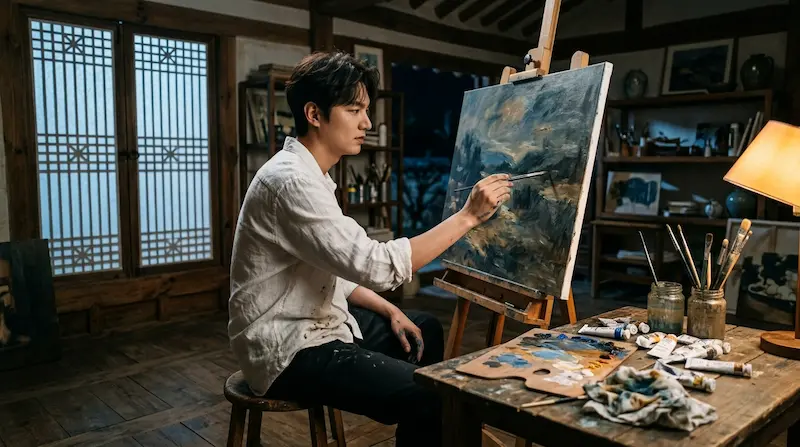
Prince I‑an (Byeon Woo‑seok) is the second son of the royal family. Unlike his politically ambitious older brother, I‑an has no interest in the throne. He paints, reads philosophy, and avoids public appearances. The palace tolerates his eccentricity because the firstborn is the heir presumptive — until a sudden scandal disqualifies the elder prince and thrusts I‑an into the spotlight as the only eligible successor.
Sung Hui‑ju (IU) is the youngest daughter of the Sung family, the wealthiest chaebol dynasty in the country. She is sharp, ruthless in boardroom negotiations, and allergic to tradition. When a corporate crisis threatens the Sung Group’s government contracts, Hui‑ju’s grandfather proposes a solution that sounds like it belongs in the Joseon Dynasty: marry her into the royal family. Hui‑ju resists — until she realizes the marriage contract gives her leverage to restructure the family business on her own terms.
The contract is simple on paper: a two‑year marriage, no romantic obligations, mutual public appearances, and a clean divorce once both parties have achieved their goals. The drama’s engine, of course, is the slow demolition of every clause in that contract as I‑an and Hui‑ju discover they are far more alike than either expected.
Full Cast and Characters: Who’s Who in Perfect Crown
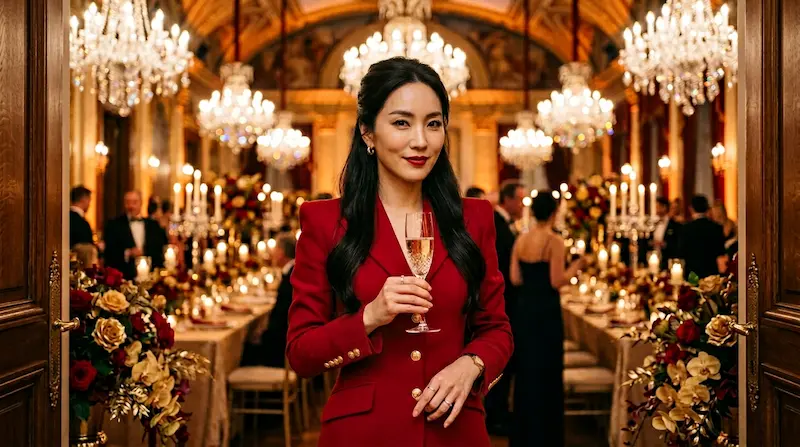
IU (Lee Ji‑eun) as Sung Hui‑ju — The 32‑year‑old singer‑actress takes on arguably her most complex role since My Mister (2018). Hui‑ju is not a typical K‑drama heroine. She does not stumble into the prince’s arms by accident; she walks in with a spreadsheet and an exit strategy. IU plays her with a precise mix of corporate coldness and barely‑suppressed vulnerability, particularly in the Episode 1 banquet scene where Hui‑ju’s hand trembles as she raises a toast she never wanted to give. IU’s filmography includes Hotel Del Luna (2019), Broker (2022, Cannes selection), and Dream (2023). Her casting alone guaranteed international attention, and she delivers.
Byeon Woo‑seok as Prince I‑an — After his breakout in Lovely Runner (2024), Byeon Woo‑seok was the most in‑demand actor in Korea. His I‑an is the opposite of the typical K‑drama prince: quiet, introspective, and visibly uncomfortable in royal robes. The character’s defining trait is his painting — I‑an communicates what he cannot say through his art, and Byeon sells this with subtle physical acting. Watch his hands in the Episode 2 archery scene: they are perfectly steady with a bow, yet shake when he tries to read the marriage contract. That contrast is entirely Byeon’s invention, not scripted.
Noh Sang‑hyun as Min Jeong‑woo — The second male lead plays the heir to the powerful Min political family. Jeong‑woo is everything I‑an is not: charismatic, media‑savvy, and openly ambitious. He is expected to become the youngest prime minister in the nation’s history. His relationship with I‑an is genuinely complex — they are childhood friends who respect each other but are heading toward an inevitable political collision. Noh Sang‑hyun, known internationally for his role in Pachinko (Apple TV+, 2022), brings gravitas and quiet menace to a character who could easily have been a one‑dimensional rival.
Gong Seung‑yeon as Yoon Da‑hae — The Queen Dowager’s niece and a media executive who runs the royal family’s public relations. Da‑hae is the gatekeeper of the palace’s image, and she views Hui‑ju’s arrival as a threat to the carefully constructed narrative she has spent years building. Gong Seung‑yeon plays her with icy precision, but Episode 2 reveals a crack: a flashback showing Da‑hae once had feelings for I‑an, which she buried under duty. This sets up a four‑way emotional dynamic that the writers are clearly building toward.
Supporting cast highlights: The drama also features seasoned veterans in key roles. The Queen Dowager, played with steely authority, functions as the true power behind the throne — her approval is the one thing neither money nor politics can buy. Hui‑ju’s grandfather, the Sung Group patriarch, mirrors the Queen Dowager on the chaebol side: old, strategic, and willing to sacrifice family members for institutional survival. The parallel between these two elderly power‑brokers is one of the show’s most intelligent structural choices.
Episode 1 Recap: The Red Suit That Launched a Thousand Headlines
Episode 1 opens not in a palace but in a Sung Group boardroom where Hui‑ju is dismantling a failing subsidiary’s management team. The scene establishes her character in under three minutes: she is competent, feared, and lonely. A brief shot of her eating lunch alone at her desk — ramyeon, not the gourmet meal her position affords — tells us more about Hui‑ju than any exposition could.
The episode pivots when Hui‑ju’s grandfather summons her to the family estate and reveals the marriage plan. IU’s performance in this scene is remarkable: Hui‑ju does not shout or cry. She listens, calculates, and asks exactly one question — “What do I get?” The grandfather’s answer (full control of Sung Group’s restructuring) is the only thing that could have made her say yes.
The centerpiece of Episode 1 is the royal birthday banquet, where Hui‑ju makes her first public appearance alongside I‑an. She arrives in a crimson red power suit — a deliberate rejection of the pastel hanboks worn by every other woman in the room. The fashion choice went viral within hours of broadcast, trending on Korean Twitter (now X) and generating over 200,000 posts. International fashion outlets including Vogue Korea and WWD covered the look by the next morning.
I‑an’s reaction to Hui‑ju’s entrance is the episode’s defining moment. He does not stare. He does not smile. He glances at her once, then returns to his conversation — but the camera lingers on his hand, which has stopped mid‑gesture. Byeon Woo‑seok communicates more with that frozen hand than most actors do with a full monologue. Director Jang Tae‑yoo, known for his visual storytelling in Jewel in the Palace, clearly trusts his actors to carry meaning in silence.
Episode 2 Recap: The Archery Gambit and the Contract
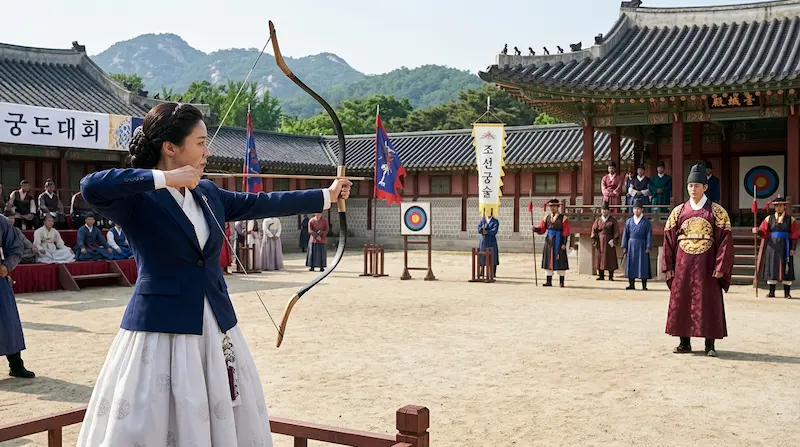
Episode 2 opens with a flashback to the 64th Seonggyungwan Archery Exhibition, set several years before the main timeline. A younger Hui‑ju, still in university, competes against I‑an in a traditional archery tournament. The scene is beautifully choreographed: Hui‑ju’s form is aggressive, powerful, and technically flawed; I‑an’s is textbook‑perfect but emotionally detached. She wins — and the flashback implies that I‑an let her, though his reasons remain ambiguous.
Back in the present, the marriage contract negotiations begin in earnest. The scenes between Hui‑ju’s legal team and the palace’s advisors are written with the tension of a corporate thriller. Every clause is a battlefield: Who controls public appearances? Can Hui‑ju maintain her position at Sung Group? What happens if either party falls in love — yes, there is an actual anti‑romance clause, and its inclusion is both absurd and narratively brilliant because the audience knows it will be the first thing to break.
The episode’s climax is a second archery scene, this time in the present day. The palace organizes a public event to introduce Hui‑ju to the media, and the format chosen — almost certainly by the Queen Dowager as a test — is a traditional archery demonstration. Hui‑ju and I‑an stand side by side, and for the first time, they must function as a team. The chemistry in this scene divided viewers: Korean audiences largely praised the restrained tension, while some international fans expected more overt romantic energy. Our take: the restraint is the point. These are two people who have agreed not to feel anything, and the drama’s power comes from watching that agreement erode one micro‑expression at a time.
Episode 2 ends with Hui‑ju signing the contract in I‑an’s private study. As she puts down the pen, she notices one of his paintings on the wall — a lone figure standing in a field of red flowers. She stares at it for a long beat, and IU lets something flicker across her face: recognition, maybe, or the first hint that this man is not what she assumed. I‑an, watching from the doorway, sees her looking at the painting and, for the first time, smiles. The screen cuts to black. It is a masterful ending.
The Chemistry Debate: Why Opinions Are Split
No discussion of Perfect Crown is complete without addressing the chemistry discourse. Within hours of Episode 1’s broadcast, Korean online communities (Nate Pann, TheQoo, DC Inside) were flooded with posts debating whether IU and Byeon Woo‑seok have romantic chemistry. The consensus among Korean viewers leans positive: the pairing works precisely because it is understated. These are not characters who are supposed to be in love yet — they are strangers bound by a contract, and the actors play that reality honestly.
International reaction, particularly on Reddit’s r/KDRAMA and X (Twitter), has been more divided. Some viewers accustomed to the instant‑spark model of K‑drama romance (think Lovely Runner‘s immediate emotional intensity) find Perfect Crown’s slow‑build approach frustrating. Others argue that the show is doing something more sophisticated: building chemistry through power dynamics, shared intelligence, and physical restraint rather than through meet‑cute tropes.
The acting controversy — if it can be called that — centers on a specific choice both actors appear to have made: they almost never look directly at each other when they are alone. In group scenes, they perform the expected social courtesies. But in private moments, their eye lines diverge, as if both characters are afraid of what direct eye contact might reveal. Whether this is directorial instruction or actor instinct, it creates an unusual tension that rewards re‑watching. We suspect that Episodes 3‑4 will begin to dismantle this avoidance pattern, and when these two characters finally lock eyes in a private moment, the payoff will be significant.
Filming Locations: Where Perfect Crown Was Shot
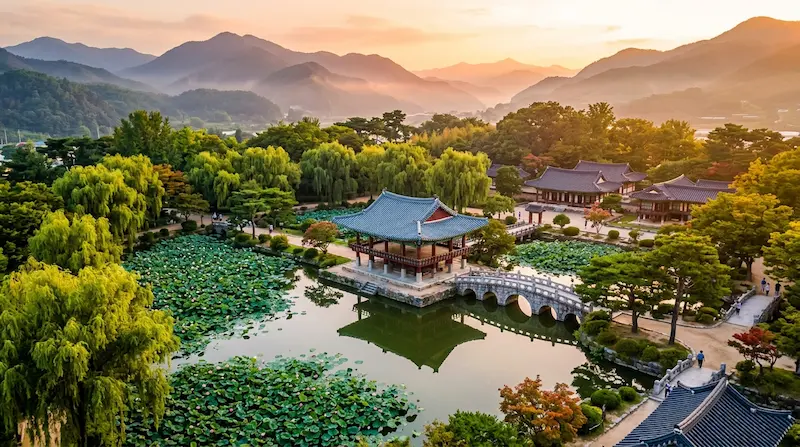
One of Perfect Crown’s greatest visual strengths is its use of real Korean heritage sites alongside purpose‑built studio sets. The production team, led by Director Jang Tae‑yoo, made the deliberate choice to shoot on location whenever possible, giving the drama a texture and depth that full‑studio productions cannot replicate. Below is a comprehensive guide to every confirmed filming location — several of which are open to the public and already seeing increased tourist interest since the premiere.
M83 Film Studio, Wonju (Gangwon Province) — The primary production base. Most interior palace scenes, including I‑an’s private quarters and the royal council chamber, were built as permanent sets inside this studio. M83 is one of Korea’s newest large‑scale production facilities and was chosen for its massive soundstages that allowed the construction of full palace corridors with 360‑degree shooting capability.
Gwanghallu Pavilion, Namwon (Jeollabuk‑do) — The iconic pavilion and its surrounding Gwanghalluwon Garden appear in the Episode 1 flashback sequence where a young I‑an watches a traditional performance from across the lotus pond. The location’s romantic literary history — it is the setting of the classic Korean love story Chunhyangjeon — makes it a symbolically perfect choice for a drama about forbidden attraction across class lines.
Gyeongbokgung Palace, Seoul — Exterior shots of the main palace gate and the Geunjeongjeon throne hall were filmed here during a special nighttime shoot. The production received rare permission to film after hours, resulting in scenes where the palace appears eerily empty — a visual metaphor for the hollow grandeur of I‑an’s royal life.
Changdeokgung Palace and Huwon Secret Garden, Seoul — The Secret Garden scenes in Episode 2, where I‑an walks alone among ancient trees, were shot at Changdeokgung’s UNESCO‑listed rear garden. The garden’s natural, unmanicured beauty contrasts sharply with the rigid formality of the palace interiors, mirroring I‑an’s desire to escape royal expectations.
Jongmyo Shrine, Seoul — The formal royal ancestral rite that opens Episode 1 was filmed at Korea’s most important Confucian shrine. The scene establishes the weight of royal tradition that I‑an carries, with over 200 extras in full ceremonial dress. Jongmyo is a UNESCO World Heritage Site and is open to the public on Saturdays or by guided tour on other days.
Kyung Hee University, Seoul — The European‑style Gothic architecture of Kyung Hee’s main building doubles as the exterior of the elite university where Hui‑ju and I‑an first competed in the archery flashback. The grand staircase and chapel‑like façade give the scenes an almost Western‑academic atmosphere that underscores the drama’s blend of Korean tradition and global modernity.
Baekje Cultural Land — Sabi Palace, Buyeo (Chungcheongnam‑do) — The stylized royal reception hall used for formal state events in the drama was filmed at this reconstructed Baekje‑era palace complex. The warm wooden interiors and elevated throne platform give these scenes a distinctly different visual palette from the Joseon‑era Gyeongbokgung sequences.
Hapcheon Image Theme Park — Cheongwadae Set (Gyeongsangnam‑do) — Several high‑budget interior shots, particularly the modern governmental conference room where the Prime Minister meets the royal household, were filmed at this controlled set originally built to replicate the Blue House (Cheongwadae). The set allows full lighting control and is frequently used in Korean political dramas.
Awon Gotaek and Soyang Gotaek, Wanju (Jeollabuk‑do) — These beautifully preserved traditional hanok houses appear in quiet, intimate scenes between I‑an and Hui‑ju. The low wooden ceilings, paper sliding doors, and courtyard gardens create a sense of privacy and warmth that the grand palace sets intentionally lack — signaling that real connection between the leads happens only outside the institution.
Gocheok Sky Dome, Seoul — In one of the drama’s most unexpected production choices, a modern stadium appears in Episode 2 during a charity event where Hui‑ju must throw a ceremonial first pitch. The scene is played for both comedy and character development: Hui‑ju’s competitive athleticism surprises I‑an, and the crowd’s enthusiastic reaction marks the first moment the public begins to accept her as a royal figure.
Cattle and Bee Café, Yangjaecheon, Seoul — This casual riverside café is used for a brief but important scene where Hui‑ju meets her best friend outside of palace surveillance. The location grounds the drama in contemporary Seoul life, reminding viewers that Hui‑ju had a normal existence before the contract marriage.
Switch 22, Yeouido, Seoul — The sleek corporate interior of this co‑working and event space doubles as Sung Group’s executive boardroom. The glass walls, minimalist furniture, and cold lighting establish the chaebol world as the visual opposite of the warm, wooden palace interiors — reinforcing the drama’s central contrast between old money and new power.
The OST: A Lineup That Reads Like a Festival Poster
MBC and the music production team revealed the full OST lineup on April 1, 2026, and the list reads more like a major music festival bill than a drama soundtrack. The strategy is clear: attract younger viewers through their favorite artists while maintaining the cinematic quality the drama demands.
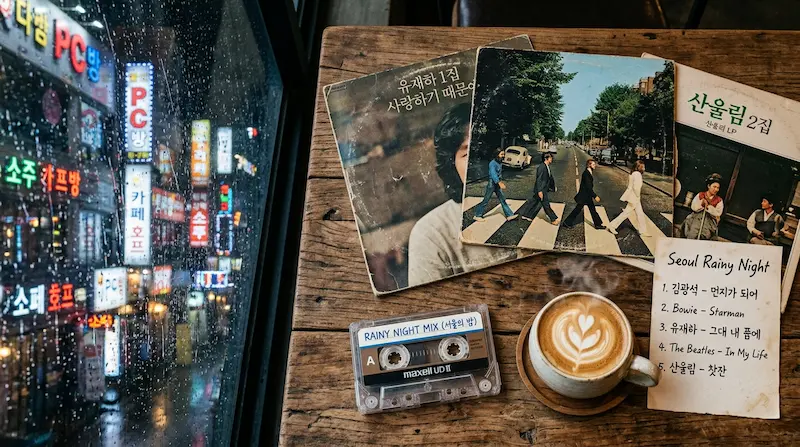
OST Part 1 — BIBI, “My Pace” — Released alongside Episode 1, BIBI’s track is a mid‑tempo R&B song with a jazz‑inflected piano loop. The lyrics describe the feeling of moving at your own speed while the world pressures you to conform — a perfect thematic match for both Hui‑ju and I‑an. “My Pace” entered the Melon Top 100 within hours of release and has been widely used in fan‑edit videos on TikTok and Instagram Reels. BIBI’s husky vocal tone gives the track a sophistication that elevates the drama’s nighttime scenes.
OST Part 2 — KiiiKiii — The second track, released with Episode 2, brings a more ethereal, atmospheric sound. KiiiKiii’s vocal style — breathy and layered with reverb — accompanies the quieter emotional moments, particularly the scenes of I‑an painting alone. The track has a dreamlike quality that contrasts effectively with BIBI’s grounded earthiness.
Confirmed upcoming artists: The full lineup includes WOODZ (Cho Seung‑youn), RIIZE, BOYNEXTDOOR, Sam Kim, and 한로로 (Hanroro). If the pattern holds — one new OST track per two episodes — viewers can expect WOODZ or RIIZE for Episodes 3‑4, with BOYNEXTDOOR and Sam Kim likely arriving in the mid‑season stretch. The inclusion of both idol groups (RIIZE, BOYNEXTDOOR) and indie‑leaning soloists (Sam Kim, 한로로) suggests the OST will cover a wide emotional range, from upbeat romantic tracks to melancholic ballads.
The OST is available on all major platforms including Spotify, Apple Music, Melon, Bugs, and Genie. A full OST album is expected after the drama’s conclusion.
Episodes 3‑4 Preview: What the Teasers Are Telling Us
MBC released the Episode 3 preview immediately after Episode 2’s broadcast, and a longer combined 3‑4 teaser appeared on the drama’s official YouTube channel the following day. The previews have already accumulated over 18,000 views and sparked intense speculation across fan communities. Here is what we can piece together.
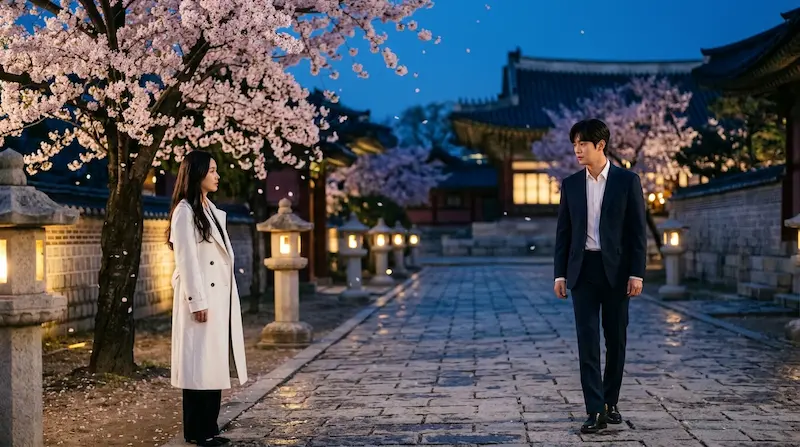
The Episode 3 preview opens with Hui‑ju’s voice: “이 말도 안 되는 결혼이…” (“This absurd marriage…”), but the sentence is cut before she finishes. The visual shows her standing in a palace corridor at night, still in formal dress, suggesting the scene takes place shortly after an official event. The most discussed frame shows I‑an and Hui‑ju sitting together in what appears to be his private quarters — a location she has not entered voluntarily before. His painting supplies are visible in the background, and she appears to be examining one of his canvases. This suggests a shift in their dynamic: from contractual obligation to genuine curiosity.
Min Jeong‑woo’s political move: The preview includes a brief but loaded scene of Jeong‑woo (Noh Sang‑hyun) at a press conference, and the chyron visible on the in‑drama news broadcast references a “royal budget review bill.” This aligns with the character background revealed in promotional materials: Jeong‑woo’s political faction wants to reduce the royal household’s public funding, a policy that would directly threaten I‑an’s already precarious position. The personal friendship between I‑an and Jeong‑woo makes this political betrayal dramatically rich — Jeong‑woo may genuinely like I‑an while still being willing to dismantle the institution I‑an represents.
The Queen Dowager’s counter‑move: A split‑second shot in the teaser shows the Queen Dowager handing a document to Da‑hae (Gong Seung‑yeon). Given Da‑hae’s role as the palace’s PR chief, this likely signals a strategic media offensive — possibly leaking information designed to boost public sympathy for the royal marriage and undercut Jeong‑woo’s budget bill. If the Queen Dowager is using Hui‑ju’s popularity (the red suit virality) as a political weapon, it would add a fascinating layer: Hui‑ju becoming a pawn in a game she does not yet fully understand.
The “crazy dating” strategy: Fan analysis of the preview suggests Episodes 3‑4 will feature I‑an and Hui‑ju being forced into a series of public “dates” designed to convince the media their marriage is real. One preview frame shows them at what appears to be a traditional market, another at a modern art gallery. The forced‑proximity trope is a K‑drama staple, but Perfect Crown’s version appears to come with a twist: both characters know they are performing, and the tension comes from the moments when the performance accidentally becomes real.
Episodes 3 and 4 air on April 17 (Thursday) and April 18 (Friday), 2026, at 9:50 PM KST on MBC, with global streaming available simultaneously on Disney+.
Our Verdict: Perfect Crown Is Playing the Long Game
After two episodes, Perfect Crown has established itself as the most ambitious Korean drama of spring 2026. The ratings trajectory is exceptional. The production values — from the real heritage‑site locations to the carefully art‑directed palace interiors — are film‑quality. The OST lineup promises a soundtrack that will chart independently of the drama. And the cast, led by IU and Byeon Woo‑seok but supported by genuinely compelling performances from Noh Sang‑hyun and Gong Seung‑yeon, is operating at a level that justifies the pre‑premiere hype.
The chemistry question will continue to dominate online discourse, and that is exactly what the creative team wants. Perfect Crown is not a drama that gives you the love story in Episode 1. It is a drama that makes you earn it — and based on the blueprint laid down in these first two episodes, the payoff is going to be worth the wait.
Will the contract hold? Will I‑an choose the crown or Hui‑ju? And what will Min Jeong‑woo sacrifice to become prime minister? Episodes 3‑4 air April 17‑18 on MBC and Disney+ — and we will be here with the full recap.
👉 Read more Perfect Crown coverage on K‑Drama Recap Hub:
- Perfect Crown Episode 1 Recap: The Royal Birthday and a Red‑Suit Entrance
- Perfect Crown Episode 2 Recap: The Archery Gambit and a Signed Contract
- Perfect Crown Fashion and Chemistry Analysis: IU and Byeon Woo‑seok
- Perfect Crown Complete Guide: Cast, Schedule, and Everything You Need to Know
- Perfect Crown Character Guide, Fan Theories & Deep Dive (2026)
3 thoughts on “Perfect Crown Episodes 1‑2 Review: IU and Byeon Woo‑seok’s Royal Romance, Filming Locations, OST, Cast Guide, and Episodes 3‑4 Preview”