Two episodes in, and We Are All Trying Here has already pulled off something no one predicted: a 2.2% TV rating on JTBC — and the No. 1 spot on Netflix Korea within 24 hours. Written by Park Hae-young, the woman behind My Mister and My Liberation Notes, this 12-episode black comedy slice-of-life isn’t chasing explosive twists. It’s doing something harder — making you sit with the uncomfortable feeling of not being good enough, and finding someone who understands that without you having to explain it.
If you’re wondering whether this drama is worth your time, what the characters are really about, or where you can watch it — this guide covers everything.
What Is “We Are All Trying Here”?
We Are All Trying Here (Korean: 모두가 자신의 무가치함과 싸우고 있다, abbreviated 모자무싸) is a 2026 South Korean television series that premiered on JTBC on April 18, 2026. It airs every Saturday and Sunday at 10:40 PM KST and streams simultaneously on Netflix in selected regions worldwide.
The series is classified as a black comedy, slice-of-life melodrama — a combination that sounds contradictory until you watch it. The humor is sharp enough to make you laugh, and the emotional beats hit hard enough to make you question why you’re laughing. This tonal tightrope is Park Hae-young’s signature, and it’s fully on display here.
Here are the essential details at a glance. The drama runs for 12 episodes, each approximately 70 minutes long. It is directed by Cha Young-hoon, who previously helmed When the Camellia Blooms (2019) and Welcome to Samdal-ri (2023–2024). The production is handled by Studio Phoenix, SLL, and Studio Flow. Filming began in October 2025 and wrapped in April 2026. The series was greenlit after Park Hae-young’s script attracted an ensemble cast that reads like a Korean film awards nominee list.
The core premise: Hwang Dong-man (Koo Kyo-hwan) is the only member of a famous film industry group who hasn’t debuted as a director — after 20 years of trying. When he meets Byeon Eun-a (Go Youn-jung), an overworked producer who recognizes his potential before anyone else does, both begin to rediscover what makes them worth something in a world that’s been telling them otherwise.
Cast & Characters: The Group of Eight and Beyond

Main Cast
Hwang Dong-man (Koo Kyo-hwan) is the beating, bleeding heart of this drama. Among the eight members of a prestigious film school club known as “The Eight” (8인회), he is the only one who never debuted. For 20 years, he has watched every single one of his peers become successful directors and producers while he remained stuck — pitching scripts no one wants, attending premieres for films he didn’t make, and slowly becoming the person everyone tolerates but no one respects. On the surface, he’s loud, abrasive, and exhausting to be around. He publicly trashes his friend’s new film, writes negative reviews under his own name, and makes every group gathering about himself. But underneath that noise is a man who screams his own name on a hillside because “on days when I haven’t talked to anyone, I call my own name out loud — to remind myself that I exist.” This is Koo Kyo-hwan’s first lead role in a JTBC network drama, and the role was reportedly written specifically for him.
Byeon Eun-a (Go Youn-jung) is the production director at Choi Film. Her colleagues call her “Dokki” (도끼, meaning “Axe”) because her script critiques are so precise they feel like being chopped. On the surface, she appears unshakably composed — the person in the room who has everything under control. Underneath, she’s battling emotional overload and unresolved trauma from a past relationship. The cruel paradox of her situation is that she’s too competent: her boss sees her abilities as a threat rather than an asset, her colleagues resent her efficiency, and she’s been systematically devalued precisely because she’s good at what she does. When she meets Dong-man, she sees something the others refuse to see — not a failure, but someone whose desperation mirrors her own.
Park Gyeong-se (Oh Jung-se) is a successful director at Gobak Film with at least five films released worldwide. He is also a member of The Eight, and on paper, he should be content. He isn’t. Despite his achievements, he harbors a deep, almost pathological inferiority complex toward Dong-man — not because Dong-man is better than him, but because Dong-man’s relentless presence forces him to confront the possibility that his own success might be hollow. His wife calls him out on this directly: if he’s so successful, why does one struggling peer threaten his entire sense of self?
Ko Hye-jin (Kang Mal-geum) is Gyeong-se’s wife and CEO of Gobak Film. A former journalist, she quit the film industry after growing tired of digging into other people’s tragedies. She is the most clear-eyed character in the drama — the one person willing to say what everyone else is thinking but won’t admit. Her line to her husband, “You’d be worse than Dong-man if you were in his position,” is arguably the single most devastating sentence in the first two episodes.
Hwang Jin-man (Park Hae-joon) is Dong-man’s older brother. Once a talented poet who won a literary contest seemingly out of nowhere, he quit his job to pursue writing full-time. It didn’t work out. He tried graduate school to become a professor. That didn’t work out either. Now he manages his unstable life one day at a time, mostly with the help of alcohol. This marks Park Hae-joon’s reunion with writer Park Hae-young seven years after My Mister.
Oh Jeong-hee (Bae Jong-ok) is a top actress who uses her craft as an escape. When she’s acting, she becomes someone else, enters another world, and forgets the dark past she carries offscreen. Jang Mi-ran (Han Sun-hwa) is Jeong-hee’s stepdaughter and a rising movie star in her own right. On camera, they play the most devoted mother and daughter. Off camera, they turn icy toward each other. Choi Dong-hyun (Choi Won-young) is the CEO of Choi Film. He believes people exist in a hierarchy and will cut anyone he deems incompetent — which makes him the closest thing the drama has to a straightforward antagonist.
Key Supporting Characters
Lee Jun-hwan (Shim Hee-seop) is Dong-man’s only genuine ally within The Eight — the one person who shows patience and understanding while the rest of the group barely conceals their contempt. Park Young-soo (Jeon Bae-soo) is another member of the group whose role is set to expand. Sae-bom (Kim So-yul), a newcomer, rounds out the supporting cast alongside Lee Gi-ri (Bae Myung-jin), Woo Seung-tae (Jo Min-kook), and Eun-a’s grandmother (Yeon Woon-kyung), who silently prepares lunchboxes her granddaughter may or may not be eating.
Why This Drama Matters: The Park Hae-young Universe

You cannot understand the anticipation surrounding this drama without understanding who Park Hae-young is and what her previous works mean to Korean drama audiences — and, increasingly, to global viewers.
In 2018, My Mister (나의 아저씨) told the story of a middle-aged man crushed by life and a young woman carrying invisible wounds, who heal each other not through romance but through the simple act of listening. It starred Lee Sun-kyun and IU, and it is widely considered one of the greatest Korean dramas ever written. On Reddit, user netflixdark123 put it this way: “My Mister immediately shot into my top 5 shows of all time, which is no easy feat because I’m very strict with giving high ratings. It’s not just one of the best-written K-dramas, but one of the best-written TV shows I’ve ever seen, period. Park Hae-young is easily one of the most talented screenwriters I’ve ever seen, and I’ll watch anything she makes.”
In 2022, My Liberation Notes (나의 해방일지) explored three siblings trapped in the suffocating routine of suburban life, each searching for their own form of liberation. It was quieter, slower, and even more divisive than My Mister — and it became a cultural touchstone for anyone who has ever felt stuck.
Now, in 2026, We Are All Trying Here completes what feels like an informal trilogy about ordinary people fighting to believe they matter. The DNA is unmistakable: no explosive plot twists, no villains in the traditional sense, just flawed human beings failing, hurting each other, and occasionally — just occasionally — saying exactly the right thing at the right time. Reddit user West_b0und captured the early reaction after Episode 1: “How does she do it. She’s done it again. Genuinely stared transfixed at my screen for the episode’s entire runtime, unable to look away. Pure magic.”
Koo Kyo-hwan himself described the drama as “his leaked diary,” praising Go Youn-jung’s performance and the emotional accuracy of the script. Director Cha Young-hoon has said the series offers “warmth, comfort, and empathy rather than instant gratification” — a description that doubles as a warning: if you need something to happen every five minutes, this isn’t for you. If you’re willing to sit with discomfort and let the story find you, it will.
Episode Guide & Ratings

The ratings story of We Are All Trying Here is a case study in how the Korean drama landscape has fundamentally changed. On traditional television, the numbers look modest. Episode 1 recorded a 2.173% nationwide rating (2.481% in Seoul), and Episode 2 came in at 2.239% nationwide (2.834% in Seoul). For context, JTBC is a cable channel that typically draws smaller audiences than free-to-air broadcasters like MBC, SBS, and KBS. And the drama’s direct competitor in the same time slot, MBC’s Perfect Crown, recorded 11.1% nationwide — a five-to-one margin.
But here’s where the story flips: within 24 hours of its premiere, We Are All Trying Here climbed to No. 1 on Netflix Korea’s Top 10 Series, overtaking Phantom Lawyer, Bloodhounds, and every other title on the platform. By the time Episode 2 aired, it was still holding the top spot. The message from the market was unmistakable: the audience for this drama exists — they’re just watching on their phones and laptops instead of their TVs.
This pattern isn’t entirely new. My Liberation Notes followed a similar trajectory in 2022, starting with modest TV numbers before becoming a word-of-mouth phenomenon. Park Hae-young’s dramas tend to build momentum slowly, rewarding patience with emotional payoff that compounds over time. At the production press conference, actor Park Hae-joon made a bold declaration: he expressed hopes of surpassing the 28.4% record set by The World of the Married. Whether that’s realistic remains to be seen, but the Netflix performance suggests the ceiling for this drama is far higher than 2.2%.
Here is the full episode schedule. Episodes 1 and 2 aired on April 18–19. Episodes 3–4 air on April 25–26. Episodes 5–6 on May 2–3. Episodes 7–8 on May 9–10. Episodes 9–10 on May 16–17. And the finale, Episodes 11–12, on May 23–24. Each episode runs approximately 70 minutes.
OST Lineup & Soundtrack Guide

The soundtrack for We Are All Trying Here matches the drama’s emotional temperature perfectly — warm enough to comfort, melancholic enough to sting. Unlike the bombastic K-pop-driven OSTs of action dramas, these tracks are designed to sit quietly inside scenes and amplify feelings that the characters themselves can’t articulate.
Part 1 — Kim Min-seok (MeloMance), “Be with U” (내가 있을게), released on April 19. This is the track that plays during the railway crossing scenes between Dong-man and Eun-a, and it perfectly captures the tentative, almost accidental way two broken people begin to recognize each other. MeloMance’s vocals have a warmth that makes the song feel less like a performance and more like a whispered reassurance. It’s the kind of OST that will define the drama in people’s memories long after it ends.
The remaining confirmed tracks include WENDY with “Daydream,” WINTER with “On Such a Day,” Jungsoomin with “You Are My Color,” and LUCY (Choi Sang-yeop) with a track title yet to be announced. The involvement of SM Entertainment artists — particularly WENDY from Red Velvet and WINTER from aespa — has generated significant buzz from fandoms that might not otherwise have discovered a JTBC slice-of-life drama. That cross-pollination of audiences is likely intentional and could contribute to the drama’s growing Netflix numbers.
The full playlist is available on Spotify. Additional tracks will be added as they’re released alongside new episodes.
Filming Locations You Can Visit

We Are All Trying Here filmed across 32 confirmed locations, primarily in Seoul with additional shoots in Gwangju, Ganghwa Island, Namyangju, and Bucheon. The production used real locations rather than studio sets for the vast majority of scenes, giving the drama an authenticity that viewers have praised as one of its strongest assets. Many fans have described the locations as feeling like “an extra character — reflecting loneliness, ambition, and recovery.”
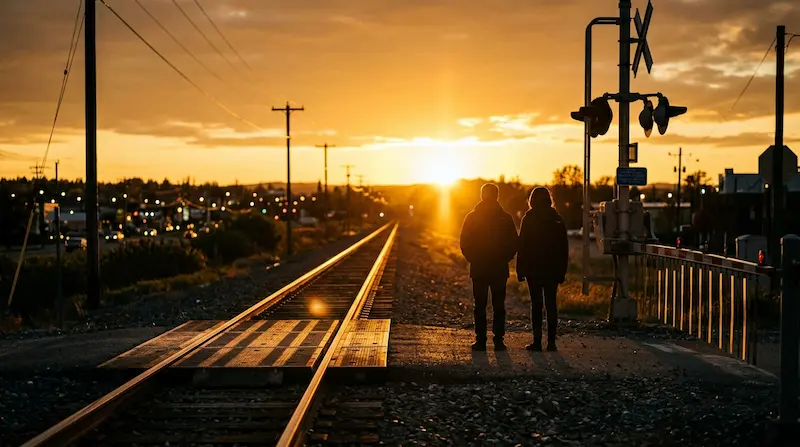
The most iconic filming spot is arguably the Shinchon-dong railway crossing in Gwangju. This is where Dong-man screams his own name into the void, where Eun-a first begins to see him as more than the group’s punching bag, and where the mood watches sync for the first time. If the drama becomes a classic — and with Park Hae-young’s track record, it might — this railway crossing will be its defining image, the way Misaeng’s office or My Mister’s underpass became synonymous with their respective dramas.
In Seoul, Bamvoo Bakery & Brewing in Hapjeong appears in scenes where characters attempt serious conversations over coffee. The Mapo District neighborhood is already known for trendy cafés and creative spaces, making it a natural fit for a drama about exhausted artists. Nearby, Yeonhuigung in Yeonhui-dong provides calmer, more elegant interiors. The Book Company in Yeoksam-dong serves as a corporate creative office — the kind of space where scripts become weapons and feedback becomes warfare. Viewers noted that scenes filmed there felt “more tense than action dramas.”
For commuter realism, the Nowon Station transfer corridor between Lines 4 and 7 delivers the exhausting everyday texture of Seoul transit. Summit Gallery in Daechi-dong, Gangnam provides the polished, high-status backdrop for scenes involving money and carefully controlled smiles. The Seogang Bridge and Han River Park handle the signature K-drama skyline shots where characters stare into the distance questioning their life choices.
Outside Seoul, Jeondeungsa Temple on Ganghwa Island brings spiritual calm and visual breathing room, while the surrounding Choji-ri farm roads contrast sharply with the city’s pressure. Praum House Wedding in Namyangju adds glamour to scenes where characters look beautiful while privately falling apart. And Megabox Goyang Starfield — a real multiplex — brings meta-humor to a drama about the film industry: fictional industry anxiety playing out inside an actual cinema.
Why Netflix No. 1 Despite 2.2% TV Ratings?
The gap between We Are All Trying Here’s TV performance and its OTT performance is one of the most striking examples of how the Korean viewing landscape has split in two. On JTBC, 2.2% put it well behind Perfect Crown‘s 11.1% on MBC. On Netflix, it overtook every other series in the country within a single day. The question isn’t whether people are watching — it’s where they’re watching.
The answer lies in the drama’s tone. We Are All Trying Here doesn’t deliver the kind of moment-to-moment excitement that keeps live viewers glued to their screens on a Saturday night. Instead, it slowly, methodically explores envy, jealousy, inferiority, and loneliness through characters who feel painfully real. This type of storytelling thrives on OTT platforms, where recommendation algorithms, word-of-mouth sharing, and the ability to pause, rewatch, and sit with difficult emotions all work in the drama’s favor.
Early viewer reactions reflected this split. Some said “it may divide audiences” and “the slow pace could be a barrier.” Others praised “Koo Kyo-hwan’s acting is excellent,” “it feels like watching my own life,” and “it’s perfect for late-night viewing.” Director Cha Young-hoon addressed the pacing directly, describing the series as one that offers “warmth, comfort, and empathy rather than instant gratification.”
The precedent is encouraging. My Mister in 2018 started with modest ratings before word-of-mouth turned it into a cultural phenomenon. My Liberation Notes in 2022 followed the same pattern. If We Are All Trying Here follows the Park Hae-young trajectory, the real surge will come around Episodes 4–6, when emotional investment compounds and viewers begin pulling in their friends. The drama’s core message — “Why do we live so painfully, as if we’ll never disappear?” moving toward “You are already enough” — is the kind of theme that doesn’t just attract viewers. It makes them evangelists.
Where to Watch & Full Air Schedule
We Are All Trying Here airs on JTBC every Saturday and Sunday at 10:40 PM KST. For international viewers, the drama is available on Netflix in selected regions, with episodes uploaded after the Korean broadcast. Each episode runs approximately 70 minutes — longer than the standard K-drama format, giving Park Hae-young’s dialogue room to breathe.
Here is the complete air schedule for all 12 episodes. Episodes 1–2 aired on April 18–19. Episodes 3–4 air on April 25–26. Episodes 5–6 on May 2–3. Episodes 7–8 on May 9–10. Episodes 9–10 on May 16–17. Episodes 11–12 — the series finale — air on May 23–24, 2026.
A note for viewers deciding whether to start now or wait: Park Hae-young’s dramas are historically not designed for binge-watching. The weekly wait between episodes is part of the experience — it gives you time to sit with the emotions, notice details you missed, and come back with fresh eyes. That said, if you prefer to binge, the full series will be complete on Netflix by late May.
5 thoughts on “We Are All Trying Here Complete Guide: Cast, Plot, Where to Watch (2026)”