Four episodes in, Perfect Crown has already shattered records with a 13.8% peak nationwide rating (and still climbing), ignited Reddit debates about Joseon history, and spawned fan theories wild enough to fill a royal court diary. If you’re watching IU and Byeon Woo-seok navigate this fictional 21st-century monarchy and thinking, “Wait, who’s plotting against whom?” — this guide is for you.
Below, we break down every major character’s hidden agenda, explain why Korean viewers see the regency storyline very differently from international fans, collect the most compelling fan theories circulating after Episode 4, and round it all off with the OST lineup, confirmed filming locations, and a web-novel prequel announcement most English-language sites haven’t covered yet.
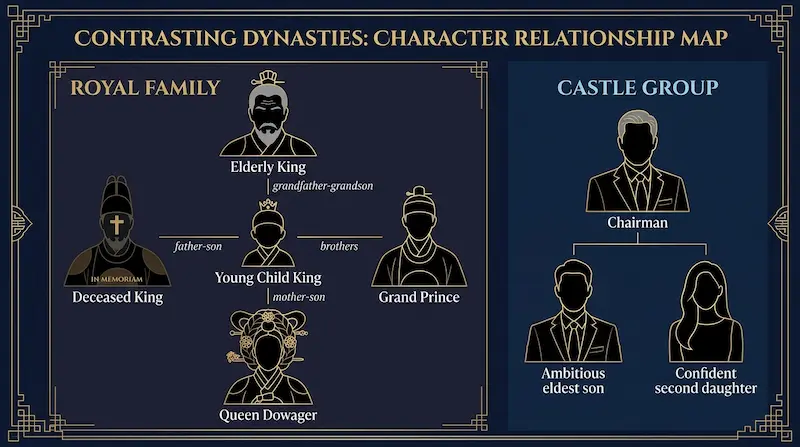
Character Relationship Map: Who Wants What — and Who’s Lying About It
The Royal Family
King Hee-jong (Son Jun-ho) is the patriarch — a former king whose reign ended before the drama begins. He had two sons, and the question of which bloodline truly rules still haunts every palace corridor.
King I-hwan (Seon-jong) (Sung-jun) was the eldest son and the previous king. He died in a palace fire under circumstances that remain the drama’s biggest mystery. Before his death, he reportedly wanted to abdicate — a decision that may have sealed his fate. He was married to Yoon Yi-rang and left behind an eight-year-old son, the current king.
King I-yun (Kim Eun-ho) is that eight-year-old — technically the reigning monarch but far too young to rule. He adores his uncle I-an, clinging to him at public events. Whether he’ll grow into a puppet or a real king is one of the show’s slow-burn questions.
Grand Prince I-an (Byeon Woo-seok) is I-hwan’s younger brother and the acting regent. The media has already branded him the “21st-century Grand Prince Suyang” — a loaded comparison to the Joseon-era prince who murdered his nephew to seize the throne. I-an insists he’s protecting the boy, not threatening him. Surface goal: keep his nephew safe, find personal freedom. Hidden motive: he genuinely seems to want out of royal life, but the drama keeps hinting he knows more about the palace fire than he lets on.
Queen Dowager Yoon Yi-rang (Gong Seung-yeon) is the deceased king’s widow and I-yun’s mother. She comes from the powerful Yoon family, which has produced four queens across generations. Her surface goal is protecting her son’s throne. Her hidden motive is far darker — the drama strongly implies she may have started the fire that killed her own husband after he announced plans to abdicate, potentially in favor of I-an. Gong Seung-yeon’s performance has become the drama’s breakout story; Korean media outlet OSEN reported that “her sageuk tone and restrained delivery are grabbing the drama by the collar and dragging it forward,” with many viewers calling her the real scene-stealer over the leads.
The Castle Group (Chaebol Family)
Chairman Seong Hyeon-guk (Jo Seong-yun) built Castle Group from nothing through ruthless means. He has two children from different mothers, and the inheritance battle between them provides the corporate half of the drama’s tension.
Seong Tae-ju (Lee Jae-won) is the eldest son and legitimate heir, married to Han Da-young (Chae Seo-an) from a prominent legal family. He’s positioned as the “safe” choice for succession but lacks his sister’s killer instinct.
Seong Hui-ju (IU) is the second daughter — brilliant, ruthless, and illegitimate. She’s the CEO of Castle Beauty and carries the “commoner” label despite being richer than most nobles. Her line “I’d rather win dirty than lose cleanly” defines everything about her approach, including her contract marriage proposal to I-an. Surface goal: gain unbreakable social status through a royal marriage. Hidden motive: she’s running from the trauma of a past relationship with a celebrity that left her publicly humiliated, pelted with eggs and stalked by paparazzi.
The Political Wild Card
Prime Minister Min Jeong-woo (Noh Sang-hyun) attended the Royal Academy with both I-an and Hui-ju. He’s I-an’s closest friend and most trusted political ally — on the surface. But when he heard about the contract marriage, his reaction wasn’t supportive — it was jealous. The Episode 5 preview confirms he proposes marriage to Hui-ju himself, which could either be a genuine confession or a calculated move to destabilize I-an. If he sides with the Queen Dowager, the power balance collapses entirely.
Key Supporting Figures
Choi Hyun (Yoo Su-bin) is I-an’s public aide and private right-hand man — loyal, slightly comedic, and the only staff member I-an kept around when he dismissed his royal security. Do Hye-jeong (Lee Yeon) is Hui-ju’s fiery chief secretary. Court Lady Choi Jin-suk (Park Joon-myun) arrived in Episode 3 to train Hui-ju in royal etiquette. And Lee Ae-rum (Choi Ji-su), a servant at I-an’s private residence, is confirmed as a mole working for the Queen Dowager — her betrayal arc is likely just getting started.
Worldbuilding Explained: How Does a 21st-Century Joseon Monarchy Work?
Perfect Crown’s premise is deceptively simple: what if the Joseon dynasty never fell and Korea became a constitutional monarchy? But the details of how this fictional system works — and where it deliberately breaks from real history — are what fuel the drama’s central conflicts.
In this alternate Korea, the monarchy is largely ceremonial, similar to the British or Japanese models. The royal family doesn’t hold direct political power; parliament and the Prime Minister run the government. However, the royals maintain enormous cultural influence and public prestige — enough to sway elections, shape business deals, and dominate media coverage.
The critical rule driving the plot is this: when a royal prince who is not the crown prince gets married, he must step down from all official duties and effectively leave palace life. This mirrors the real Japanese imperial system, where princesses who marry commoners lose their royal status. For I-an, marriage means losing his position as regent — which is exactly why the Queen Dowager keeps pushing him to marry, and exactly why Hui-ju’s proposal is both a business deal and a political weapon.
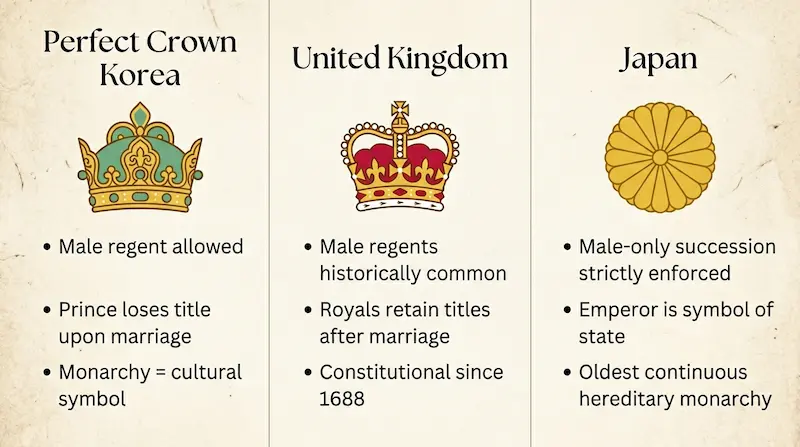
Where the drama departs from all real-world models — and from Korean history itself — is in having a male prince serve as regent. In every existing constitutional monarchy, and in all of Joseon’s historical record, this arrangement either doesn’t exist or was handled very differently. This is the detail that triggered the biggest viewer debate of the series so far, which we’ll explore in the dedicated section below.
One subtle worldbuilding touch that international viewers may have missed: in Episode 1, I-an’s aide Choi Hyun references a news headline calling the Grand Prince the “21st-century Grand Prince Suyang.” In Korean history, Grand Prince Suyang (later King Sejo) is one of the most infamous figures — he killed his own nephew, the young King Danjong, to seize the throne in 1453. The drama is deliberately telling us that the public within the show’s world doesn’t trust I-an’s intentions, even if the audience is meant to sympathize with him.
Fan Theories After Episode 4: Who’s Really Pulling the Strings?
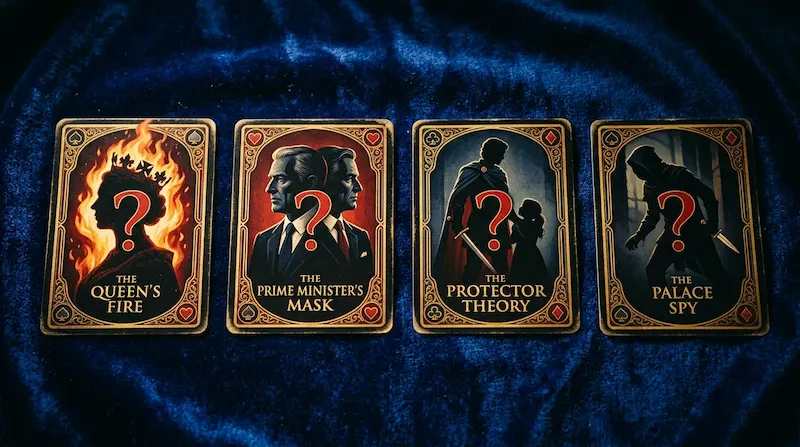
Theory 1: The Queen Dowager Killed Her Own Husband
This is the most widely discussed theory, and the drama isn’t exactly being subtle about it. The evidence so far: the palace fire that killed King I-hwan broke out after he announced plans to abdicate. Yi-rang escaped without so much as ash on her clothes. The camera lingers on her expression during fire-related conversations, and she panics whenever I-an gets close to the truth.
Reddit user neophanweb put it bluntly: “I got the impression that the queen is the one who set the last fire to kill her own husband to stop him from abdicating the throne. He was probably going to pass the throne over to the grand prince.” Another user, ravens_path, noted that “it was somewhat clear the ML had nothing to do with it, which she would know. And yet she lashed out like that. Their issues seem deeper.”
The counter-argument: two adults who were awake should have been able to escape a building fire. Either the show is oversimplifying, or Yi-rang did something worse than just starting the fire.
Theory 2: Prime Minister Min Jeong-woo Is Playing Both Sides
Jeong-woo is positioned as I-an’s oldest friend, but every scene with Hui-ju cracks that loyalty a little more. He didn’t congratulate I-an on the engagement — he went quiet. And the Episode 5 preview shows him directly proposing to Hui-ju, which could be read as either a heartfelt confession or a strategic move to remove her from I-an’s orbit.
The deeper theory: if Jeong-woo secretly cooperates with the Queen Dowager, he could orchestrate I-an’s removal from the regency and claim Hui-ju — gaining both political power and the woman he wants. His multi-generational political family background makes this plausible; he didn’t become Prime Minister at a young age on sincerity alone.
Theory 3: I-an Is Deliberately Drawing Fire to Protect His Nephew
Reddit user brasrmean offered an interesting read: I-an’s attention-seeking behavior — the rebellious outfits, the public stunts, the constant headlines — isn’t arrogance. It’s a deliberate strategy to keep the media and political enemies focused on him instead of the eight-year-old king. His aide Choi Hyun mentioned that I-an actually hates attention, yet he keeps attracting it.
Supporting details: I-an kneels to speak to his nephew at eye level, gently took the boy’s hand before a public stage appearance, and rushed to his side when summoned. The Suyang comparison works in reverse here — he’s aware of how dangerous he looks, and he accepts the criticism as the cost of keeping I-yun safe.
Theory 4: The Palace Spy Has a Bigger Role Coming
Lee Ae-rum is confirmed as the Queen Dowager’s mole inside I-an’s residence. But her storyline likely goes beyond simple espionage. If she develops genuine loyalty to I-an or sympathy for Hui-ju, her eventual betrayal of the Queen Dowager could become a pivotal turning point — or, alternatively, she could be the one who delivers the killing blow if the Queen Dowager orders something drastic.
The Regency Debate: Why Korean Viewers See It Differently
On April 12, a Reddit post titled “As a Korean, some historical inaccuracies in Perfect Crown were really immersion-breaking for me” by user Spiritual_Change_399 received 574 upvotes and 260 comments — making it the most active discussion thread about the drama to date. The core argument struck a nerve that most international viewers hadn’t considered.
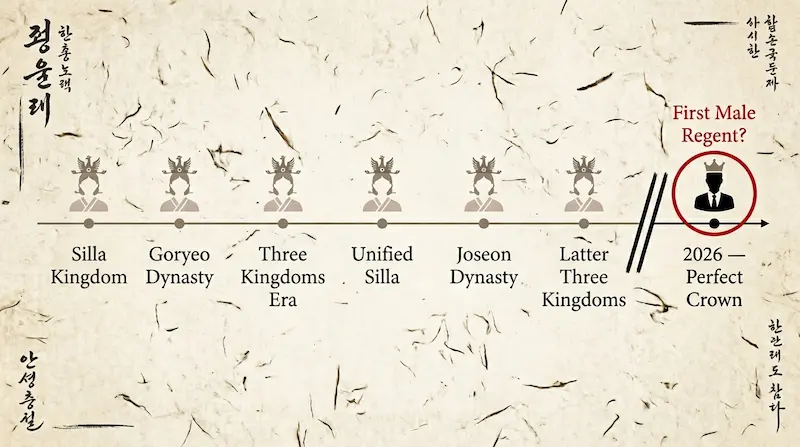
Here’s the historical context: during the Joseon dynasty (1392–1897), regency — called 수렴청정 (suryeom cheongjeong) — occurred seven times. In every single case, the regent was a woman: the king’s mother or grandmother. Male royal family members were strictly forbidden from political involvement because any male royal exercising power was considered a direct threat to the throne.
The most famous exception proves the rule. Heungseon Daewongun, the father of King Gojong, effectively ran the government in the 1860s–70s. But even he was never officially appointed regent — that title went to Queen Sinjeong. He operated behind the scenes, and the devastating power struggle between him and Empress Myeongseong became one of the factors contributing to Joseon’s eventual downfall.
This is why the Grand Prince Suyang headline in the drama hits Korean audiences so hard. Suyang is the most notorious example of what happens when a male royal does seize power — he murdered his young nephew King Danjong in 1453 and took the throne for himself. For Korean viewers, seeing I-an serve as regent isn’t just unusual; it triggers a deeply ingrained cultural alarm: “This is how coups start.”
The Reddit debate split into two clear camps. One side, represented by user Dreamchaser_seven (also Korean, 266 upvotes), argued: “This is just a fantasy version of Joseon. Even if somehow the Joseon Dynasty continued to present day, isn’t it logical to think it would have changed and adapted?” The other side, led by the original poster, countered that the drama could have solved the problem with a single line of dialogue — something like a constitutional amendment explaining why a male regent is now permitted — rather than treating it as natural.
The takeaway for international viewers: Perfect Crown deliberately chose a setup that feels normal through a Western lens (where male regents like England’s Prince Regent were common) but feels radical and even threatening through a Korean historical lens. Whether that’s a bold creative choice or a sign that the drama was written with global audiences in mind is still being debated — and that debate itself has become part of the show’s cultural footprint.
OST Lineup & Soundtrack Guide
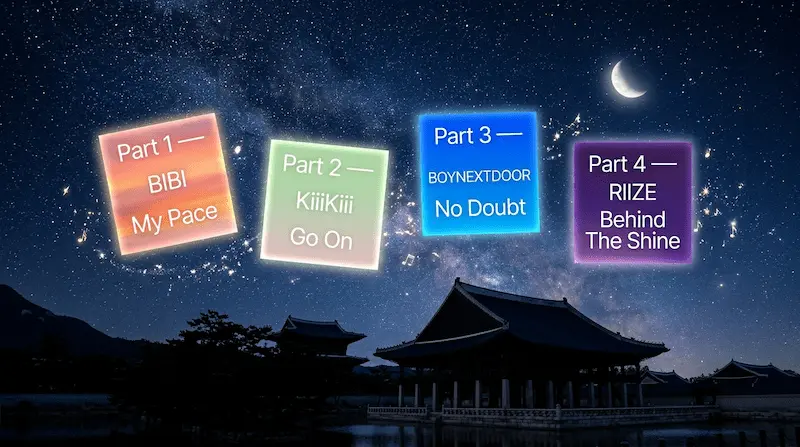
Kakao Entertainment announced the full OST lineup on April 1, and the releases have been rolling out alongside each episode pair. Here’s what’s dropped so far and what’s coming.
Part 1 — BIBI, “My Pace” (released April 10). The opening track sets the tone for Hui-ju’s character: defiant, self-assured, and unapologetic. The lyrics — “말 안 해도 알아, I can tell” (I can tell without you saying a word) — play during scenes where Hui-ju reads a room before anyone else does. It charted immediately upon release and became one of the most-discussed OST drops of the spring season.
Part 2 — KiiiKiii, “Go On” accompanies the quieter, more reflective moments between I-an and Hui-ju, particularly the scenes at his private residence. Part 3 — BOYNEXTDOOR, “No Doubt” landed during the baseball stadium kiss-cam sequence in Episode 4, adding youthful energy to one of the drama’s most viral moments. Part 4 — RIIZE, “Behind The Shine” was released on April 18 and underscores the palace intrigue scenes, with a moodier, more cinematic sound.
Still to come in future episodes: WOODZ (Cho Seung-youn), HANRORO, Sam Kim, hrtz.wav, So Soo Bin, and Im Joong Won of sonlmor. The full playlist is available on Spotify and YouTube.
Filming Locations You Can Actually Visit
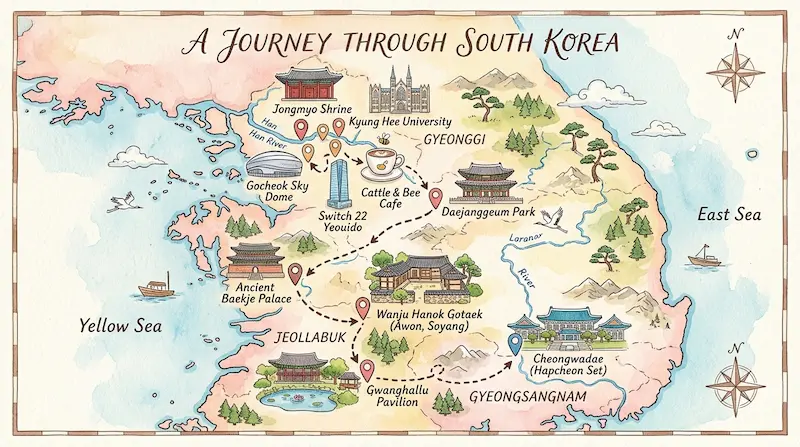
Perfect Crown filmed across ten confirmed locations spanning Seoul, Gyeonggi, Jeolla, and Gyeongsang provinces. The production leaned on the contrast between traditional palace architecture and sleek modern Seoul to mirror the drama’s core theme — a monarchy struggling to exist in the 21st century.
Gwanghallu Pavilion, Namwon serves as the symbolic retreat where characters go to think, scheme, and dramatically reconsider their lives. Its serene pond and classic architecture appear in multiple episodes. Jongmyo Shrine, Seoul — a UNESCO World Heritage Site dedicated to Joseon royal ancestral rites — provides the formal, weighty backdrop for scenes dealing with legacy and duty. Whenever the drama leans into “obligation versus desire,” this is the setting doing the emotional lifting.
Cattle & Bee at Yangjaecheon, Seoul is where the characters briefly drop their titles and pretend to be normal people. The café scenes sparked jokes online that “even their coffee breaks come with unresolved tension.” Switch 22, Yeouido handles the sleek corporate side — glass, steel, and polite smiles that feel anything but friendly.
Hapcheon Image Theme Park’s Cheongwadae Set was used for the elaborate palace interiors — a controlled filming environment that viewers noted looked “too perfect,” because it literally was purpose-built. Kyung Hee University adds its signature European-style campus for the academic and aristocratic scenes. MBC Daejanggeum Park, Yongin — MBC’s own outdoor historical drama set — provides additional traditional palace exteriors.
Baekje Cultural Land, Buyeo delivers the sweeping, cinematic palace shots designed for social media virality. Awon Gotaek and Soyang Gotaek, Wanju — traditional Korean hanok houses — create the intimate, still moments described by viewers as “calm but tense.” And then there’s Gocheok Sky Dome, Seoul — the modern baseball stadium that hosted Episode 4’s kiss-cam scene, a deliberate contrast that fans called “unexpected but oddly fitting.”
Web Novel Prequel: “Perfect Crown in Royal Academy”

Here’s a detail most English-language sites haven’t covered yet: on April 13, Kakao Entertainment announced a web novel prequel titled “21세기 대군부인 in 왕립학교” (Perfect Crown in Royal Academy), set to launch exclusively on Kakao Page on May 16, 2026.
The prequel spans 30 episodes and covers the Royal Academy school days of Hui-ju, I-an, and Min Jeong-woo — the period when the three characters first formed the bonds (and rivalries) that drive the drama’s present-day plot. Crucially, the web novel is being written by Yoo Ji-won, the same screenwriter behind the drama itself, ensuring narrative consistency with the TV series.
A few important clarifications: Perfect Crown is not based on any existing webtoon or web novel. It’s an original drama. Yoo Ji-won won MBC’s drama screenplay competition with this script. The web novel is a post-drama expansion, not the source material — it’s Kakao Entertainment building what the Korean media is calling an “IP value chain” around the show’s success.
For context, this is the reverse of the typical K-drama pipeline. Usually, a popular web novel or webtoon gets adapted into a drama. Here, the drama came first and proved popular enough (11.1% nationwide by Episode 4) for the publisher to invest in expanding the universe backward. If you’re craving backstory on why Jeong-woo’s loyalty to I-an might be more complicated than it appears, or how Hui-ju earned her “Castle Group’s mad dog” nickname, the Royal Academy prequel is likely where those answers will live.
What to Expect in Episodes 5–6
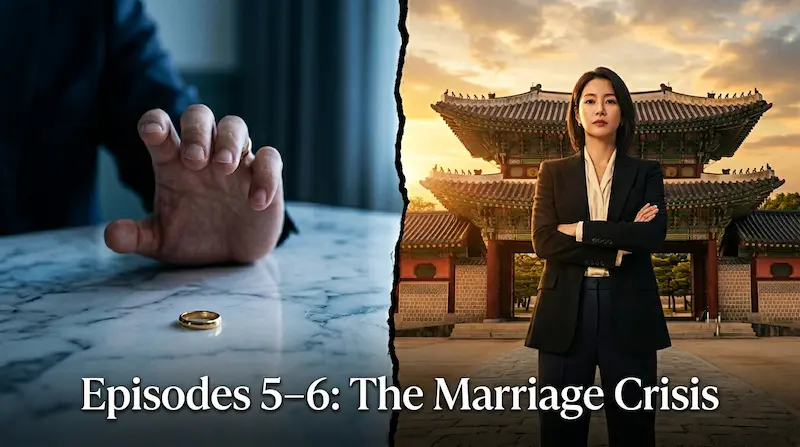
The Episode 5 preview — released by MBC on April 19 — drops three major plot threads that promise to shake the drama’s power dynamics.
First, I-an tries to call off the contract marriage. After the car crash in Episode 4 left him bleeding and Hui-ju shaken, he overhears her assistant urging her to walk away from the arrangement. Realizing that his world is putting her in danger, he tells her they should postpone the wedding. But Hui-ju, true to character, refuses to retreat. She confronts him directly: if they truly want to achieve their goals, neither of them can afford to waver.
Second, Prime Minister Min Jeong-woo proposes marriage to Hui-ju. Whether this is a genuine romantic confession or a strategic play remains unclear, but it directly challenges I-an’s position and validates Fan Theory #2 above. The love triangle that’s been simmering since Episode 1 is about to boil over.
Third, the preview tagline — “역시 부인이 임금이야” (“As expected, the wife is the king”) — hints that Hui-ju will start asserting control over the royal household in a way nobody anticipated, potentially stepping into a power role that the Queen Dowager considers her own territory.
Episodes 5–6 air on Friday, April 24 and Saturday, April 25 at 9:40 PM KST on MBC, with simultaneous streaming on Disney+ (international) and Hulu (US).
More Perfect Crown Coverage on KDrama Recap Hub
- Perfect Crown Complete Guide: Cast, Ratings, Where to Watch
- Perfect Crown Fashion & Chemistry: IU × Byeon Woo-seok Style Guide
- Perfect Crown Episodes 3–4 Recap: The Royal Romance Heats Up
- http://Perfect Crown Episode 1 Recap
- Perfect Crown Episodes 7-8 Preview
- Perfect Crown OST Guide: Every Song, Artist & Scene
- Byeon Woo-seok Style Guide: Boyfriend Looks & Prada Fits
2 thoughts on “Perfect Crown Character Guide, Fan Theories & Deep Dive (2026)”