The We Are All Trying Here episode 10 recap marks the moment this quiet ensemble drama stopped being a slow burn and started being a phenomenon. With a nationwide rating leap to 5.1% — a self-best — episode 10 delivered four story beats that critics and viewers are still dissecting: veteran actor No Gang-sik signing onto Dong-man’s debut film, a sub-zero snowstorm car crash, Eun-a’s quiet but devastating identity confrontation, and the long-dreaded return of Oh Jung-hee. However, ratings alone don’t explain why this episode landed so hard. Park Hae-young’s script finally pulled the thematic threads — worthlessness, identity, family wounds — into a single weave, and Koo Kyo-hwan, Go Youn-jung, Han Sun-hwa, Sung Dong-il, and Bae Jong-ok delivered the kind of restrained ensemble work that Korean television rarely sustains for ten consecutive hours.
For context on the full cast and premise, see our We Are All Trying Here Complete Guide. If you missed last night’s setup, the Episode 9 Recap is essential — episode 10 directly cashes in those threads. Official broadcast info is available on the JTBC program page.
The Ratings Breakthrough: 5.1% and What It Means
Episode 10’s 5.1% nationwide rating isn’t just a number — it’s a structural shift. Furthermore, the show began at low-3% territory and has climbed steadily without a single down-week. Specifically, that trajectory is rare for a JTBC weekend drama with no high-concept hook, no chaebol romance, no thriller spine. Instead, viewers came for character writing and stayed for the slow accumulation of empathy.
Consequently, the 5.1% figure tells us something about Korean viewers in 2026: there is still a substantial audience that rewards literary television when it’s executed with patience. Therefore, the comparison to Park Hae-young’s earlier works — My Mister, My Liberation Notes — is not lazy critic-shorthand. It’s accurate. This show is building the same kind of devoted, word-of-mouth audience.
Why the Mid-Run Surge Matters
Mid-run rating surges in Korean dramas usually signal one of two things: a plot twist that hooks casual viewers, or a critical mass of viewers finally trusting the show enough to recommend it. Episode 10 is clearly the second kind. Meanwhile, social media chatter shifted this week from “what is this show” to “you have to watch this show” — the exact inflection point every quiet drama needs.
No Gang-sik Signs On: Sung Dong-il Enters the Story
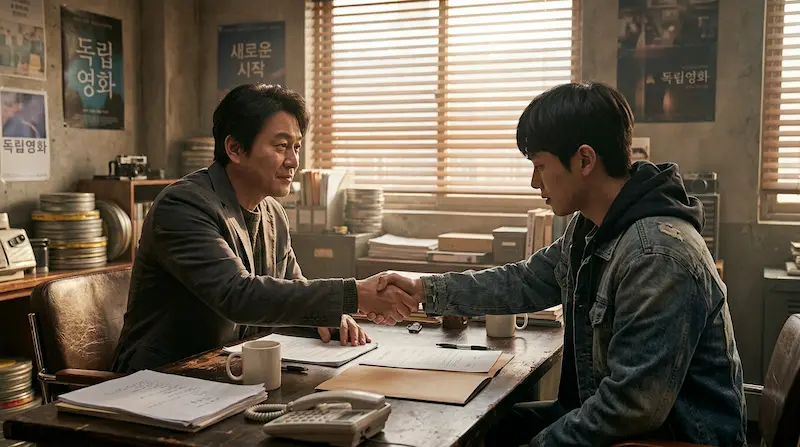
The casting handshake between Dong-man and veteran actor No Gang-sik (Sung Dong-il) is the episode’s quietest scene and its most consequential. However, Park Hae-young writes the moment with almost no dialogue. No Gang-sik reads the script. He looks up. He says, essentially, yes. That’s it. Yet the scene carries the entire weight of the previous nine episodes.
Specifically, Dong-man has spent ten episodes being told — directly and indirectly — that he is not enough. No Gang-sik signing on is the first external validation that doesn’t come with a catch. Furthermore, Sung Dong-il plays the moment with a kind of weary generosity that suggests his character recognizes something in Dong-man that the industry hasn’t yet caught up to.
Sung Dong-il’s Restraint
Sung Dong-il is a famously warm screen presence. Here, he dials it down to near-zero. Consequently, the warmth comes through in tiny gestures — a half-smile, the way he sets the script down. This is exactly the kind of casting choice that signals a writer’s confidence in their material. Park Hae-young doesn’t need Sung Dong-il to be Sung Dong-il. She needs him to be No Gang-sik, and he obliges.
The Snowstorm Crash: Dong-man’s Promise to Eun-a
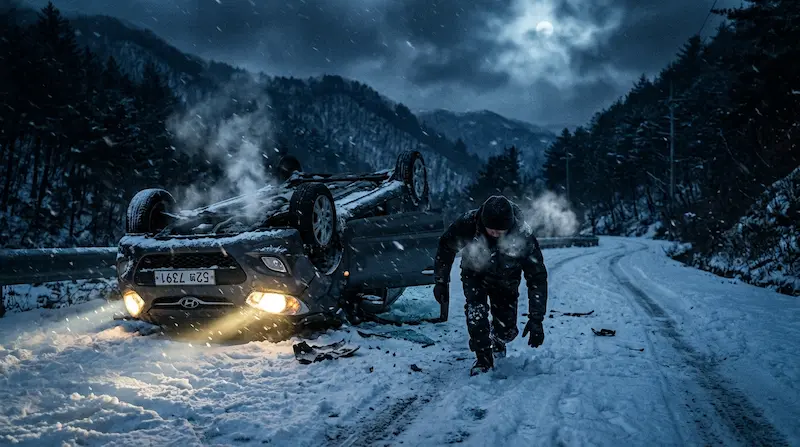
The sub-zero snowstorm sequence is the episode’s most visually arresting moment, and also its most thematically loaded. Dong-man drives through a –20°C storm because he promised Eun-a he would be somewhere. The car flips. He crawls out. The camera holds on him too long.
However, the scene isn’t about the crash. It’s about the promise. Specifically, Dong-man has been a character who breaks small promises throughout the series — to his brother, to his agent, to himself. Therefore, the one promise he refuses to break is the one to Eun-a, and the cost of keeping it is nearly fatal. Park Hae-young’s writing here is almost cruel in its precision: the moment Dong-man finally chooses to be a person who keeps promises, the world tries to kill him for it.
Koo Kyo-hwan’s Physical Performance
Koo Kyo-hwan plays the post-crash moment with no theatrics. He's cold. Confusion sets in. Then he tries to remember why he was driving. Meanwhile, the camera lingers on his breath in the freezing air — a visual echo of the “worthlessness” thesis that has animated the series. The character is alive but barely registering it, which is, of course, exactly the show’s central condition.
Eun-a’s Identity Reveal: The Sieda Moment
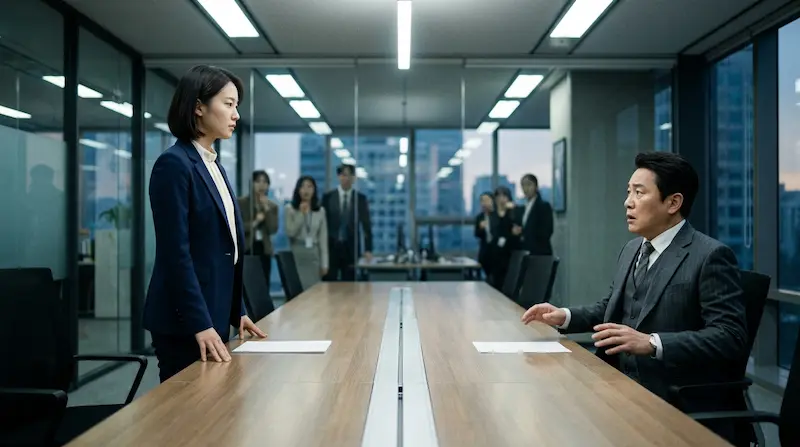
Variety Korea coined the term “sieda moment” for the scene in which a wronged character finally — quietly, devastatingly — says the thing they’ve been holding back. Eun-a’s confrontation with the company CEO who has called her “Yeong-sil” for years is this episode’s sieda moment, and it’s the best one the show has produced.
However, what makes the scene work is what Eun-a doesn’t do. She doesn’t yell. Tears don’t come either. Instead, she corrects him once, calmly, and then she leaves. Specifically, Go Youn-jung plays the exit as if she’s been rehearsing it for years — and within the show’s logic, she has. Furthermore, the CEO’s face after she leaves is the real payoff: he understands, for the first time, that he was the small person in the room.
Go Youn-jung’s Career-Defining Beat
Go Youn-jung has been good throughout this series, but episode 10 is the one that will be on her reel for the next decade. Therefore, the restraint she’s showing here — the refusal to perform victimhood, the choice to play strength as quietness — is the kind of acting choice that wins year-end awards. Consequently, expect her name on every 2026 Baeksang shortlist conversation.
Oh Jung-hee’s Return: The Mother-Daughter Trauma Resurfaces
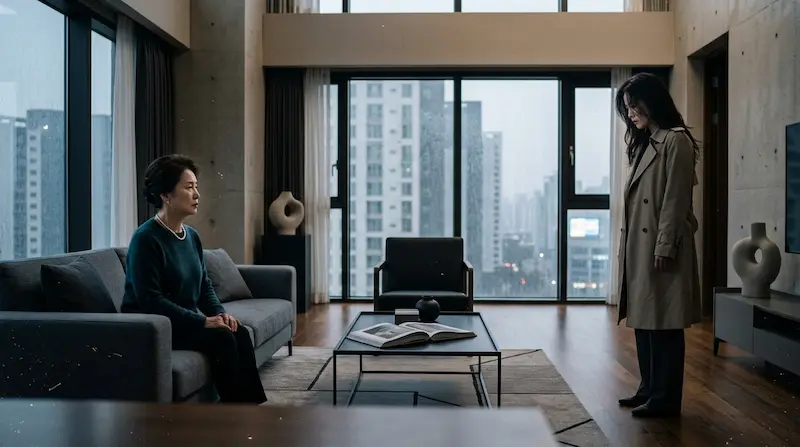
Bae Jong-ok’s Oh Jung-hee has been teased since episode 4, and her arrival in episode 10 is exactly as cold as the snowstorm. However, Park Hae-young writes Oh Jung-hee not as a villain but as a wound that learned to speak. Specifically, the woman is composed, articulate, even gracious — and every word she says to Eun-a draws blood.
The mother-daughter scene in the upscale apartment is staged with brutal restraint. Furthermore, Oh Jung-hee sits. Eun-a stands. The camera doesn’t move. The two actresses do everything in the silences between lines. Meanwhile, Bae Jong-ok plays cruelty as a kind of elegance, and it’s the most disturbing performance choice in the episode.
The “친딸” Subplot with Mi-ran
The parallel thread — Oh Jung-hee taking interest in Mi-ran (Han Sun-hwa) and treating her with the warmth she withheld from Eun-a — is the episode’s cruelest structural irony. Consequently, the “친딸” (real daughter) language Oh Jung-hee deploys toward Mi-ran is the precise wound she knows will land hardest. Therefore, Park Hae-young is setting up the final two episodes as a triangulation of wounded women, and the architecture is devastating.
Park Hae-young’s Endgame: The Final Two-Episode Setup
With only two episodes remaining, episode 10’s job is to load every gun. However, Park Hae-young has loaded them with characteristic patience. Specifically: Dong-man has his film greenlit but is physically injured; Eun-a has reclaimed her name but lost her mother again; Mi-ran is being courted by the woman who destroyed her best friend; and Hwang Jin-man’s intervention from episode 9 is still working its way through the family.
Furthermore, the preview for episode 11 — Eun-a opposing Oh Jung-hee’s casting, a plot hook involving Ma Jae-young and CEO Choi — suggests the endgame will be about the cost of saying no to people who have power over you. Therefore, this is the thesis Park Hae-young has been circling for ten episodes, and she’s finally letting her characters arrive at it.
The Two-Episode Math
Twelve-episode runs leave no room for slack. Consequently, episode 11 will likely resolve the casting confrontation and the family revelations, while episode 12 will deliver the emotional reckoning. Meanwhile, the show’s track record suggests the finale will not be tidy. Park Hae-young’s finales rarely are. Instead, expect ambiguity, expect grace, expect at least one character to be left mid-sentence.
The Ensemble Cashes In: Why Episode 10 Felt Different
What separates episode 10 from the previous nine is the ensemble finally functioning as a single organism. However, every actor — Koo Kyo-hwan, Go Youn-jung, Han Sun-hwa, Sung Dong-il, Bae Jong-ok, Park Hae-jun — calibrated their performance to the same low key. Specifically, no one is acting against anyone else. They’re acting with each other, which is the rarer and more difficult thing.
Furthermore, this is the kind of ensemble cohesion you usually see only in long-running prestige cable dramas, not in a 12-episode network run. Therefore, credit goes equally to director Cha Yeong-hun, who has been quietly composing some of the most thoughtful frames on Korean television this year. Consequently, the show’s visual language — muted palettes, held shots, soft natural light — gives the actors room to do the small work that doesn’t survive in busier productions.
Why This Drama Will Outlast Its Run
Some dramas are events. Others are objects. We Are All Trying Here is the second kind — the kind people will return to in three years, in five years, when they need to remember that their worthlessness is shared and survivable. Meanwhile, episode 10 was the episode that confirmed it. Compare this trajectory to the very different but equally satisfying ensemble work in our Episode 8 Recap, and to the wholly different register of last weekend’s Perfect Crown Episode 12 Finale Recap.
Two episodes remain. The We Are All Trying Here episode 10 recap ends not on a cliffhanger but on a held breath. That is, characteristically, exactly how Park Hae-young wants it.