
The Perfect Crown episode 12 finale recap covers the night the MBC romantic comedy delivered on every promise its title implied. Specifically, Yi Wan dismantled the constitutional monarchy from inside the throne, defeated Prime Minister Min Jung-woo’s last attempt to block the abolition, reclaimed his birth name, and sealed the series with a baseball stadium kiss. Furthermore, the finale pushed Perfect Crown to a self-best 13.8% nationally and 14.1% in the Seoul metropolitan area. Therefore, episode 12 closed the twelve-episode run on a rising curve, capping six consecutive weeks atop the Korean drama buzz index.
If you need the wider context, our Perfect Crown Complete Guide covers the cast, premise, and full episode arc. Additionally, the Episode 11 Recap sets up the coronation and gun confrontation that pay off in this finale.
Where Episode 11 Left Off
Episode 11 closed on Yi An’s coronation. Specifically, the grand prince ascended to the throne with a private intention his court did not yet share — to use the crown’s authority to abolish the constitutional monarchy itself. Therefore, episode 12 inherited a single structural question: could a king actually dissolve the institution that crowned him without triggering a counter-coup?
Going into the finale, viewers also carried over the unresolved Prime Minister Min thread. Furthermore, Hui-ju had extracted Min’s confession at gunpoint in episode 11, but the confession alone did not remove him from power. Consequently, the finale’s first act had to resolve the legal-political endgame before the romance beats could land.
Prime Minister Min’s Final Stand
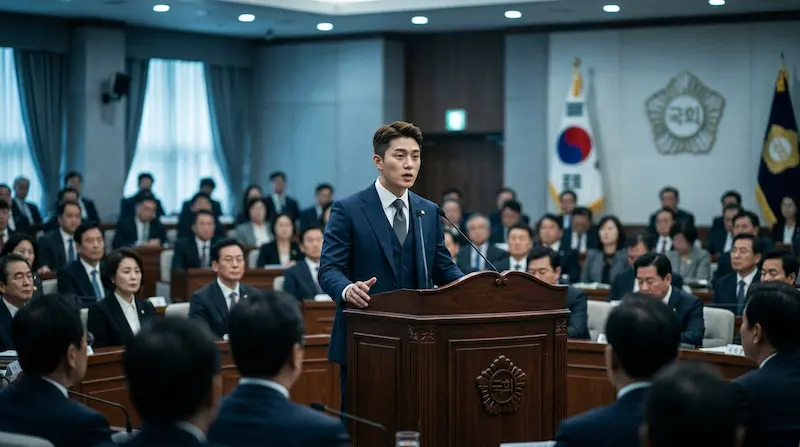
Yi Wan dismantles the constitutional monarchy — defeating Prime Minister Min's resistance.The opening act delivers Min’s last attempt to hold the line. Specifically, he confronts Yi Wan directly, framing the monarchy as worth preserving and arguing that any king who dissolves his own throne betrays the institution that legitimized him. Therefore, the scene plays as ideological combat, not a physical one.
“A King Without Public Support Is Not Needed”
Yi Wan returns Min’s own words to him. Furthermore, the line that anchored the finale’s pre-release clips — “국민의 지지를 받지 못하는 왕은 필요치 않다” (“A king without public support is not needed”) — was originally spoken by Min himself in an earlier episode. Consequently, the writers use the callback to flip Min’s logic against him, and the moment lands as the finale’s cleanest ideological pivot.
How Min Falls
Korean entertainment outlets specifically described Min’s fate as being “처단” — neutralized rather than killed. Furthermore, the show stages his defeat through legal and political mechanisms rather than violence, which keeps the finale tonally consistent with the rom-com surface. Therefore, Min exits the story as a defeated power broker rather than a martyr, and the distinction matters for the abolition that follows.
The Monarchy Abolition: Yi Wan’s Final Move
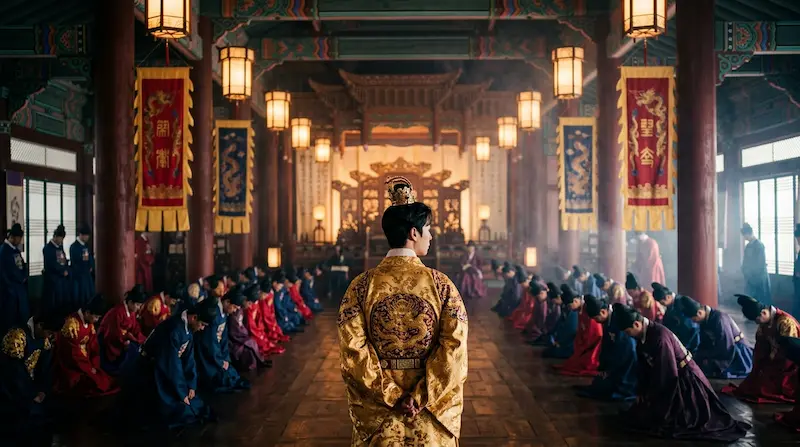
With Min neutralized, the finale moves into its central political beat. Specifically, Yi Wan signs the legislation that dissolves the constitutional monarchy, and the camera holds on the signature long enough for the audience to feel the procedural weight of the moment. Therefore, the show fulfills the promise its premise has been pointing at since episode 1.
The Procedural Coronation
The finale clarifies why episode 11’s coronation was necessary. Furthermore, only a sitting king holds the legal authority to formally dissolve the monarchy, which means Yi Wan’s ascension was always a means rather than an end. Consequently, the gonryongpo he wore in episode 11 functioned as a tool, not a trophy.
The Critical Reception Split
The abolition itself divided viewers. Specifically, some Korean and international reviewers called the resolution rushed, with one English-language K-drama critic describing it as an “absurd royal twist” deployed to enable the rom-com finale. However, domestic press largely framed the move as thematically consistent with the show’s six-week argument that birth status should not determine destiny. Therefore, the abolition reads differently depending on whether viewers came for the romance or the political fantasy.
Reclaiming the Name: From Grand Prince Yi An to Yi Wan
The finale’s quietest beat is also its most loaded. Furthermore, the man the audience has known as Yi An — Grand Prince Yi An — reclaims his birth name, Yi Wan, once the monarchy is formally dissolved. Therefore, the title “Grand Prince” stops applying mid-finale, and the show acknowledges the shift through how other characters address him.
Why the Name Change Matters
The name reclamation works as the inverse of Hui-ju’s arc. Specifically, Hui-ju spent twelve episodes refusing to let her commoner birth define her, and Yi Wan spent the same twelve episodes refusing to let his royal birth define him. Consequently, the finale converges their arcs at the point where neither character is defined by the status they were born into.
The Symmetry the Writers Wanted
Korean entertainment press flagged the name change as the show’s clearest thematic statement. Furthermore, the writers had planted the name “이완” in scattered earlier scenes — in a contact entry, in a childhood flashback — without explaining its significance. Therefore, the finale rewards close viewers without alienating casual ones, which is the structural balance the show maintained throughout its run.
The Baseball Stadium Kiss: The Ending Shot
The finale’s last sequence delivers the image MBC used in every promotional package. Specifically, Yi Wan and Hui-ju kiss publicly at a baseball stadium, and the kiss reads as the inverse of every secret palace embrace the show staged in earlier episodes. Therefore, the location is the point — a public space, freely chosen, with no court protocol governing the gesture.
The Decalcomania Composition
The shot is framed as a deliberate mirror of the pilot’s opening sequence. Furthermore, episode 1 had staged a hidden palace moment between the two leads using a specific camera angle, and the finale recreates that angle in reverse — same framing, opposite setting, opposite emotional register. Consequently, the kiss functions as visual punctuation, closing the loop the pilot opened.
Why the Stadium
The baseball stadium choice is not incidental. Specifically, baseball in Korean dramas often signals ordinary public life — the most democratic of national pastimes — and using it as the kiss location underlines the show’s argument about chosen ordinariness. Therefore, the ending reads as a couple choosing public commonness over private privilege.
The Ordinary Newlyweds: Life After the Palace

The finale’s denouement shows Hui-ju and Yi Wan in domestic routine. Furthermore, the show explicitly stages them as “평범한 부부” — an ordinary couple — preparing breakfast, sharing morning coffee, navigating the small frictions of cohabitation. Therefore, the epilogue argues that ordinariness, once chosen rather than imposed, becomes its own kind of luxury.
Hui-ju’s Career Continuity
The epilogue also confirms that Hui-ju retains her CEO position outside the dissolved royal household. Specifically, the show frames her continued chaebol leadership as the natural extension of who she always was, not a concession to the romance. Consequently, the finale avoids the genre trap of dissolving the female lead’s career into the marriage.
The Coronation Controversy Footnote
Domestic press did flag one lingering issue. Furthermore, episode 11’s coronation sequence had used the phrase “천세 천세 천천세” — a vassal-state honorific historically associated with tributary kingdoms — which contradicted the show’s independent-nation worldbuilding. Therefore, several Korean outlets cited the choice as the finale’s residual “오점” (blemish), even while praising the broader resolution.
Ratings and Reception: 13.8% Self-Best Finale
The finale cleared 13.8% nationally and 14.1% in the Seoul metropolitan area, marking the show’s highest numbers of the entire run. Furthermore, the trajectory across twelve episodes — from a 7.8% premiere to a 13.8% finale — represents one of the cleanest upward curves any Korean broadcast drama has charted this year. Therefore, Perfect Crown closes as the defining broadcast drama of the spring window.
Six Weeks Atop the Buzz Index
Beyond linear ratings, the drama held the number one position on Korea’s drama buzz index for six consecutive weeks. Furthermore, the finale extended that streak into the post-broadcast cycle, with social media engagement continuing into the following day. Consequently, the show’s cultural footprint outlasted its broadcast schedule.
What Comes Next
A special episode has been confirmed for post-finale broadcast, extending the twelve-episode run into a 12+1 format. Specifically, the special will revisit unresolved supporting character threads and offer additional behind-the-scenes context for the finale’s political beats. Therefore, viewers still have one more installment to anticipate before Perfect Crown fully closes its run.
For the soundtrack that scored the rescue and coronation sequences, our Sam Kim “If You Were My World” OST guide covers the standout ballad of the late run. Meanwhile, the Episode 10 Recap revisits the fire cliffhanger that detonated across episodes 11 and 12. For official broadcast information, the MBC Perfect Crown program page lists the special episode schedule.
For more on the costumes and fashion analysis, read our Perfect Crown Fashion Analysis.