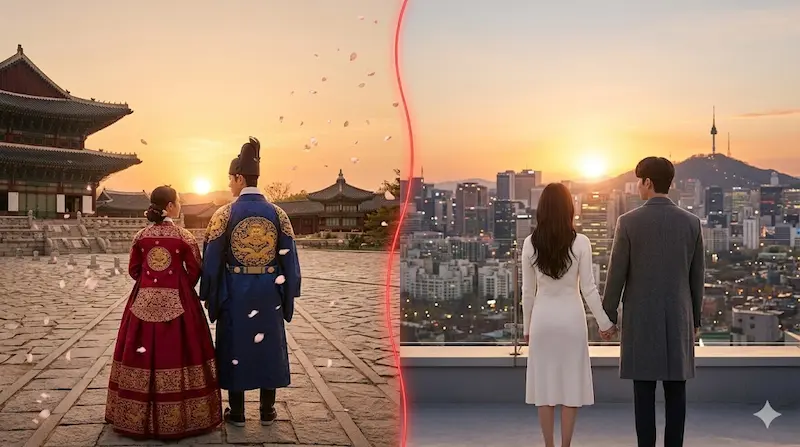
My Royal Nemesis episode 14 closed the book on the most-talked-about SBS drama of 2026. The June 20 finale pulled in a nationwide rating of 11.8% with a peak moment of 14.1%, capping nine consecutive weeks of self-best growth on Nielsen Korea. Meanwhile, Korean and international viewers spent the weekend debating one question — was that ending earned, or was it a gift?
This My Royal Nemesis episode 14 finale recap walks through every major beat. We cover Seo-ri’s arrival in 1724 Joseon, the shaman’s warning that explains the entire return, the eunjangdo reckoning with Anjong, the arrow and the river, Mun-do’s public collapse in modern Seoul, and the rooftop reunion that closed the fate loop for good. Furthermore, this recap delivers the My Royal Nemesis ending explained breakdown that international viewers have been searching for since the credits rolled.
Where Episode 13 Left Us — The Stabbing Cliffhanger
Before diving in, here is the setup. Episode 13 ended with two impossible problems — Cha Se-gye bleeding out on a rainy Seoul backstreet after Choi Mun-do’s knife found its mark, and Shin Seo-ri stepping back through the gate of falling cherry blossoms into 1724 Joseon. For full context, see our Episode 13 recap, the Episode 12 recap, and the earlier Episode 11 recap.
The finale picks up the same night on both timelines simultaneously. In modern Seoul, paramedics are loading Se-gye into an ambulance. In 1724 Joseon, Seo-ri is opening her eyes inside Dan-sim’s body for the first time in three hundred years.
The Finale’s Record-Breaking 11.8% Rating
Before the plot, the headline. The June 20 broadcast hit 11.8% nationwide with a peak of 14.1%, marking the show’s ninth consecutive self-best rating. According to Nielsen Korea, this places My Royal Nemesis among the top three highest-rated SBS Friday-Saturday finales in the past three years. Indeed, the ratings curve tells you exactly when audiences locked in — the show opened at 4%, broke 7% by episode 8, climbed past 10% with episode 12’s identity reveal, and never looked back.
The international numbers track similarly. Netflix Korea reported the finale among the day’s top three across nineteen countries within twelve hours of release. Therefore, whatever else this show was, it knew how to land a finale.
Seo-ri Wakes Inside Dan-sim’s Body in 1724 Joseon
The episode opens with Seo-ri’s eyes opening to lantern light. She is wearing a court lady’s blue hanbok. Her hair has been pinned with a binyeo she has not touched in three centuries. Furthermore, she is alone in a small palace antechamber that she immediately recognizes — this is the room where Dan-sim was held the night she died.
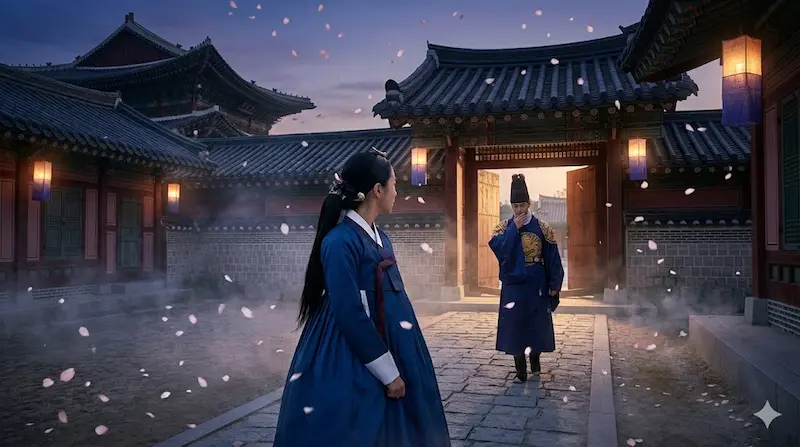
Seo-ri sits up slowly, presses her hand to her chest, and realizes she can feel Dan-sim’s heartbeat. This is not a soul possession the way the modern-era arc was structured. Instead, Seo-ri has been pulled back into Dan-sim’s body at the exact moment before history claimed it. She has hours, possibly less, to rewrite what happens next.
The Reunion with Crown Prince Lee Hyun
The reunion lands in the first ten minutes. Crown Prince Lee Hyun — Se-gye’s Joseon-era self, played by Heo Nam-jun in flashback robes for the entire hour — pushes through the antechamber door and stops cold when he sees her. He had thought she was dead. He had been preparing to die himself. Consequently, Seo-ri does not waste time on explanations. She tells him, plainly, that she has come back from the future to break the loop, and she needs his help to do it before dawn.
Lim Ji-yeon plays the reunion with extraordinary restraint. There is no embrace, no tears, just the small detail of Lee Hyun’s hand reaching toward her face and stopping a centimeter short, the way someone touches a memory they are afraid to disturb. This is the kind of writing that earned the show its 14.1% peak.
The Shaman’s Warning — Why Seo-ri Had to Return
The finale answers a question episodes 11-13 had only hinted at — why was returning to Joseon the only option? The shaman who first explained the fate loop appears in a brief flashback to recontextualize her earlier warning. Specifically, she had told Seo-ri that Se-gye was destined to die, whether in Joseon or in the present. The loop did not care which timeline ended the tragedy. It only required that one of them did.
Therefore, the only way to save modern Se-gye was to save Joseon Lee Hyun first. If Dan-sim and Lee Hyun survived 1724, the loop would no longer demand a payment in 2026. This is the mechanism the entire series had been building toward, and the finale finally states it directly.
Anjong’s Secret Letters and the Eunjangdo Reckoning
The villain who killed Dan-sim and Lee Hyun in the original timeline was Anjong, the corrupt minister who had been quietly orchestrating the conspiracy against the crown prince for years. The finale dedicates twenty minutes to dismantling him.
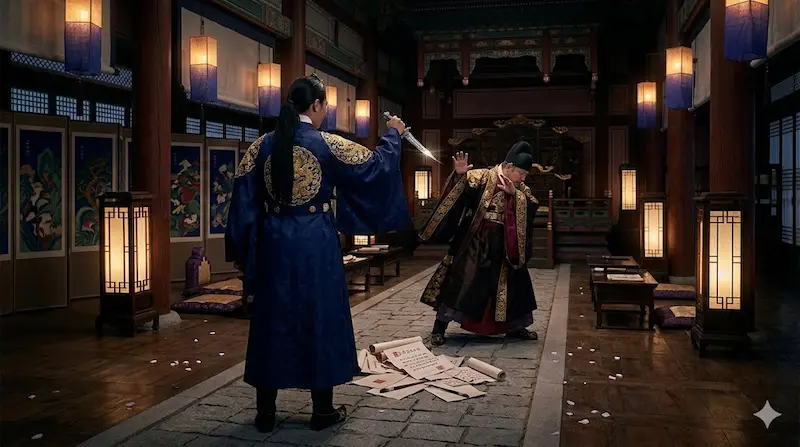
Seo-ri remembers something Dan-sim had discovered hours before her death — Anjong kept his coded correspondence with foreign agents hidden inside a lacquered chest in the royal council chamber. The original Dan-sim had been killed before she could expose the letters. The new Dan-sim, armed with three hundred years of hindsight, goes directly for the chest.
How the Original Conspiracy Worked
For viewers who lost track of the political plot, here is the structure. Anjong had been selling state secrets to a neighboring power in exchange for personal fortune and a guarantee of his family’s position in the next reign. Crown Prince Lee Hyun, once enthroned, would have stopped him. Therefore, Anjong’s solution was to discredit and execute the prince before his father’s death — using a manufactured scandal involving Dan-sim as the trigger. Notably, in the original 1724 timeline, the conspiracy succeeded. Both Dan-sim and Lee Hyun died within hours of each other.
The eunjangdo — the ornamental silver dagger Joseon noblewomen carried as a symbol of personal honor — becomes the finale’s emblem of corrected history. Lee Hyun draws his own and uses it not for violence but to slash open Anjong’s lacquered chest and scatter the letters across the council floor. Consequently, the truth comes out in front of every minister in the room. Anjong is arrested before dawn.
The Arrow, the River, and the Rewritten History
History does not surrender quietly. Anjong’s last agents, knowing the game is lost, fire on Dan-sim and Lee Hyun as they cross a wooden bridge toward the palace gate. An arrow finds Dan-sim’s shoulder. She staggers against the railing. The bridge gives way.

Both of them fall into the river below. For a long moment, the camera holds on the empty bridge while the current carries them downstream. This is the visual echo of the original tragedy, and the show makes sure the audience feels every second of it.
Why This Time Was Different
In the original 1724 timeline, Dan-sim died from the arrow wound and Lee Hyun drowned trying to reach her. The finale rewrites both outcomes through one specific change. Specifically, the new Dan-sim turned her body at the last instant so the arrow caught her shoulder instead of her chest. Furthermore, Lee Hyun, warned in advance by Seo-ri about the bridge collapse, was wearing his ceremonial armor underneath his outer robes — armor heavy enough to anchor him through the current and pull Dan-sim with him to the shore.
These are small mechanical changes, but they are exactly the kind of careful plotting the show has rewarded. The loop did not require a grand miracle to break. It only required one person who knew where the original story had failed.
Mun-do’s Public Collapse in Modern Seoul
While the Joseon arc resolves, the modern timeline runs in parallel. Choi Mun-do, having stabbed Se-gye the night before, holds a press conference to control the narrative. The official line is self-defense. Furthermore, Mun-do blames Dal-su for the original kidnapping of his son. Throughout the briefing, he positions himself as a wronged father acting in extremity.

The conference unravels in real time. A reporter — one Mun-do had bribed for years — asks the wrong question. Subsequently, his composure cracks. The footage of Mun-do’s face during that question becomes the meme that travels across Korean social media within the hour.
The Press Conference That Ended Him
Jang Seung-jo has played Mun-do as controlled menace for fourteen episodes. The finale lets him unravel publicly, and he plays it with the same precision he used on the way up. By the end of the press conference, Mun-do has admitted to enough on camera that his lawyers physically pull him from the podium. He is arrested by the following morning. His company collapses by the end of the week. The reckoning is total.
Seo-ri Returns — The Modern Seoul Reunion
In Joseon, Dan-sim and Lee Hyun marry and live the long, unremarkable life the original timeline denied them. The finale gives this only ninety seconds of screen time, which is exactly the right length. We do not need to see their happiness in detail. We need to know it happened.
Then Seo-ri returns. The mechanism is deliberately vague — a closing of eyes in Joseon, an opening of eyes in a modern Seoul hospital room beside Se-gye’s bed. He is recovering. He has been waiting. Furthermore, he does not ask where she has been, because some part of him already knows.
The closing scene takes place on the rooftop of his apartment building at sunset. Both of them are alive. Both of them remember everything. The red thread that has appeared in nearly every episode since the pilot is shown one last time, wrapped around both their wrists, no longer frayed.
My Royal Nemesis Ending Explained — What It All Means
For international viewers searching for the My Royal Nemesis ending explained breakdown, here is the cleanest summary. The fate loop was a karmic structure binding Dan-sim and Lee Hyun to repeat their tragic ending across multiple lifetimes. The loop could only be broken by a version of one of them who carried memory of the original failure. Seo-ri, as Hee-bin’s reincarnated soul living in the modern Seo-ri’s body, became that version.
The Fate Loop Mechanism, Fully Closed
Therefore, the finale’s logic runs as follows. Seo-ri inherited Dan-sim’s memories. She lived a full modern life with Se-gye, fell in love with him again, and was sent back at the moment Se-gye’s modern death would have completed the loop. By saving Lee Hyun in 1724, she removed the karmic debt that demanded Se-gye’s death in 2026. Both timelines were rewritten with one intervention.
Why This Is Called a “Tightly Closed Happy Ending”
Korean drama critics have a specific term — “꽉 닫힌 해피엔딩,” which translates roughly as “tightly closed happy ending.” It refers to a finale where every plot thread resolves, every character receives a fitting outcome, and no ambiguity remains for the audience to argue over afterward. Indeed, My Royal Nemesis episode 14 finale recap discussions confirm this is the exact structure SBS delivered. Dan-sim and Lee Hyun live. Seo-ri and Se-gye live. Anjong falls. Mun-do falls. The loop closes.
The choice is deliberate. The show spent thirteen episodes earning its complexity, and the writer concluded that a clean resolution was the only honest payoff for that investment. Whether you agree with the choice is a matter of taste. However, the execution is undeniable.
Choco Papa’s Take on the Finale
Look, I have watched SBS Friday-Saturday finales for thirty years, and most of them either over-explain or under-deliver. This one did neither. The script trusted the audience to track two timelines simultaneously, accept the shaman’s mythology without footnotes, and feel the weight of three hundred years of repetition without spelling it out. That trust is rare, and it landed.
What I will remember most is not the big set pieces. The first is the small choice of having Lee Hyun’s hand stop a centimeter from Dan-sim’s face during their reunion. Equally striking is Mun-do’s expression cracking during the wrong question. Finally, the ninety seconds of Joseon married life shown without dialogue stayed with me longest. The finale won because the writer understood which moments needed to breathe.
A full series review is coming separately — caveats, ratings curve, character-by-character verdict, and where this show fits in the broader 2026 SBS slate. For now, the finale earned its 11.8% honestly.
Related Reading
For more on the music that carried the series, see our OST guide covering every song, artist, and scene. Official broadcast information is available at the SBS drama page, finale ratings coverage at Yonhap News, and an English-language analytical review at The Review Geek’s ending explained breakdown.
A complete My Royal Nemesis series review and final verdict drops later this week. Stay tuned.