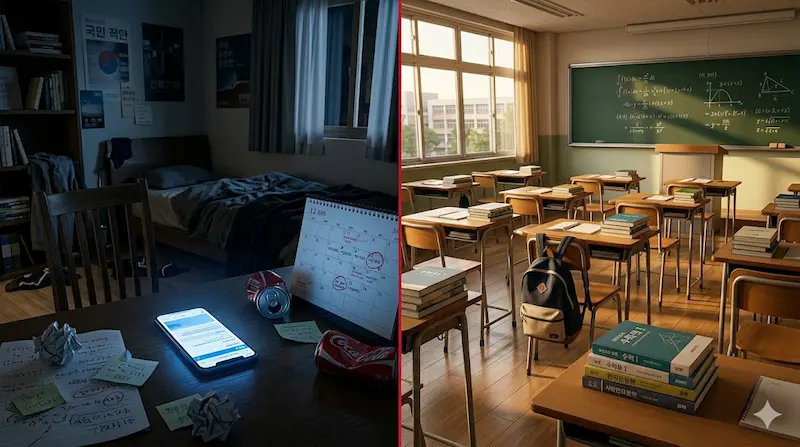
Teach You a Lesson episodes 7-8 hit harder than any pair the series has produced so far. The June 19 broadcast pulled in record streaming hours on Netflix Korea, and Korean viewers spent the weekend arguing about two specific moments — a father walking into the bureau with a folder of evidence, and a mother who watched her son collapse mid-exam and ordered the proctor to keep going.
This Teach You a Lesson episodes 7-8 recap breaks down both hours. We cover the Nawon High gambling ring, the Phnom Penh connection, Geun-de’s undercover work, the Seungyeon High medical prep collapse, Na Hwa-jin’s verdict on the mother, and the Hwang Ki-tae subplot that sets up the back half of the series.
Where Teach You a Lesson Episodes 5-6 Left Us
Before diving in, here is the setup. Episodes 5-6 closed with the elementary teacher harassment case fully resolved and the juvenile delinquent arc pushed to its grim conclusion at Gimcheon Juvenile Prison. For full context, see our Episodes 5-6 recap and the earlier Episodes 3-4 recap.
This Teach You a Lesson episodes 7-8 recap picks up the following Monday morning. The bureau has finally earned grudging media attention, Minister Choi Kang-seok is fielding political questions, and two new cases land on Na Hwa-jin’s desk within the same hour.
Episode 7 Opening: A Father Walks Into the Bureau
The episode opens on a middle-aged man sitting in the bureau’s reception area, gripping a manila folder so tightly his knuckles have gone white. He has been waiting since six in the morning. When Na Hwa-jin finally calls him in, the father places the folder on the desk and slides it across with both hands, the way someone hands over something they have already failed at.
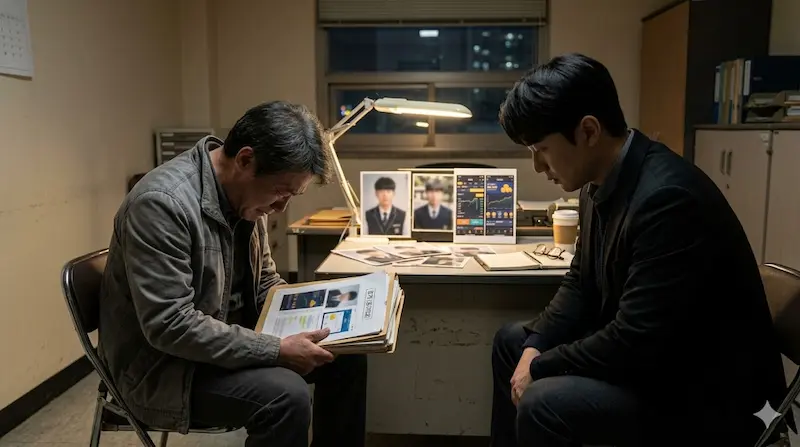
Inside the folder are screenshots, bank statements, and a printed-out conversation log. His seventeen-year-old son has lost over thirty million won to an online gambling app in four months. Furthermore, the boy has now disappeared from home for the third time in two weeks. The father has been to the school, the police, and the prosecutor’s office. Nobody would act.
The Nawon High Gambling Case
The case maps directly onto a real crisis. Throughout 2024 and 2025, Korean prosecutors brought wave after wave of charges against operators of Cambodia-based gambling and scam syndicates, many of which deliberately targeted Korean teenagers. The drama calls the fictional school Nawon High, but the mechanism — free starter credits, predatory loan offers, debt collectors that escalate to threats against family members — is documented exactly as Korean police reports describe it.
The Phnom Penh Connection — Scambodia Comes to Class
The investigation traces back to a Phnom Penh operations center. Western viewers may not have heard the term “Scambodia,” but it has been in heavy Korean media rotation for two years. The reference to overseas syndicates is not a screenwriter’s invention. Rather, it is the show’s most direct mapping yet between a fictional bureau case and a real national crisis.

Importantly, the show resists the temptation to demonize the teenage users. Instead, episode 7 frames the boys as victims of a sophisticated grooming operation that exploits adolescent risk-taking, parental absence, and the easy availability of microloan products. Therefore, when Na Hwa-jin sends Geun-de into Nawon High undercover, the goal is not to punish the students. It is to shut down the recruiters.
Why This Storyline Mirrors a Real Korean Crisis
For English-speaking viewers, here is the context. The Donga Ilbo and KBS News documented multiple cases throughout 2024-2025 where Korean teenagers lost amounts equivalent to a family’s annual income within weeks, often without their parents knowing until collection threats arrived. Subsequently, Korean lawmakers proposed expanded prevention curricula and criminal penalties for cross-border syndicates. The drama’s choice to dramatize this rather than invent a new fictional crime tells you which audience it was made for.
Geun-de’s Undercover Operation
Pyo Ji-hoon’s Geun-de returns to undercover duty for the first time since the Jeonju vocational school case. He enrolls at Nawon High as a transfer senior and identifies seven students who have been actively recruiting classmates into the gambling app. Notably, all seven are themselves heavily in debt, recruiting under coercion to clear their own balances. The pyramid structure is the operation’s true engine.
The undercover sequence runs about fifteen minutes of screen time and contains the episode’s only sustained moment of relief. Geun-de’s deadpan reaction to his “homeroom teacher” handing out study tips while seven students around him owe combined hundreds of millions to overseas syndicates is the kind of dry comedy this show does extraordinarily well. Honestly, after six episodes of escalating darkness, the audience needed it.
Episode 8 Opening: The Seungyeon High Exam
Episode 8 opens at Seungyeon High School during a major mock exam for the advanced medical prep track. The camera pans across rows of seventeen-year-olds bent over their papers, each desk identical, the proctor pacing slowly between aisles. The atmosphere is suffocating before anything happens.
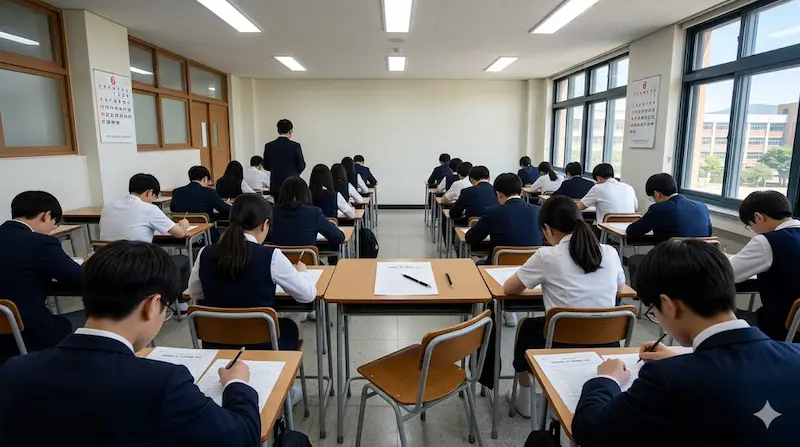
Episode 8's most devastating image — a student collapses mid-exam, the other students never look up, and the pill bottle on the floor tells the rest of the story.A boy in the middle row, Jung Hyeon-min, stops writing. His pencil rolls off the desk. He stands up halfway and then sits back down, and then he is on the floor. The teacher kneels beside him. The proctor steps to the front of the room and announces that the exam will continue. Not a single other student turns to look.
The Empty Seat and What It Means
That moment — the empty seat in the middle of a high-stakes exam, surrounded by classmates who never lift their heads — is the most damning image the show has produced. Indeed, episode 8’s entire thesis is contained in that frame. The system does not pause for a collapsed child because the system was never built to. Furthermore, the parents who pay for this system know exactly what they bought.
The Daechi-dong Mother — Pressure Becomes Abuse
Hyeon-min wakes in the hospital. His mother is already there, holding a fresh set of practice books. She tells the doctor he needs to be discharged by morning. There is another mock exam on Saturday. When the doctor pushes back, she switches to her phone and starts calling around to find a hospital that will release him sooner.
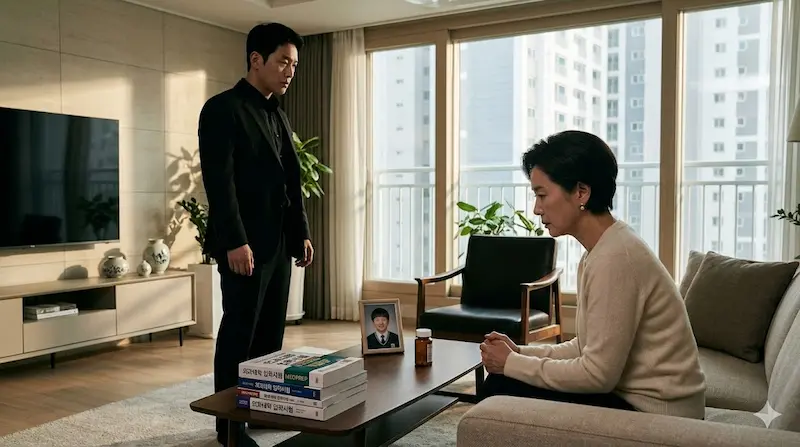
The bureau gets involved because the school nurse files a report. Specifically, the nurse documented that Hyeon-min had been taking unprescribed stimulants for at least eighteen months, sourced through his mother’s private channels, with dosage levels she had been adjusting based on exam schedules. This is the show’s careful, restrained way of saying child abuse without using the phrase until Na Hwa-jin uses it himself.
“If Medical School Is So Great, You Go”
The confrontation between Na Hwa-jin and the mother is the most quoted scene in the Korean drama internet this week. She defends herself with the standard scripts — every Daechi-dong family does this, the competition demands it, her son chose this path, she only wants the best for him. Na Hwa-jin lets her finish. Then he asks why, if medical school is so important, she does not simply attend herself. He offers to fund her tuition. He suggests she could become her son’s safety net and his connection both, the way she has always wanted.
The line lands because it strips away the last layer of justification. Consequently, the mother has no answer. The ambition was never about the child. It was about a parent rewriting her own thwarted life through a body that did not consent.
Na Hwa-jin’s Verdict and the Bureau’s Limits
The legal outcome is deliberately unsatisfying. The mother is charged, but the penalties for parental medication abuse in Korean law are weak, and the family’s lawyers know exactly which loopholes to use. Hyeon-min is placed in temporary protective custody, but he will likely return home within months. The bureau wins the headline and loses the war.
Importantly, the writer refuses to give the audience a clean victory. Instead, episode 8 closes with Hyeon-min sitting alone in a hospital recovery room, holding the same practice book his mother brought him, opening it because he does not know what else to do. This is what the bureau cannot fix. The system has trained him too well.
The Hwang Ki-tae Subplot — A Villain Sharpens
While the two cases play out, the political B-plot escalates. Kim Jong-soo’s Hwang Ki-tae, the conservative lawmaker introduced briefly in earlier episodes, now moves to center stage. He has been quietly building parliamentary opposition to the bureau, framing it as governmental overreach into private parenting. Episodes 7-8 reveal that Hwang Ki-tae has direct ties to Cho Gyu-cheol, the show’s incarcerated final villain whose release date is approaching.
Why Hwang Ki-tae Matters for Cho Gyu-cheol’s Return
Here is the structural point. The bureau cannot survive once Cho Gyu-cheol walks out of prison if a sitting lawmaker is feeding him political cover. Therefore, the back half of the series will not be about individual cases anymore. It will be about whether the bureau itself gets dismantled before Cho can be stopped. Episodes 7-8 plant that seed quietly, but the implications reshape everything that follows.
Choco Papa’s Take on Episodes 7-8
Look, I have watched a lot of Korean dramas that try to make sense of Daechi-dong, and most of them either lecture or sentimentalize. This pair did neither. Instead, the writer trusted the audience to sit with how ugly the math actually is — a mother who genuinely loves her son and is also abusing him; a father who genuinely tried everything and is also too late; a system that genuinely produces doctors and also produces empty seats in exam rooms.
Episode 7’s Cambodia connection landed because it refused to make the teenage gamblers into either monsters or fools. Subsequently, episode 8 landed because it refused to make the mother into a cartoon. Both hours treated Korean parents as adults capable of moral failure. That is unusually generous television, and it is why the ratings keep climbing.
Episodes 9-10 air this weekend on Netflix. The preview shows Cho Gyu-cheol’s release date confirmed, Hwang Ki-tae moving on the bureau publicly, and a brief flash of Choi Ga-yoon — Minister Choi Kang-seok’s murdered daughter — in what appears to be a flashback.
For more on the production, see our filming locations guide and the complete series guide. Official information is available at the Netflix title page, ongoing discussion at Dramabeans’ drama hangout, and background on the real Cambodia syndicate cases at Donga Ilbo.
Come back this weekend for the episodes 9-10 recap.